

Can Cyprus Permanent Residents Travel Visa-Free to Schengen in 2026? What Changes If Cyprus Joins Schengen
Cyprus Permanent Residency can provide a long-term legal base in an EU Member State, but in 2026 it should not be confused with a Schengen residence permit. Cyprus has not yet completed full accession to the Schengen Area, which means a residence permit issued by the Republic of Cyprus currently has national validity and does not, by itself, replace a Schengen visa for short trips to France, Greece, Italy, Germany or other Schengen countries.
The practical answer depends on the holder’s passport. A Cyprus permanent resident whose nationality already benefits from visa-free short-stay access to Schengen may continue to travel under the rules applicable to that passport. A resident whose nationality normally requires a Schengen visa must still obtain the appropriate visa before travelling to the Schengen Area. In both cases, the current travel right comes from the passport or visa, not from Cyprus Permanent Residency itself.
The position could change materially if Cyprus completes full Schengen accession. The Republic of Cyprus currently states that, after full integration into Schengen, visas and residence permits issued by Cyprus are expected to support short-stay travel in the rest of the Schengen Area for up to 90 days in any 180-day period. For investors already considering Cyprus Permanent Residency by Investment, that potential future mobility benefit is relevant, but it should be treated as an additional consideration rather than a benefit that is already available today.
Key takeaways: Cyprus Permanent Residency & Schengen Travel
The key distinction is between the legal residence rights that Cyprus PR provides today and the short-stay Schengen mobility that could follow full accession. The following points should be understood before a residency decision is made.
- Cyprus is an EU Member State, but it is not yet fully in Schengen. Internal border controls with Cyprus have not yet been lifted, so the current Cyprus residence permit is not equivalent to a residence permit issued by a fully participating Schengen state.
- Cyprus PR does not currently create automatic visa-free Schengen travel. A permit holder must follow the visa rules attached to the passport they use for travel. Visa-exempt nationals may already travel without a short-stay visa; visa-required nationals generally still need one.
- The Commission has positively assessed Cyprus’s technical preparedness. In July 2026, the European Commission confirmed a positive assessment of the country’s technical readiness and stated that the report would be presented to the Council in September. No final accession date has been confirmed.
- Full Schengen accession could make Cyprus residence permits materially more useful for regional travel. Under the expected framework, a valid Cyprus residence permit could support short visits to other Schengen countries for up to 90 days in any 180-day period without a separate Schengen visa, subject to the applicable entry conditions.
- Schengen access would not create EU-wide residence or work rights. Cyprus PR would remain a residence status issued by Cyprus. Living, working or studying long term in another country would continue to require the appropriate status under that country’s immigration rules.
- The Cyprus RBI decision should stand on the program’s existing value. Schengen is a potential future enhancement, not a reason to overlook investment suitability, family eligibility, source of funds, property quality, tax residence or long-term maintenance requirements.
Cyprus Permanent Residency and Schengen Travel at a Glance
The table below separates the 2026 position from the potential position after full Schengen accession. This distinction is especially important for applicants whose existing passport requires a Schengen visa.
Question | Position in August 2026 | If Cyprus fully joins Schengen |
Is Cyprus fully in Schengen? | No. Internal border controls with Cyprus have not yet been lifted. | Cyprus would participate in the Schengen travel framework once the Council decision and implementation are completed. |
Does Cyprus PR replace a Schengen visa? | No. The holder follows the visa rules applicable to their nationality. | A valid Cyprus residence permit would generally support short travel in the Schengen Area without a separate short-stay visa. |
Short-stay limit in other Schengen countries | Normal passport and visa rules apply. | Generally up to 90 days in any 180-day period, subject to entry conditions. |
Right to live or work in another EU country | No automatic right. | Still no automatic right. Long-term residence or employment remains subject to the destination country’s rules. |
Cyprus PR investment framework | Existing Cyprus RBI rules apply. | Schengen accession would not automatically change the qualifying investment, income or maintenance requirements. |
Can Cyprus Permanent Residents Travel Visa-Free to Schengen in 2026?
Not because of the Cyprus residence permit alone. As of August 2026, Cyprus-issued visas and residence permits are national documents for entry and residence in Cyprus. A Cyprus Permanent Residence card does not independently provide the same short-stay access to the rest of the Schengen Area as a residence permit issued by a country that fully applies the Schengen acquis.
This does not mean every Cyprus permanent resident needs a Schengen visa. The decisive question is the nationality of the traveller. If the person holds a passport whose nationals are already exempt from a Schengen short-stay visa, the person can generally travel under that passport-based visa exemption. If the passport is subject to a Schengen visa requirement, Cyprus PR does not currently remove that requirement.
For this reason, phrases such as “Cyprus PR gives visa-free access to Europe” are too broad under the current framework. The more accurate description is that Cyprus PR gives permanent residence rights in Cyprus, an EU Member State, while Schengen travel remains governed by the holder’s nationality and any visa or other travel authorization required for the destination.
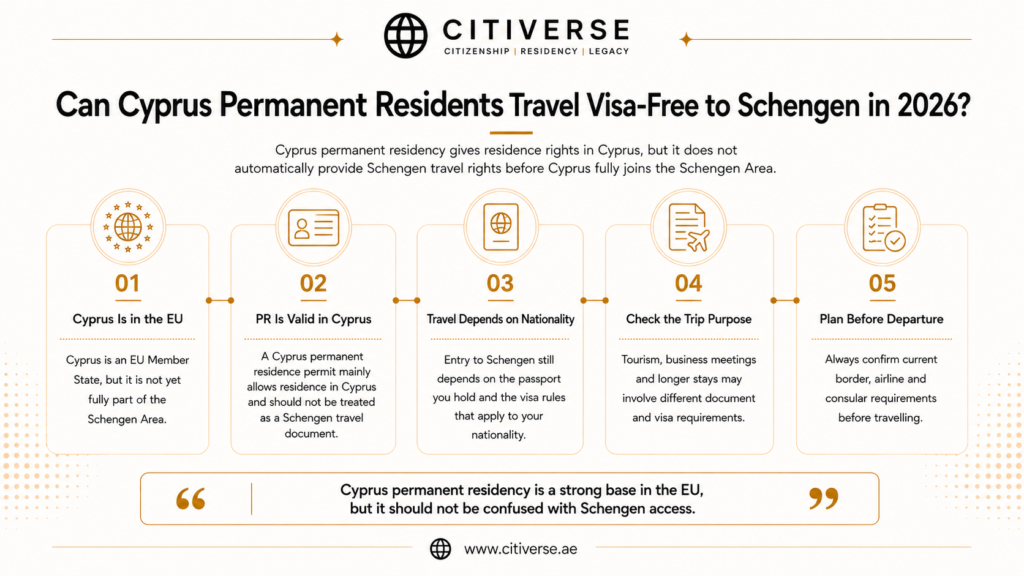
Cyprus Is in the EU, but It Is Not Yet Fully in Schengen
The European Union and the Schengen Area overlap, but they are not the same legal framework. Cyprus has been an EU Member State since 2004. Schengen, however, is the system under which participating European countries apply common external-border and short-stay rules and, in normal circumstances, remove checks at their internal borders.
Cyprus is the remaining EU Member State, apart from Ireland’s separate position, where internal border controls with the Schengen Area have not yet been lifted. This is why a Cyprus residence permit currently functions differently from a residence permit issued by France, Greece, Italy or another state fully participating in Schengen.
Cyprus has nevertheless moved significantly closer to accession. Citiverse’s existing update, Cyprus Moves Closer to Schengen: What It Means for Cyprus Permanent Residency, explains the broader accession process. In July 2026, the European Commission confirmed that its 2025–2026 country report delivered a positive assessment of Cyprus’s technical preparedness. The Commission also stated that the report would be presented to the Council in September 2026, while the final decision on when and how Cyprus joins remains with the Council.
The positive technical assessment is therefore important, but it does not itself change the travel rights attached to Cyprus PR. Until the formal accession decision is taken and implemented, the current visa and border framework continues to apply.
What Travel Rights Does Cyprus Permanent Residency Give You Today?
Cyprus Permanent Residency is first and foremost a residence status in Cyprus. It can allow qualifying non-EU nationals and eligible family members to maintain a long-term legal base on the island, subject to the conditions of the relevant residence category. For investment-based applicants, the status is linked to maintaining the qualifying investment and the ongoing conditions of the program.
The current Cyprus Permanent Residency by Investment framework starts from a qualifying investment of €300,000 and may be structured through eligible new residential property, other qualifying real estate, investment in the share capital of a qualifying Cyprus company or eligible investment fund units, depending on the route. The main applicant must also satisfy the applicable income, documentation, insurance and due diligence requirements.
The residence status does not convert the holder into an EU citizen. It also does not provide an unrestricted right to settle, work or remain indefinitely in another EU Member State. Those outcomes are governed by separate immigration and employment rules. This distinction matters because “residence in an EU Member State” and “EU freedom of movement” are different legal concepts.
Do You Still Need a Schengen Visa If You Hold Cyprus PR?
The answer depends on your passport. Cyprus PR is not currently the document that determines whether you need a short-stay Schengen visa. Instead, the starting point is the visa regime applicable to your nationality, together with the purpose and length of the proposed trip.
- If your passport is already visa-exempt for Schengen short stays: you may generally travel under the visa exemption applicable to that nationality, subject to the normal Schengen entry conditions and short-stay limit. The Cyprus PR card does not create the exemption; your passport does.
- If your passport normally requires a Schengen visa: you generally still need the appropriate Schengen visa before travelling to a Schengen state. Holding Cyprus PR does not currently replace that visa.
- If you hold another qualifying visa or residence status: the analysis may differ depending on the document, issuing state and route of travel. The individual travel documents should be checked before departure rather than relying on the Cyprus PR card alone.
This distinction is commercially important for investors comparing European residence programs. Some applicants prioritize the right to live in a specific country, while others place greater weight on regional short-stay mobility. Those objectives should be separated before a program is selected.
Citiverse explains the broader distinction between residence rights and citizenship rights in Residency by Investment vs Citizenship by Investment: What’s the Difference?. A residence permit can be highly valuable without producing the same travel rights as a passport or a residence permit issued inside a fully integrated regional travel area.
What Changes If Cyprus Joins the Schengen Area?
Full Schengen accession could materially improve the short-stay mobility attached to Cyprus residence permits. The Republic of Cyprus currently states that, after full integration into the Schengen acquis, Cyprus-issued visas and residence permits will provide the right to travel in the rest of the Schengen Area for up to 90 days in any 180-day period.
For a Cyprus permanent resident whose passport currently requires repeated Schengen visas, this could remove a significant administrative burden. Short trips for holidays, family visits, meetings, conferences and other permitted short-stay purposes could generally be made using the passport together with the valid Cyprus residence permit, without applying for a separate Schengen short-stay visa for each journey.
The effect would be less dramatic for a person who already holds a passport with visa-free Schengen access. That applicant may still value the convenience and legal clarity of travelling as a resident of a Schengen state, but the practical gain is smaller because the passport already provides short-stay access.
Schengen accession would also affect border procedures. Cyprus would become part of the common Schengen external-border framework and routine internal border controls between Cyprus and other Schengen states would, subject to the final implementation arrangements, be removed. This is a travel and border-management change; it should not be interpreted as creating a general right for Cyprus PR holders to relocate across Europe.
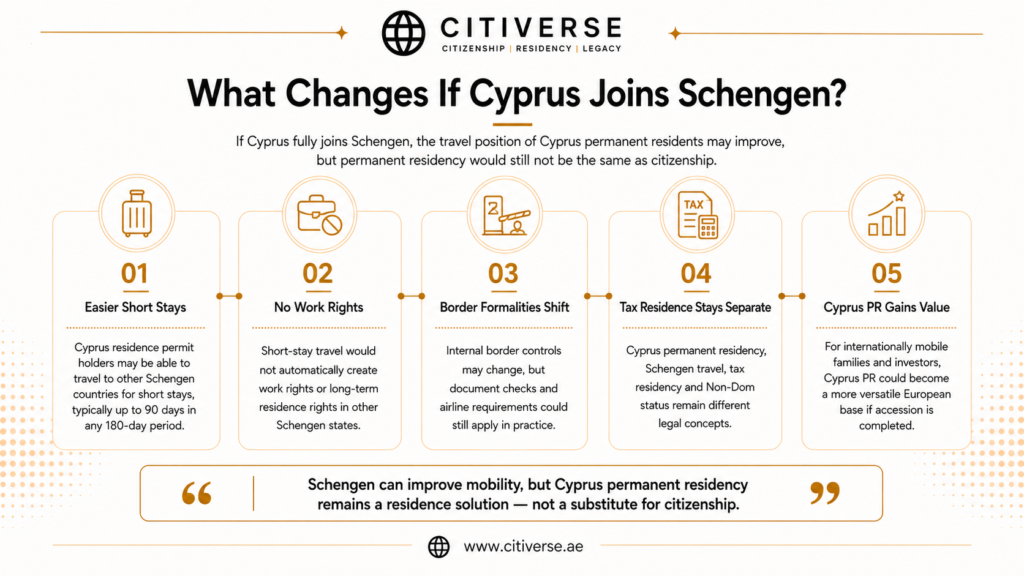
How Would the 90/180-Day Rule Apply to Cyprus PR Holders?
The standard Schengen short-stay rule allows eligible third-country nationals to spend up to 90 days in any rolling 180-day period in the Schengen Area for short visits. The calculation is cumulative across participating countries rather than a separate 90-day allowance for each destination.
After Cyprus fully joins Schengen, a valid Cyprus residence permit is expected to support this type of short travel in the other Schengen states. Time spent living in Cyprus under the Cyprus residence permit would be governed by the residence status itself, while short visits to other Schengen countries would need to remain within the applicable short-stay framework.
The 90/180-day rule should not be treated as a residence right. A person who wants to spend longer periods in France, Greece, Spain or another Schengen state, move there permanently, take local employment or establish a long-term study arrangement would still need to consider the immigration rules of that country.
Would Cyprus PR Become an EU-Wide Residence Permit After Schengen Accession?
No. Schengen membership primarily concerns border controls, short-stay travel, common visa rules and related security cooperation. Cyprus Permanent Residency would remain a residence status issued under Cyprus law. It would not become EU citizenship and it would not automatically grant the holder the right to choose any EU country as a place of permanent residence.
The practical benefit would be regional travel, not unrestricted relocation. This is an important distinction for investors who describe their objective as “European residency.” If the real goal is to live in Cyprus, own property there and maintain a long-term base in an EU jurisdiction, Cyprus PR may fit that objective. If the goal is an unrestricted right to relocate across the Union, a Cyprus residence permit does not create that outcome.
What Would Schengen Mean for Cyprus Residency by Investment?
For Cyprus Residency by Investment, Schengen accession would add a mobility layer to a program that already has a separate investment and residence proposition. The underlying program should still be evaluated on its current terms: the qualifying investment, family inclusion, income requirements, source-of-funds evidence, investment maintenance, physical presence and the practical value of holding permanent residence in Cyprus.
The Cyprus Permanent Residency by Real Estate route is particularly relevant to applicants who want a tangible asset and a future home or family base. The residential category generally centres on qualifying new property from €300,000 plus VAT where applicable, while other eligible real estate categories can follow different rules. Property selection should be based on legal, commercial and lifestyle suitability rather than immigration eligibility alone.
Applicants who want a more detailed property-led explanation can also review Cyprus Permanent Residency by Investment in 2026: A Real Estate Guide for International Investors. That guide focuses on the property structure and qualifying investment rather than Schengen travel rights.
Cyprus RBI: Key Program Points to Keep Separate From Schengen
Program factor | Current Cyprus RBI position |
Minimum qualifying investment | From €300,000, depending on the qualifying investment category; VAT may apply to property. |
Main residence value | Permanent residence in Cyprus for qualifying non-EU applicants and eligible family members. |
Income | The main applicant generally needs secured annual income of at least €50,000, with increases for the spouse and dependent minor children under the current framework. |
Presence | No full-time relocation is generally required, but the holder should not remain outside Cyprus for a continuous period of two years. |
Investment maintenance | The qualifying investment must generally be maintained for the residence status to remain valid. |
Schengen travel today | Not automatically provided by the Cyprus residence permit. |
Potential Schengen benefit | Short-stay travel to other Schengen states without a separate Schengen visa, once full accession is formally completed and implemented. |
Who Would Benefit Most From Cyprus Joining Schengen?
The mobility benefit would not be identical for every applicant. Its value depends primarily on the applicant’s existing passport, travel patterns and how Cyprus fits into the wider family or business strategy. A technically valuable benefit can be commercially unimportant if the applicant already has the same travel access through another nationality or residence status.
- Applicants with visa-required passports: could see the clearest improvement because short trips to the Schengen Area may no longer require repeated Schengen visa applications once the Cyprus permit becomes usable for short stays under the Schengen framework.
- Families with frequent European travel: may gain more flexibility for holidays, university visits, family meetings and multi-country trips, while retaining a permanent base in Cyprus.
- Entrepreneurs and internationally active investors: may find short business travel across Schengen more practical, particularly where meetings and commercial relationships are spread across several European markets. This remains separate from the right to work or operate a business locally in another country.
- Applicants whose passports are already visa-exempt: would receive a smaller incremental travel benefit. Their decision should therefore focus more heavily on Cyprus residence rights, investment quality, family planning and the intended use of the country as a long-term base.
For business owners, the residence status should also be assessed as part of a practical continuity structure. Citiverse’s Second Residency for Entrepreneurs: How to Build an Alternative Business Base explains why personal residence, work rights, banking, company management and operational readiness need to be considered separately.
Should You Apply for Cyprus PR Before Schengen Accession?
A residency decision should not depend on an unconfirmed future accession date. Cyprus should make sense under the rules and benefits that exist when the application is filed. That means the applicant should be comfortable with the qualifying investment, family structure, maintenance conditions and the fact that the permit currently provides residence rights in Cyprus rather than automatic Schengen mobility.
At the same time, applicants who already view Cyprus as a suitable long-term base do not necessarily need to wait for Schengen before beginning their assessment. A full residency application can involve investment selection, property or corporate due diligence, source-of-funds preparation, income evidence, criminal-record certificates and family documentation. These are substantive steps regardless of the timing of the Schengen decision.
The stronger approach is therefore to treat Schengen as potential upside. If Cyprus already fits the applicant’s residence, investment and family objectives, future integration may improve the practical mobility of the permit. If the program is unsuitable without Schengen, the applicant should reconsider whether Cyprus is the correct route in the first place.
Two Practical Applicant Scenarios
The difference between passport-based travel rights and residence-permit travel rights becomes clearer when the same Cyprus PR is considered for two different applicant profiles.
Scenario 1: Cyprus PR Holder With a Visa-Required Passport
A family secures Cyprus Permanent Residency through a qualifying investment but holds passports that normally require a Schengen visa. In 2026, the family can live in Cyprus under the residence permit, but the Cyprus PR card does not remove the Schengen visa requirement for a holiday in France or a business trip to Germany. They must continue to follow the Schengen visa process applicable to their nationality.
If Cyprus later completes full Schengen accession and the residence permit becomes recognized for short-stay travel under the Schengen framework, the same family could gain a meaningful additional benefit: short trips across participating states without a separate short-stay Schengen visa, within the 90/180-day limit and subject to the relevant entry conditions.
Scenario 2: Cyprus PR Holder With a Visa-Exempt Passport
Another investor holds a passport that already allows visa-free short stays in the Schengen Area. Cyprus PR does not materially improve that travel position today because the investor can already visit Schengen countries under the passport-based exemption. The main value of Cyprus PR is instead the right to maintain a permanent base in Cyprus, together with the investment, family and lifestyle objectives connected to the program.
For this applicant, Schengen accession may improve convenience and integration of travel documentation, but it is less likely to be the deciding factor. The quality of the qualifying property or investment, family needs, long-term use of Cyprus and wider residence strategy should carry more weight.
Cyprus PR, Schengen Travel and Tax Residence Are Separate Questions
A common planning error is to treat residence status, Schengen mobility and tax residence as one package. They are separate legal questions. Cyprus Permanent Residency gives immigration residence rights in Cyprus. Schengen membership concerns short-stay travel and border rules. Tax residence depends on the relevant tax law, physical presence and other connecting factors.
Accordingly, obtaining Cyprus PR does not automatically make the holder a Cyprus tax resident, and future Schengen accession would not change that principle. Applicants who intend to relocate, manage a business from Cyprus or use local tax regimes should obtain a separate tax analysis based on their actual facts before changing residence or management arrangements.
What International Families Should Consider
For families, the most important question is usually not whether a residence card offers the maximum number of travel destinations. The stronger question is whether the status supports the family’s actual plan: a long-term home, children’s education, proximity to Europe and the Middle East, property ownership, future relocation and manageable maintenance conditions.
Citiverse’s article on How to Choose the Right Residency by Investment Program for Your Family explains why family composition, age of children, education, healthcare, physical presence, renewal conditions and long-term pathways should be assessed before a jurisdiction is chosen. Schengen travel can strengthen a family residence strategy, but it should not replace that broader analysis.
How Citiverse Supports Cyprus Permanent Residency Applicants
Citiverse supports international investors and families considering Cyprus Permanent Residency through a structured review of eligibility, objectives, investment route, family composition and documentation readiness. The purpose is to determine whether Cyprus is suitable before a substantial financial commitment is made.
Where real estate is selected, the residence strategy can be coordinated with property sourcing, project comparison, acquisition due diligence and the documentation required for the residency application. Where another qualifying investment category is preferred, the route should be reviewed according to its own financial, corporate and regulatory requirements.
Applicants comparing Cyprus with other residency or citizenship options can also use Citiverse’s Citizenship and Residency Programs Advisory service to review the legal status, investment requirement, family position, mobility value and long-term relevance of alternative programs.
Schengen progress forms part of that analysis, but Citiverse assesses Cyprus based on the rights and obligations that exist today. Potential future travel benefits are considered separately so that the client’s decision does not depend on an accession date that has not yet been formally confirmed.
Is Cyprus Permanent Residency the Right European Base for You?
Cyprus Permanent Residency can be relevant for non-EU investors who want a long-term legal base in an EU Member State, limited ongoing physical presence and the ability to structure the residence through a qualifying investment. The country’s progress towards Schengen adds an important future consideration, particularly for applicants whose passports currently require visas for short travel across Europe.
The current position remains clear: Cyprus PR does not yet provide automatic visa-free Schengen travel. If Cyprus completes full accession, the residence permit could become materially more useful for short-term movement within the Schengen Area, while remaining a Cyprus residence status rather than an EU-wide right to relocate or work.
Speak with Citiverse to review your Cyprus Permanent Residency eligibility, qualifying investment options and how the program could fit your family’s wider European mobility strategy.
Considering Cyprus Permanent Residency by Investment?
Speak with Citiverse for a confidential assessment of your eligibility, suitable property route, and next steps before you commit to an asset.
Our team supports investors with residency strategy, acquisition coordination, and compliant application preparation.
Frequently Asked Questions: Cyprus Permanent Residency & Schengen Travel
Is Cyprus in the Schengen Area in 2026?
Not yet. Cyprus is an EU Member State, but internal border controls with the Schengen Area have not yet been lifted. In July 2026, the European Commission confirmed a positive assessment of Cyprus’s technical preparedness, but the final decision on when and how Cyprus joins remains with the Council and no final accession date has been confirmed.
Does Cyprus Permanent Residency currently allow visa-free travel to Schengen?
No, not by itself. A Cyprus residence permit currently has national validity for Cyprus. Whether the holder can visit the Schengen Area without a short-stay visa depends on the holder’s passport and any other qualifying travel document.
Can a Cyprus PR holder travel to Greece without a Schengen visa?
Only if the traveller is otherwise exempt from the Schengen visa requirement or holds the appropriate visa or qualifying document. Cyprus PR alone does not currently remove the Schengen visa requirement. Greece is a Schengen state, so the applicable Schengen entry rules apply.
Can a Cyprus PR holder travel to France, Italy or Germany?
The same principle applies. A Cyprus PR holder must currently satisfy the Schengen entry requirements attached to their nationality. A visa-exempt passport holder may travel under that exemption, while a visa-required passport holder generally needs a Schengen visa.
What changes if Cyprus joins Schengen?
After full integration, Cyprus-issued residence permits are expected to support short-stay travel in the rest of the Schengen Area for up to 90 days in any 180-day period without a separate short-stay Schengen visa, subject to the applicable entry conditions and final implementation arrangements.
Would Cyprus PR allow me to work in another Schengen country?
No. Schengen concerns short-stay travel and border rules. A Cyprus residence permit would not automatically grant the right to work, study or live long term in another country. Those activities remain subject to the immigration and employment rules of the destination state.
Would Cyprus PR become EU citizenship after Schengen accession?
No. Cyprus PR is a residence status, not nationality. Schengen accession would not convert a permanent resident into a Cypriot or EU citizen and would not create EU freedom-of-movement rights equivalent to those held by EU citizens.
What is the minimum investment for Cyprus Permanent Residency?
The current fast-track framework starts from a qualifying investment of €300,000, with the exact structure depending on the selected category. Qualifying routes can include certain real estate, investment in a Cyprus company and eligible investment fund units, subject to the current requirements.
Do I need to live in Cyprus full time to maintain Permanent Residency?
Full-time relocation is not generally required under the investment route. However, the qualifying conditions must be maintained and the holder should not remain outside Cyprus for a continuous period of two years, as this can affect the residence status.
Should I wait for Cyprus to join Schengen before applying for PR?
Not necessarily. The decision should be based on whether Cyprus PR already fits your residence, investment and family objectives. Schengen should be treated as a potential additional mobility benefit rather than a guaranteed condition of the current program.
Does Cyprus PR make me a Cyprus tax resident?
Not automatically. Immigration residence and tax residence are separate. Tax residence depends on the applicable tax rules, physical presence and other connecting factors, and should be assessed independently.
How can Citiverse help with Cyprus Permanent Residency?
Citiverse can assess eligibility, compare qualifying investment routes, support property and investment due diligence, coordinate source-of-funds and family documentation, and manage the residency process through the appropriate professional channels. The Schengen position can be assessed as part of the wider mobility strategy without treating future accession as a guaranteed current benefit.
Explore Citizenship & Residency by Investment
Programs by Citiverse
Discover premium citizenship and residency opportunities in world-class destinations, offering exceptional lifestyle benefits. Explore our overview brochure or continue reading below.
All the latest news & insights
Whether you’re seeking a better lifestyle, secure investments, or greater mobility, Citiverse is your gateway to a borderless future.