



For an international entrepreneur, a second passport can improve travel flexibility, reduce dependence on one nationality and support long-term family planning. Its value, however, depends on the specific problem it is expected to solve and how well the selected citizenship aligns with the entrepreneur’s business activity, family position and future plans.
A second citizenship does not automatically change tax residency, guarantee access to banking or provide unrestricted rights to work in other countries. It is a legal status that may strengthen a wider mobility strategy when selected for clear and practical reasons.
This guide explains when a second passport may be useful for a business owner, what it can realistically provide and how to compare available citizenship by investment options.
A second passport is issued after a person acquires an additional citizenship. That citizenship may be obtained through ancestry, marriage, naturalization or an approved investment route.
For entrepreneurs who do not qualify through family connections or long-term residence, Citizenship by Investment Programs can provide a direct and structured pathway. Eligible applicants make a qualifying contribution or investment and complete the required documentation, source-of-funds review and government due diligence.
The passport is issued as a result of citizenship, so the process should be viewed as an application for a permanent legal status rather than simply the acquisition of another travel document. This distinction matters because citizenship can create rights, responsibilities and long-term consequences for the applicant and eligible family members.
International businesses can operate across several countries, but their owners may still depend on one passport and one country’s political, legal and diplomatic position. This dependency can become a practical business issue when visa requirements, entry restrictions or regional developments affect the entrepreneur’s ability to travel or relocate.
Visa applications may delay meetings, market entry or participation in international events. Changes in immigration policies can restrict access to important commercial destinations, while political instability or new regulations may reduce an entrepreneur’s ability to respond quickly when circumstances change.
For many business owners, second citizenship is therefore part of a broader risk-management strategy. It may support business mobility, family security and greater personal flexibility without requiring the entrepreneur to give up an existing nationality, where dual citizenship is permitted.
This approach is often described as passport diversification: reducing reliance on one nationality and one set of future rules. The objective is not to replace the entrepreneur’s existing identity or commercial base, but to create an additional legal option that may remain available when circumstances change.
The value of a second passport should be measured against the entrepreneur’s actual business activity, travel patterns and family circumstances. A higher passport ranking does not necessarily mean that a program will provide the best practical outcome.
The strongest option is usually the one that improves access to relevant markets, fits the applicant’s family structure and remains useful over the long term.
Entrepreneurs often need to travel at short notice for negotiations, conferences, investor meetings and operational matters. Repeated visa applications can add cost, delay and uncertainty to these plans, particularly where appointment availability or processing timelines are unpredictable.
A second passport may provide visa-free or visa-on-arrival access to additional destinations. The relevant question, however, is not simply how many countries appear on a passport index, but whether the passport improves access to the markets the entrepreneur uses most.
For example, easier entry to a small number of important business hubs may offer more value than access to many countries that the applicant is unlikely to visit. A practical assessment should therefore focus on real travel patterns rather than headline mobility figures.
An entrepreneur may own foreign companies, hold international investments and work with clients across several regions while remaining personally dependent on one country. This can create a concentration risk that is easy to overlook when business operations are already international.
A second citizenship can provide another legal position if the original nationality becomes more restrictive or less useful. This may be relevant where business owners are concerned about regional instability, travel limitations, political changes or a lack of reliable relocation options.
Second citizenship can therefore form part of a wider Plan B residency, citizenship and global mobility strategy. The purpose is to establish alternatives before they are urgently needed, rather than trying to build them during a period of uncertainty.
Entrepreneurs rarely plan only for themselves. Education, relocation, succession and long-term security for children often influence the decision to pursue second citizenship.
Many citizenship by investment programs allow qualifying family members to apply together. Depending on the jurisdiction, this may include a spouse, dependent children and, in some cases, parents or other eligible dependants.
Family rules are not identical across programs, so age limits, financial dependency, marital status and educational requirements must be checked before a route is selected. An option that works well for an individual applicant may be less suitable for a family with adult children or dependent parents.
The assessment should also consider whether family members can be added later and whether citizenship can be passed to future generations. These points may be more important than initial cost, especially where the application forms part of a wider family planning strategy.
Certain nationalities may qualify to apply for visa categories that are not open to every passport holder. This can make a particular citizenship more relevant to an entrepreneur with a defined business expansion plan.
Grenada is often considered by business owners because Grenadian citizens may be eligible to apply for the United States E-2 Treaty Investor Visa. The E-2 is a separate application and requires a qualifying investment in a US business, so obtaining Grenadian citizenship does not guarantee visa approval.
Entrepreneurs considering this route should assess Grenada Citizenship by Investment together with the separate US visa requirements and the intended business model. The citizenship and visa applications should be treated as connected but distinct processes.
A second passport can create valuable options, but it should not be presented as a universal solution. Several areas require separate legal, tax or commercial planning.
Understanding these limitations is essential because many poor decisions begin with unrealistic expectations about what citizenship will achieve.
Citizenship and tax residency are different concepts. Obtaining another passport does not usually change where a person is treated as tax resident.
Tax residency may depend on physical presence, permanent home, family connections, business management and domestic legislation. An entrepreneur who continues living and managing their affairs from the same country may remain tax resident there after acquiring another citizenship.
Where second citizenship forms part of a relocation or international structuring plan, tax advice should be obtained before changes are made. The timing and sequence of decisions can affect personal taxation, company management and reporting obligations.
Banks assess the applicant’s full risk and compliance profile. This may include nationality, country of birth, residence, source of wealth, source of funds, business activity and transaction history.
A second passport may form part of the client profile, but it does not replace proper documentation or guarantee approval. Entrepreneurs should be cautious of any suggestion that citizenship alone will resolve banking difficulties.
A well-prepared profile, clear source-of-funds documentation and a transparent business explanation are generally more important than the possession of an additional passport.
Visa-free travel usually allows short visits. It does not necessarily provide the right to live, work or operate a business in the destination country.
An entrepreneur who wants to establish a long-term base may need a residence permit, work authorization or investor visa. Understanding the difference between Residency by Investment vs Citizenship by Investment is therefore essential before a route is selected.
A second passport may improve mobility, while residency may provide the legal right to live in a specific country. These are different outcomes and should not be confused.
A person’s citizenship does not automatically determine where their company should be incorporated, managed or taxed. Company registration, licensing, economic substance, management and control, tax residence and reporting obligations must be reviewed separately.
Personal mobility and corporate structuring may support the same international strategy, but they are not interchangeable. A second passport should not be selected on the assumption that it will automatically improve the tax or legal position of an existing business.
There is no single best second passport for every business owner. The right option depends on the applicant’s current position, intended outcome and ability to meet the relevant compliance requirements.
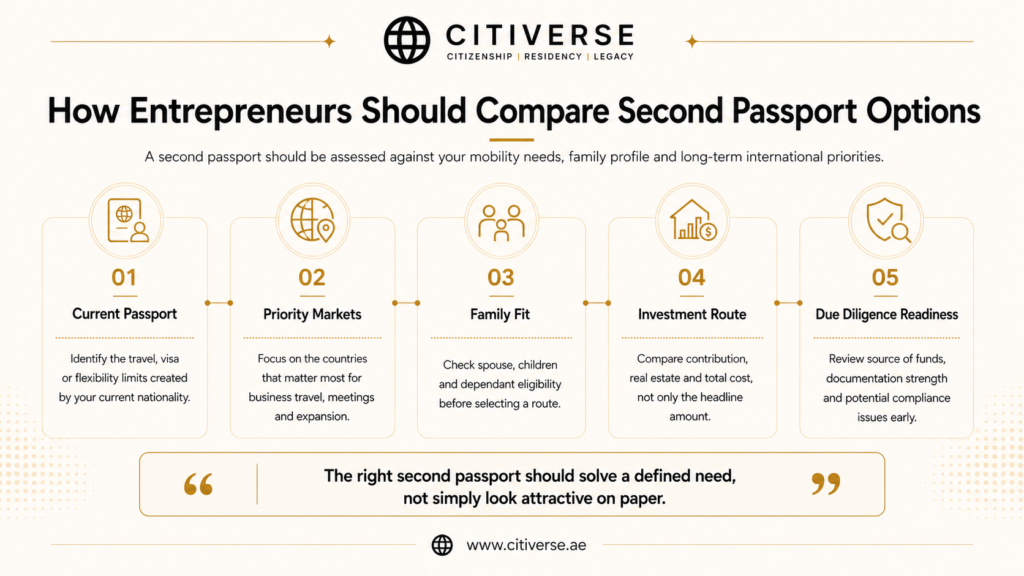
A proper comparison should cover the following areas.
The first step is to identify the restrictions created by the entrepreneur’s existing nationality. This establishes what the second citizenship must improve.
An applicant with strong travel access may place greater importance on family inclusion, a specific visa route or long-term diversification. Someone who currently faces frequent visa delays may focus more heavily on access to commercial destinations.
The value of a second citizenship lies in what it adds to the applicant’s current position. A passport should therefore be assessed in context rather than ranked in isolation.
Passport comparisons should reflect the entrepreneur’s real commercial geography. The assessment should consider where clients, suppliers, investors and business partners are located.
It should also distinguish between short-term travel needs and the intention to live or operate permanently in another country. A passport that improves entry for meetings may not provide the residence or work rights required for a longer-term business presence.
A useful comparison may include:
This approach is more useful than relying only on the total number of visa-free destinations.
Family eligibility can significantly affect the choice and overall cost of a program. Before comparing jurisdictions, the applicant should identify every family member who may need to be included.
Their age, marital status, education and financial dependency should be reviewed against the rules of each program. The assessment should also consider whether family members can be added later and whether citizenship can be passed to future generations under the relevant law.
These details should be clarified at the beginning of the process. Selecting a program first and reviewing family eligibility later can create unnecessary cost, delays or the need to change strategy.
Citizenship by investment programs may offer different qualifying routes, including government contributions, approved real estate, public benefit options or other authorized investments.
A contribution route is generally non-refundable but may provide a simpler process. A real estate route may create an underlying asset, although it can involve additional purchase costs, holding periods, management expenses and restrictions on resale.
Entrepreneurs interested in property-linked programs can review Real Estate Acquisition opportunities as part of the wider program assessment. The property should still be evaluated on its own merits because an investment that qualifies for citizenship is not automatically a strong commercial investment.
The total cost should include more than the headline qualifying amount. Government fees, due diligence charges, family costs, taxes, legal expenses and ongoing holding obligations may materially affect the final budget.
Entrepreneurs may have more complex financial backgrounds than salaried applicants. Their wealth may come from company profits, dividends, business sales, investments, shareholder loans or income generated in several countries.
The source of wealth and the source of the investment funds must be explained clearly and supported by consistent documentation. This may require corporate records, financial statements, tax returns, bank statements, sale agreements and evidence of dividend payments.
A complex profile is not necessarily a problem, but unclear, inconsistent or incomplete information is more likely to create delays or additional questions. Early preparation allows the applicant to identify gaps before the formal process begins.
Citiverse’s Investment Processing Services support applicants with document coordination, application preparation and due diligence readiness.
Processing time may matter where the entrepreneur is planning business expansion, relocation or a contingency strategy. However, the fastest program is not automatically the most suitable one.
Indicative timelines can be affected by document availability, applicant background, government capacity and requests for additional information. No adviser can guarantee an approval date or final outcome.
Timing should therefore be considered alongside mobility benefits, family eligibility, investment structure, reputation and long-term relevance. A faster result has limited value if the citizenship does not address the applicant’s real priorities.
Not every country permits its citizens to hold another nationality. In some jurisdictions, acquiring foreign citizenship may result in restrictions, reporting obligations or loss of the original citizenship.
This issue should be checked before an application begins. The consequences may depend on the applicant’s nationality, personal circumstances and the method through which the new citizenship is acquired.
Where the legal position is unclear, country-specific advice should be obtained before any financial commitment is made.
Citizenship is a long-term legal status, so the decision should remain useful beyond the initial application. Travel arrangements, visa policies and program rules can change over time.
Entrepreneurs should consider the wider stability of the jurisdiction, the credibility of its due diligence process and the continuing value of the citizenship for the applicant and their family. A program should not be selected only because it is currently the fastest or least expensive option.
The stronger question is whether the citizenship will remain relevant if the entrepreneur’s business, family or residency plans change.
The appropriate jurisdiction depends on the applicant’s priorities. Program selection should follow a personal assessment rather than begin with a generic ranking.
The most relevant factors include the entrepreneur’s current nationality, priority markets, family structure, investment preference and expected timeline. A suitable program should address a defined need and remain useful beyond the initial application.
The established Caribbean Citizenship by Investment Programs include Antigua and Barbuda, Dominica, Grenada, Saint Kitts and Nevis, and Saint Lucia.
These programs are often considered by entrepreneurs seeking direct citizenship, family inclusion and a process that does not normally require permanent relocation. Each jurisdiction has different investment routes, fees, family rules and procedural requirements.
Grenada may be particularly relevant to entrepreneurs interested in potential E-2 visa eligibility, while another Caribbean program may be better suited to a particular family structure, budget or investment preference. The correct choice depends on the complete applicant profile rather than the passport alone.
São Tomé and Príncipe Citizenship by Investment may be considered by entrepreneurs looking for a newer, contribution-based route outside the Caribbean.
Its potential relevance lies in a structured application model, family inclusion and a comparatively accessible entry position. As a newer option, it should be assessed carefully against the applicant’s actual travel needs, long-term objectives and comfort with the program’s shorter operating history.
A lower entry point should not be the only reason for selecting a citizenship route. The program must still provide practical value for the entrepreneur’s business activity, family plans and wider mobility strategy.
Applicants should also review how the citizenship complements their existing passport. The decision should be based on the additional rights and flexibility it provides rather than on cost alone.
Vanuatu Citizenship by Investment is generally associated with a relatively direct application structure and shorter indicative processing timelines than many alternatives.
It may appeal to entrepreneurs who prioritize speed and a straightforward contribution-based route. Its actual travel access and relevance to the applicant’s commercial markets should still be assessed before it is selected.
A faster process provides limited value if the resulting citizenship does not address the entrepreneur’s main needs. Timing should therefore be considered together with family eligibility, due diligence, travel access and long-term usefulness.
The entrepreneur should also consider how the passport fits into a broader strategy. Speed may be important, but it should not outweigh practical mobility or family requirements.


Some entrepreneurs begin by searching for a second passport when a residence permit would provide a more practical solution. The correct choice depends on whether the objective is another nationality or the right to live in a particular country.
Residency by investment may be more suitable when the priority is to relocate the family, establish a regional base, access a specific market or develop a future route to permanent residence or citizenship.
Citizenship by investment may be more appropriate when the entrepreneur wants another nationality, an additional passport and a long-term status that is not generally dependent on residence permit renewals.
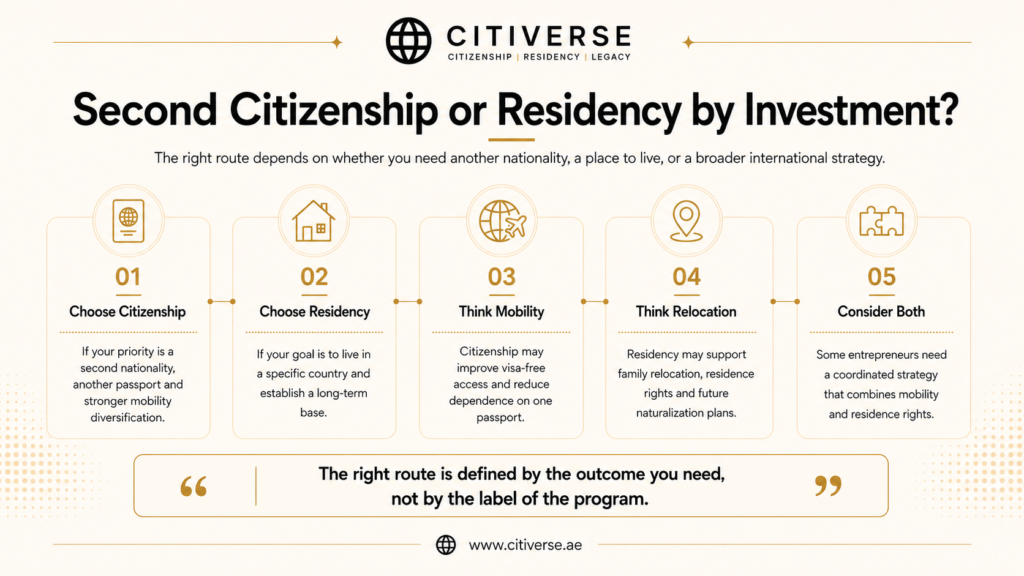
| Objective | More Likely Route |
|---|---|
| Obtain a second passport | Citizenship by investment |
| Relocate to a specific country | Residency by investment |
| Improve access to selected travel destinations | Citizenship by investment |
| Establish a long-term family base | Residency by investment |
| Reduce dependence on one nationality | Citizenship by investment |
| Build a future naturalization pathway | Residency by investment |
| Combine mobility with residence rights | A coordinated strategy |
Citiverse provides guidance across both Residency by Investment Programs and direct citizenship routes. The recommendation should be based on the required outcome, not on assumptions about which category is more prestigious or valuable.
In some cases, the strongest solution may combine both. An entrepreneur may use residency to establish a base in a strategic jurisdiction while pursuing citizenship elsewhere for wider mobility or long-term diversification.


Ready to Take the Next Step? Let’s Talk About Your Goals!