



Expats are already accustomed to living across borders, but the residence status that supports today’s lifestyle may not be the status they want to rely on for the next decade. Employment can change, children may reach a different stage of education, a business can move, and a temporary or renewable residence arrangement may no longer provide the permanence or flexibility the family needs.
Residency by investment can provide a more deliberate next base. Instead of linking residence only to a job or short-term immigration category, the applicant secures residence through a qualifying investment and builds the legal structure around a jurisdiction selected for lifestyle, family, business or long-term planning. The investment can be real estate or another approved route depending on the country.
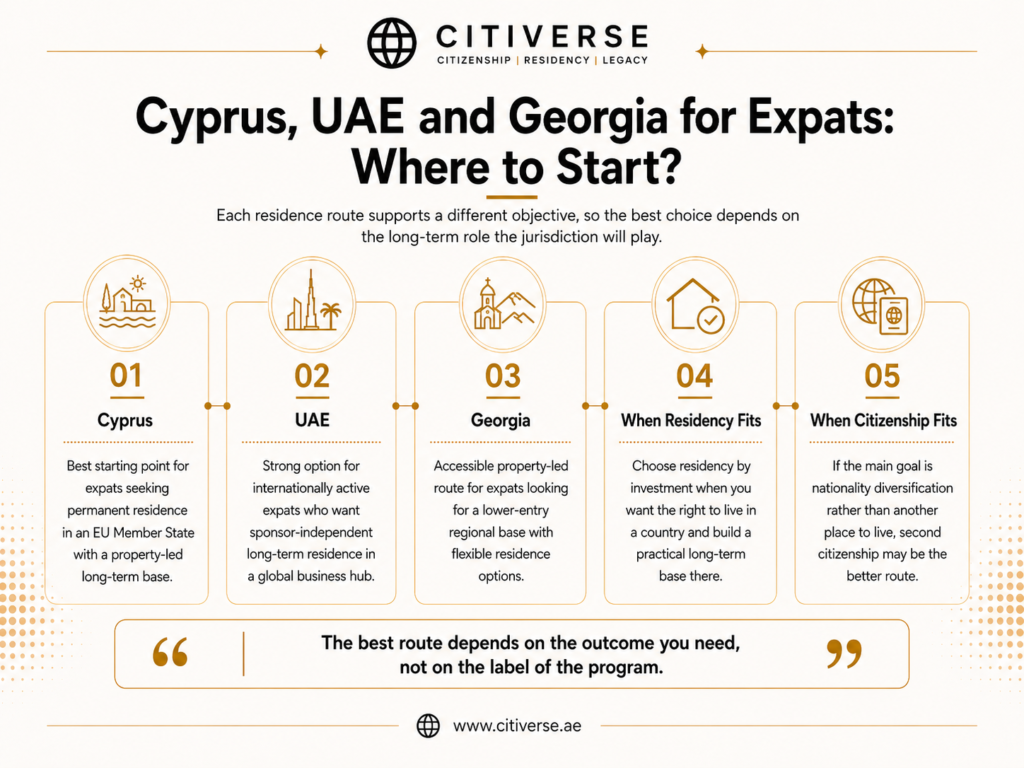
This guide focuses on the residency routes currently supported by Citiverse in Cyprus, the UAE and Georgia. They do not create the same legal outcome, and the strongest choice depends on whether the expat wants permanence, a regional hub, a property-led relocation plan, family continuity or simply a credible alternative base.
An expat can spend many years in one country without wanting that country to be the permanent centre of family life. The current base may work because of employment, a regional business opportunity or a particular stage in the family’s development. Later, priorities can shift towards permanence, property ownership, education, healthcare, retirement planning or proximity to other markets.
A second residence base can also reduce dependence on a single host-country immigration status. This does not mean abandoning the current residence. In many cases, the applicant simply wants another jurisdiction that remains available if the current employment or business arrangement changes, or a country that can become the future primary home when the family is ready to relocate.
Citiverse’s broader Residency by Investment solutions are designed around this type of planning: identifying a residence route that fits the applicant’s intended use rather than selecting a country because it is currently fashionable or marketed as a Golden Visa.
Factor | Typical Employment / Sponsored Residence | Residency by Investment |
Primary basis | Employment, sponsor, family relationship or another temporary category | Qualifying investment and compliance with the selected program |
Independence from employer | Often limited | Generally stronger where the investor is the principal applicant |
Investment required | Not necessarily | Yes, under the relevant route |
Family inclusion | Depends on the host-country category | Usually structured into the investor route, subject to program rules |
Permanence | Often renewable or tied to the underlying activity | Varies: can be permanent or long-term renewable depending on jurisdiction |
Property role | Optional | May be the qualifying asset in property-led routes |
Tax residence automatic? | No | No |
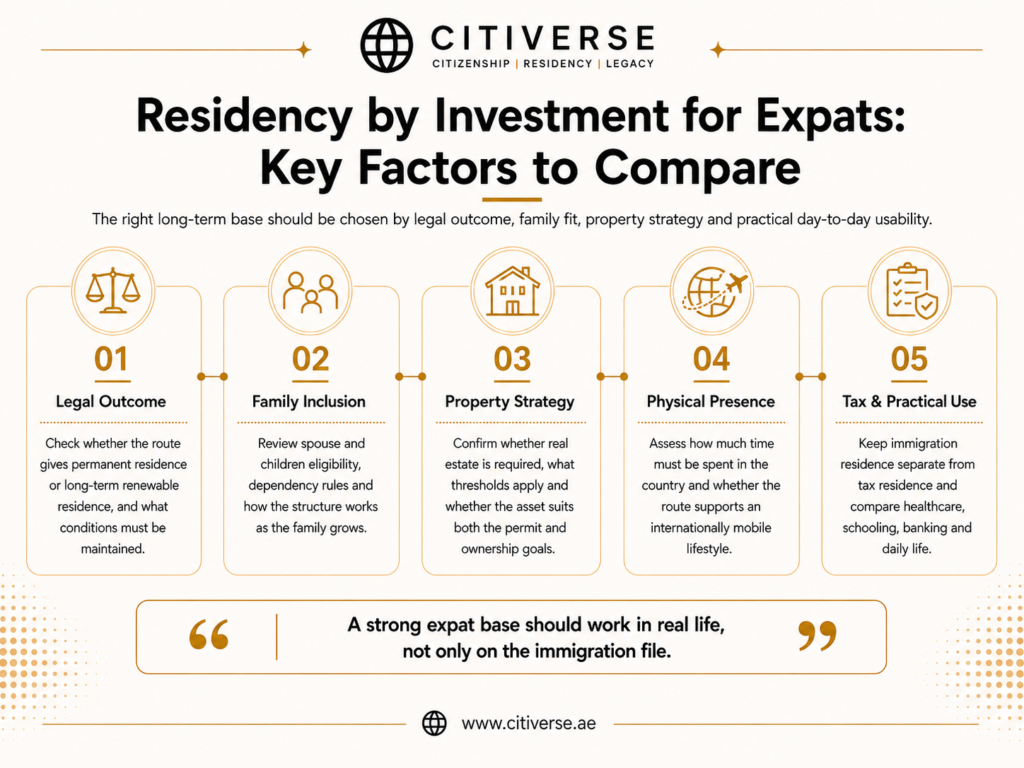
Residency by investment should therefore be assessed as a legal residence strategy, not simply as an investment product. The applicant needs to know what the permit allows, how long it lasts, how it is maintained, who in the family is covered and what happens if the qualifying asset is sold.
A strong long-term base must work in everyday life as well as on the immigration file. Expats often have a better understanding of this than first-time migrants because they already know how residence rules, banking, healthcare, schooling and day-to-day administration affect the practical quality of an international move.
Exit flexibility: Can the investment be replaced or sold, and what happens to the residence if the family later chooses another base?
Factor | Cyprus | UAE | Georgia |
Residence outcome | Permanent residence through qualifying investment | Long-term renewable Golden Residency | Short-term property residence or investment residence, depending on route |
Indicative investment entry point | From €300,000 | AED 2 million for real-estate investors under current federal guidance | Property above USD 150,000; investment residence from USD 300,000 |
Best suited for | Non-EU expats seeking a permanent EU-member-state base and property-led long-term planning | Internationally active expats seeking a globally connected Middle East base and sponsor-independent long-term residence | Expats seeking a comparatively accessible property-led regional base |
Property route | Yes, including qualifying residential and other eligible real estate | Yes, qualifying real estate | Yes, qualifying non-agricultural real estate |
Family planning | Spouse and qualifying children under current rules | Spouse and children may be sponsored subject to current requirements | Family treatment depends on the selected residence category |
Tax residence automatic? | No | No | No |
For non-EU expats who want a permanent legal base in an EU Member State, Cyprus Permanent Residency by Investment is one of the strongest residence outcomes in the current Citiverse portfolio. The program starts from a qualifying investment of €300,000 and can be structured through new residential property, other eligible real estate, a qualifying Cyprus company or eligible Cyprus investment funds.
The attraction for an expat is not simply European location. The residence right is permanent, while the applicant is not required to relocate full time merely to hold the status. This can suit a family that wants to keep an existing business or employment base elsewhere while establishing Cyprus as a future home, second base or long-term contingency.
Cyprus can be particularly relevant when the applicant wants more permanence than a temporary work or investor permit but is not seeking immediate citizenship. A family may acquire a qualifying property, establish a reliable European base and move gradually rather than restructuring every aspect of life on day one.
The main applicant must also demonstrate secured annual income of at least €50,000, with increases for a spouse and dependent minor children under the current investor policy. Source of funds, clean criminal records, health insurance and maintenance of the qualifying investment form part of the wider application framework.
For applicants who expect to use Cyprus as a genuine family base, the Cyprus Permanent Residency by Real Estate route can align immigration planning with the acquisition of a future home. The residential category generally centres on qualifying first-sale property from a development company, while other real-estate categories operate under different conditions.
The sequence matters. An expat should not purchase an attractive apartment first and ask later whether it supports the residence strategy. The safer approach is to confirm eligibility, investment category, family structure and source-of-funds position before signing a binding acquisition.
The UAE Golden Residency serves a different expat profile. It is particularly relevant to individuals who value global connectivity, private infrastructure, business access and the ability to hold long-term residence without depending on an employer sponsor. This can be attractive both to expats already living in the UAE and to internationally active investors moving into the region.
Current federal guidance identifies a minimum capital threshold of AED 2 million for investors in public investments or qualifying real estate. For real-estate investors, the current federal Golden Residency framework provides a long-term renewable status subject to the applicable authority requirements and continued eligibility.
The UAE can be the stronger option where the applicant’s life remains highly international and the desired base needs to support frequent travel, investment activity, private healthcare, education and a substantial professional network. It may also suit founders, executives and investors who plan to remain commercially active rather than moving into a purely residential lifestyle.
It should not, however, be selected only because it is associated with a favourable personal tax environment. Immigration residence, UAE tax residence and tax obligations in other connected countries remain separate questions. The applicant should first decide whether the UAE is the right place to live and operate, then coordinate the tax analysis around the actual facts.
For expats seeking a lower property entry point, Georgia Residency by Investment can offer a different type of solution. Under the current 2026 framework, a short-term residence permit may be available where a foreign national owns qualifying non-agricultural real estate with a market value exceeding USD 150,000 equivalent in GEL.
A separate investment residence route applies at a higher level, including an investment of at least USD 300,000 equivalent in GEL or qualifying property above that value. These routes should not be treated as interchangeable, because the legal status, duration and long-term outcome depend on the category used.
Georgia may appeal to expats who want property ownership, a regional base and a comparatively accessible capital requirement. It can also be relevant where the applicant values flexibility more than the permanence of Cyprus or the high-end infrastructure and global connectivity associated with the UAE.
The property decision should still follow the immigration analysis. Market value, asset category, certified valuation and the exact residence route need to be verified before acquisition, especially where the applicant expects the property to serve both as an investment and the legal basis of the permit.


Ready to Take the Next Step? Let’s Talk About Your Goals!