

Residency by Investment for Expats:
How to Choose Your Next Long-Term Base

residency by investment for expats

Expats are already accustomed to living across borders, but the residence status that supports today’s lifestyle may not be the status they want to rely on for the next decade. Employment can change, children may reach a different stage of education, a business can move, and a temporary or renewable residence arrangement may no longer provide the permanence or flexibility the family needs.

Residency by investment can provide a more deliberate next base. Instead of linking residence only to a job or short-term immigration category, the applicant secures residence through a qualifying investment and builds the legal structure around a jurisdiction selected for lifestyle, family, business or long-term planning. The investment can be real estate or another approved route depending on the country.

This guide focuses on the residency routes currently supported by Citiverse in Cyprus, the UAE and Georgia. They do not create the same legal outcome, and the strongest choice depends on whether the expat wants permanence, a regional hub, a property-led relocation plan, family continuity or simply a credible alternative base.

Key takeaways: Residency by Investment for Expats


  • Residency by investment is most useful for expats who want a defined legal base in a specific country rather than immediate second citizenship.
  • The current host country should not automatically become the permanent base. Expats should compare whether their existing residence remains suitable if employment, sponsorship, business ownership or family circumstances change.
  • Cyprus offers permanent residence through qualifying investment from €300,000 and can be particularly relevant to non-EU expats seeking a long-term base in an EU Member State.
  • The UAE Golden Residency provides long-term renewable residence without an employer sponsor. Current federal guidance identifies AED 2 million as the real-estate investor threshold.
  • Georgia provides a lower-entry property route, with short-term residence linked to qualifying non-agricultural real estate above USD 150,000 and an investment residence route from USD 300,000.
  • Immigration residence and tax residence are separate. A residence card should not be selected on the assumption that it automatically creates the desired tax position.
  • Property should follow the residence strategy, not lead it. Eligibility, family structure, source of funds and long-term use should be confirmed before a binding acquisition is made.
  • For some expats, second citizenship may ultimately be more useful than another residence permit. The decision should begin with the legal outcome required.

Why Expats Consider a Second Long-Term Residence Base


An expat can spend many years in one country without wanting that country to be the permanent centre of family life. The current base may work because of employment, a regional business opportunity or a particular stage in the family’s development. Later, priorities can shift towards permanence, property ownership, education, healthcare, retirement planning or proximity to other markets.

A second residence base can also reduce dependence on a single host-country immigration status. This does not mean abandoning the current residence. In many cases, the applicant simply wants another jurisdiction that remains available if the current employment or business arrangement changes, or a country that can become the future primary home when the family is ready to relocate.

Citiverse’s broader Residency by Investment solutions are designed around this type of planning: identifying a residence route that fits the applicant’s intended use rather than selecting a country because it is currently fashionable or marketed as a Golden Visa.

Residency by Investment vs Ordinary Expat Residence


Factor

Typical Employment / Sponsored Residence

Residency by Investment

Primary basis

Employment, sponsor, family relationship or another temporary category

Qualifying investment and compliance with the selected program

Independence from employer

Often limited

Generally stronger where the investor is the principal applicant

Investment required

Not necessarily

Yes, under the relevant route

Family inclusion

Depends on the host-country category

Usually structured into the investor route, subject to program rules

Permanence

Often renewable or tied to the underlying activity

Varies: can be permanent or long-term renewable depending on jurisdiction

Property role

Optional

May be the qualifying asset in property-led routes

Tax residence automatic?

No

No

Residency by investment should therefore be assessed as a legal residence strategy, not simply as an investment product. The applicant needs to know what the permit allows, how long it lasts, how it is maintained, who in the family is covered and what happens if the qualifying asset is sold.

What Makes a Good Long-Term Base for an Expat?


A strong long-term base must work in everyday life as well as on the immigration file. Expats often have a better understanding of this than first-time migrants because they already know how residence rules, banking, healthcare, schooling and day-to-day administration affect the practical quality of an international move.

  • Legal durability: Is the status permanent, renewable or dependent on maintaining a specific investment? What events can cause it to lapse?
  • Physical presence: Can the applicant remain internationally mobile, or does the route require substantial time in the country?
  • Family structure: Can a spouse and children be included, and what happens as children reach adulthood?
  • Property strategy: Does the qualifying asset also work as a home or investment, and what are the holding, resale and maintenance conditions?
  • Healthcare and education: If the family actually relocates, can the jurisdiction support the practical needs that motivated the move?
  • Business relevance: Can the location support board activity, regional business, investment management or the applicant’s professional network?
  • Tax position: What would happen if the applicant becomes tax resident, and how would that interact with existing companies, pensions, investments or another country of residence?

Exit flexibility: Can the investment be replaced or sold, and what happens to the residence if the family later chooses another base?
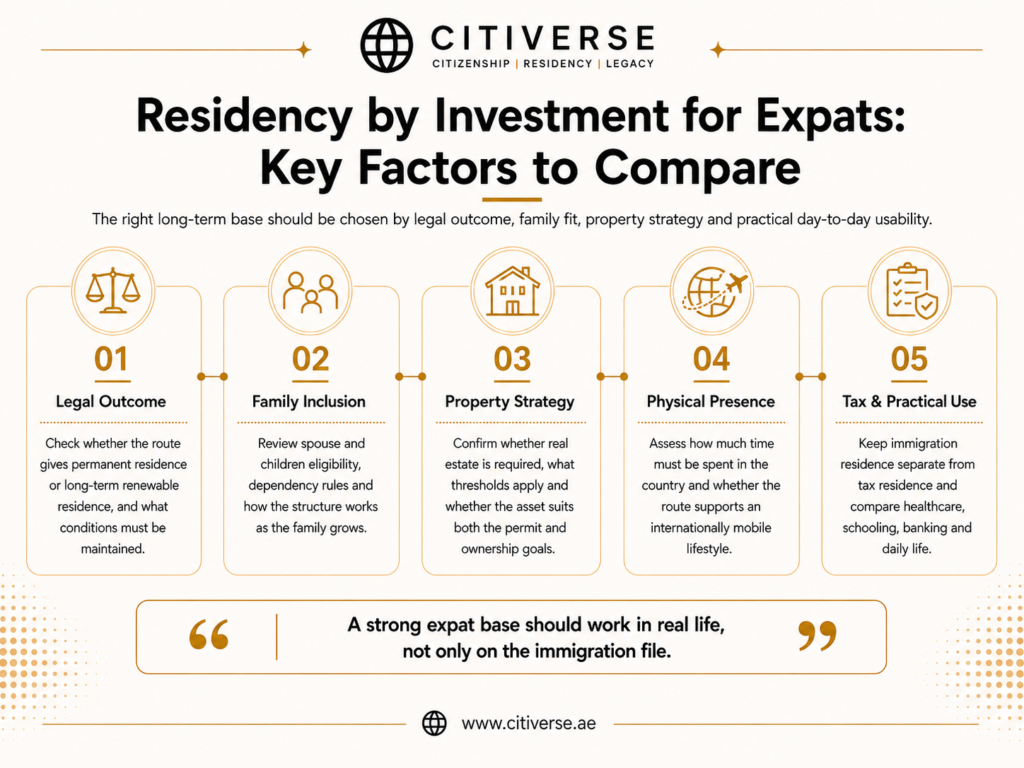
Residency by investment for expats in 2026 covering legal outcome, family inclusion, property strategy, physical presence, tax residence and practical relocation considerations

Residency by Investment for Expats in 2026: Cyprus, UAE and Georgia at a Glance


Factor

Cyprus

UAE

Georgia

Residence outcome

Permanent residence through qualifying investment

Long-term renewable Golden Residency

Short-term property residence or investment residence, depending on route

Indicative investment entry point

From €300,000

AED 2 million for real-estate investors under current federal guidance

Property above USD 150,000; investment residence from USD 300,000

Best suited for

Non-EU expats seeking a permanent EU-member-state base and property-led long-term planning

Internationally active expats seeking a globally connected Middle East base and sponsor-independent long-term residence

Expats seeking a comparatively accessible property-led regional base

Property route

Yes, including qualifying residential and other eligible real estate

Yes, qualifying real estate

Yes, qualifying non-agricultural real estate

Family planning

Spouse and qualifying children under current rules

Spouse and children may be sponsored subject to current requirements

Family treatment depends on the selected residence category

Tax residence automatic?

No

No

No

Cyprus Permanent Residency by Investment: A Permanent European Base


For non-EU expats who want a permanent legal base in an EU Member State, Cyprus Permanent Residency by Investment is one of the strongest residence outcomes in the current Citiverse portfolio. The program starts from a qualifying investment of €300,000 and can be structured through new residential property, other eligible real estate, a qualifying Cyprus company or eligible Cyprus investment funds.

The attraction for an expat is not simply European location. The residence right is permanent, while the applicant is not required to relocate full time merely to hold the status. This can suit a family that wants to keep an existing business or employment base elsewhere while establishing Cyprus as a future home, second base or long-term contingency.

Why Cyprus Can Work for Expats Planning Ahead


Cyprus can be particularly relevant when the applicant wants more permanence than a temporary work or investor permit but is not seeking immediate citizenship. A family may acquire a qualifying property, establish a reliable European base and move gradually rather than restructuring every aspect of life on day one.

The main applicant must also demonstrate secured annual income of at least €50,000, with increases for a spouse and dependent minor children under the current investor policy. Source of funds, clean criminal records, health insurance and maintenance of the qualifying investment form part of the wider application framework.

Property-Led Cyprus Residency for Expats


For applicants who expect to use Cyprus as a genuine family base, the Cyprus Permanent Residency by Real Estate route can align immigration planning with the acquisition of a future home. The residential category generally centres on qualifying first-sale property from a development company, while other real-estate categories operate under different conditions.

The sequence matters. An expat should not purchase an attractive apartment first and ask later whether it supports the residence strategy. The safer approach is to confirm eligibility, investment category, family structure and source-of-funds position before signing a binding acquisition.

UAE Golden Residency: A Sponsor-Independent Global Base


The UAE Golden Residency serves a different expat profile. It is particularly relevant to individuals who value global connectivity, private infrastructure, business access and the ability to hold long-term residence without depending on an employer sponsor. This can be attractive both to expats already living in the UAE and to internationally active investors moving into the region.

Current federal guidance identifies a minimum capital threshold of AED 2 million for investors in public investments or qualifying real estate. For real-estate investors, the current federal Golden Residency framework provides a long-term renewable status subject to the applicable authority requirements and continued eligibility.

When the UAE May Be the Better Expat Base


The UAE can be the stronger option where the applicant’s life remains highly international and the desired base needs to support frequent travel, investment activity, private healthcare, education and a substantial professional network. It may also suit founders, executives and investors who plan to remain commercially active rather than moving into a purely residential lifestyle.

It should not, however, be selected only because it is associated with a favourable personal tax environment. Immigration residence, UAE tax residence and tax obligations in other connected countries remain separate questions. The applicant should first decide whether the UAE is the right place to live and operate, then coordinate the tax analysis around the actual facts.

Georgia Residency: A More Accessible Property-Led Base


For expats seeking a lower property entry point, Georgia Residency by Investment can offer a different type of solution. Under the current 2026 framework, a short-term residence permit may be available where a foreign national owns qualifying non-agricultural real estate with a market value exceeding USD 150,000 equivalent in GEL.

A separate investment residence route applies at a higher level, including an investment of at least USD 300,000 equivalent in GEL or qualifying property above that value. These routes should not be treated as interchangeable, because the legal status, duration and long-term outcome depend on the category used.

When Georgia May Fit an Expat Strategy


Georgia may appeal to expats who want property ownership, a regional base and a comparatively accessible capital requirement. It can also be relevant where the applicant values flexibility more than the permanence of Cyprus or the high-end infrastructure and global connectivity associated with the UAE.

The property decision should still follow the immigration analysis. Market value, asset category, certified valuation and the exact residence route need to be verified before acquisition, especially where the applicant expects the property to serve both as an investment and the legal basis of the permit.
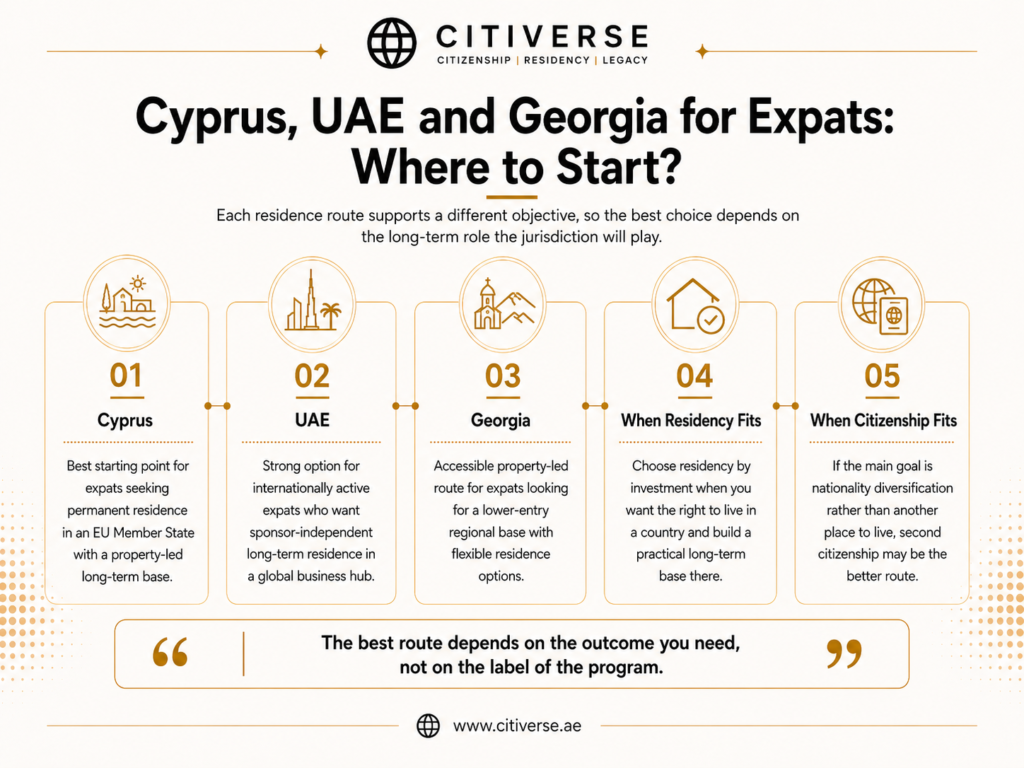
Comparison of Cyprus, UAE and Georgia residency options for expats in 2026, including permanent residence, Golden Residency, property-led routes and when second citizenship may be more suitable

Featured Residency by Investment Programs

Discover premium residence opportunities in world-class destinations that offer exceptional lifestyle benefits

Cyprus

Investment from: €300,000+

Processing time: 4-6 months

• EU permanent residency with citizenship eligibility after 8 years
• Real estate investment only – no donation required
• Favourable tax regime with non-dom status
• No full-time presence required – one visit every two years
• Strong rental yields and investment returns
• Visa-free travel to 170+ countries
• Includes main applicant, spouse, and dependents up to age 25

UAE

Investment from: $545,000

Processing time: 2–6 weeks

• 5 or 10-year renewable UAE residency via real estate investment
• No sponsor or employer required – investor-led residency
• Includes spouse, children, and parents
• Zero tax on income, property, or dividends
• Fast-track process with full legal & medical support
• Emirates ID and residency stamp included
• Access to Schengen visa facilitation and global mobility

Georgia

Investment from: $150,000+

Processing time: 10–30 days

  • 1-year renewable residency permit with a minimum real estate investment of $150,000

  • Upgrade to a 5-year renewable residency with $300,000+ investment in real estate

  • Pathway to permanent residency after 6 years of holding residency status

  • Citizenship eligibility after 10 years

  • Includes main applicant, spouse, and dependent children

  • No relocation requirement – minimal physical presence needed

How to Choose Between Cyprus, the UAE and Georgia as an Expat


Expat objective

Likely starting point

Reason

Permanent European residence base

Cyprus

Permanent residence outcome, EU-member-state location and property-led planning

Global business and lifestyle hub

UAE

Long-term sponsor-independent residence, connectivity and international infrastructure

Lower-entry property-led regional base

Georgia

More accessible property threshold and flexible residence options

Gradual move from current expat country

Cyprus or UAE

Both can support a staged relocation without requiring the applicant to abandon the current base immediately

Primarily nationality diversification rather than relocation

Consider second citizenship instead

A residence permit may not solve the objective if the applicant does not need another place to live

Eight Questions to Ask Before Choosing Your Next Residence Base


  1. What happens if my current expat visa ends tomorrow? Identify whether the next base is intended as an emergency alternative, a future primary home or simply a second legal option. The answer changes the importance of permanence and processing time.
  2. Do I actually want to live there? A residence permit has most value when the jurisdiction is genuinely usable for the applicant and family. Climate, travel connections, healthcare, schooling and day-to-day services should be tested alongside the legal rules.
  3. How permanent is the status? Distinguish permanent residence from a five-year permit, annual renewals and routes tied closely to the continued ownership of an asset.
  4. What does the investment need to achieve? Decide whether capital should be held in a home, commercial asset, company or fund. Immigration eligibility and investment quality are separate tests.
  5. Who in the family needs residence? Map spouses, minor children, adult dependants, students and any future relocation plans before choosing the route.
  6. What are the physical-presence rules? A globally mobile expat may need a status that can be maintained without spending most of the year in one place. A future full-time resident may view presence differently.
  7. Could I become tax resident there? Model the tax consequences before materially changing day counts, homes, family location or company management. Residence permission does not by itself answer the tax question.
  8. What is the exit strategy? Understand what happens if the property is sold, the investment is replaced, family circumstances change or another jurisdiction becomes more suitable later.

Immigration Residence, Tax Residence and Citizenship: Keep the Three Separate


Expats often encounter all three concepts at the same time, which makes it easy to blur them together. Immigration residence determines whether a person has the legal right to live in a country. Tax residence determines whether that country treats the person as resident for tax purposes under its domestic rules and applicable treaties. Citizenship creates nationality.

An investor may therefore hold Cyprus permanent residence while remaining tax resident elsewhere, or hold UAE Golden Residency without automatically obtaining the desired UAE tax position. Likewise, a person may hold a second citizenship and still need a residence permit to live in a third country. Citiverse’s Residency by Investment vs Citizenship by Investment guide explains these distinctions in a broader global mobility context.

Family Planning for Expats Choosing a New Base


The best residence route for an individual can become unsuitable once the family is included. Children’s ages, school plans, university location and financial dependency can determine whether they remain eligible as dependants. A spouse may also have separate professional or tax considerations that affect the preferred jurisdiction.

Families should compare the rules before the principal applicant commits to property or another qualifying investment. Citiverse’s guide to Residency by Investment for Families explains why education, healthcare, work rights, renewal conditions and the route to permanent status should be mapped as one family plan rather than handled after the main application.

Property Should Follow the Residence Strategy


Property is one of the most common qualifying assets in investment migration, but the property and the residence permit are not the same decision. A home may be attractive from a lifestyle perspective and still fail the immigration criteria, while a qualifying asset may be legally acceptable but commercially weak or unsuitable for the family.

The correct sequence is eligibility first, jurisdiction second, investment route third and property selection fourth. This protects the applicant from making a binding acquisition that cannot support the intended status or that creates unnecessary exit, maintenance or liquidity issues later.

When Second Citizenship May Be Better Than Another Residency


Not every expat needs another residence card. If the applicant already has a strong place to live and the real objective is nationality diversification, broader passport mobility or a status that remains independent of the next relocation, a second citizenship may be the stronger solution.

Citiverse’s guide to Second Citizenship for Expats is designed around this decision. In practice, some clients may ultimately hold citizenship in one jurisdiction and residence in another, with each serving a separate purpose in the wider international plan.

A Practical Expat Relocation Scenario


Consider a couple in their forties who have lived abroad for more than a decade. One spouse runs an international company, the other works remotely, and their children attend an international school. Their current residence is secure for the next several years, but they want a long-term base that will still be useful if the business moves, the children study in Europe or the family eventually reduces its time in the current host country.

Cyprus may be the strongest starting point if permanent European residence and a future family home are priorities. The UAE may be more suitable if the family wants to remain in a globally connected commercial hub, while Georgia may deserve consideration if property cost and regional flexibility carry more weight. The right answer comes from the future life the family is planning, not from the permit with the most attractive headline.

Residency by Investment for Expats: A Pre-Application Checklist


  • Define whether the new jurisdiction is a Plan B, a second home or the intended future primary residence.
  • Review nationality, current residence status and any restrictions created by the existing immigration arrangement.
  • Map every family member and confirm dependant eligibility before calculating the investment budget.
  • Identify the capital available for the qualifying investment and prepare the source-of-funds trail before transfers begin.
  • Check property rules, valuation requirements, holding periods and resale conditions before signing a reservation or sale agreement.
  • Model physical presence and potential tax residence across the current and future countries.
  • Review healthcare, insurance, schooling and practical relocation costs if the residence will be actively used.
  • Confirm what happens if the investment is sold, replaced or transferred and how that affects the residence status.
  • Compare whether second citizenship would solve the objective more efficiently than another residence permit.

How Citiverse Supports Expats Choosing a Long-Term Residence Base


Citiverse provides structured Citizenship and Residency Program Advisory for expats comparing long-term residence options. The process begins with the applicant’s current nationality and residence, family structure, investment capacity, intended physical presence and the practical outcome required from the next base.

Once the jurisdiction and route are clear, Citiverse can coordinate property selection where relevant, documentation, due diligence preparation and Investment Processing Services. The objective is to align the investment with the residence application rather than treating the property purchase and immigration process as separate projects.

Where tax, corporate, estate or regulated financial questions become material, these should be coordinated with appropriately qualified professionals. A strong relocation plan keeps each workstream distinct while ensuring the overall structure remains coherent.

Residency by Investment for Expats: Choosing Your Next Base


Residency by investment can be particularly valuable for expats because it turns an international lifestyle into a more deliberate legal structure. The right base can provide permanence, family continuity, property ownership and the ability to relocate on the applicant’s own timetable rather than waiting for a change in employment or sponsorship to force the decision.

The best route is not necessarily the country with the lowest investment threshold or the most recognisable Golden Visa label. It is the jurisdiction that the applicant can realistically use, maintain and integrate with family, business and tax planning over the long term.

Looking for Your Next Long-Term Residence Base?

Speak with Citiverse to compare Cyprus, the UAE and Georgia against your current expat position,
family structure, investment profile and long-term relocation objectives.

Frequently Asked Questions: Residency by Investment for Expats in 2026

What is residency by investment for expats?

Residency by investment is a route through which an eligible applicant obtains residence rights in a country by completing a qualifying investment and meeting the relevant immigration, financial and due diligence requirements.

An expat may want a residence base that is independent of current employment, a future family home, a regional business hub or a long-term alternative if the present host-country arrangement changes.

Citiverse advises on selected investment-led residence routes in Cyprus, the UAE and Georgia, subject to current rules and applicant eligibility.

The current Cyprus investor route starts from a qualifying investment of €300,000. Additional income, documentation, health insurance, source-of-funds and due diligence requirements apply.

Current federal guidance identifies AED 2 million as the minimum capital threshold for the real-estate investor category, subject to the applicable authority requirements.

The current short-term property residence route applies to qualifying non-agricultural real estate with a market value exceeding USD 150,000 equivalent in GEL. A separate investment residence route applies from USD 300,000.

Not automatically. Immigration residence and tax residence are separate legal concepts, and tax residence depends on domestic rules, physical presence and other factual connections.

Family inclusion depends on the jurisdiction and category. Spouses and children are commonly covered under selected routes, but age, dependency and separate-application rules must be checked.

Usually no. The safer sequence is to confirm eligibility and the qualifying investment category first, then acquire an asset that supports both the immigration application and long-term ownership objectives.

It depends on the applicant’s objective. Permanent residence can provide greater legal permanence, while a renewable long-term residence may be more attractive where the jurisdiction itself is a stronger lifestyle or business fit.

Second citizenship may be more suitable where the main objective is an additional nationality, passport diversification or a status independent of the next place of residence rather than the right to live in one particular country.

Citiverse can compare the supported jurisdictions against nationality, family needs, investment capacity, property preferences, presence plans and due diligence readiness before the applicant commits capital.

Explore Citizenship & Residency by Investment
Programs by Citiverse

Discover premium citizenship and residency opportunities in world-class destinations, offering exceptional lifestyle benefits. Explore our overview brochure or continue reading below.

Meet the Citiverse team

Meet the specialists guiding Citiverse’s mission to connect global citizens with opportunities worldwide.

Cezary Zieniuk Citizenship by Investment

Cezary Zieniuk

Founder

Alexander Mabian Citiverse Citizenship by Investment

Alexander Mabian

Managing Director

Scroll to Top