



Retiring abroad is increasingly part of long-term lifestyle and financial planning for internationally mobile individuals. The decision is no longer limited to choosing a warmer climate or lower cost of living. A successful move requires a legal residence route that fits the retiree’s income, investment profile, healthcare needs, family circumstances and preferred level of physical presence.
For clients who want an investment-led route, residency by investment can create a structured long-term base without requiring immediate citizenship. Citiverse currently advises on selected residence solutions in Cyprus, the UAE and Georgia, each of which serves a different retiree profile and should be assessed on its own legal, financial and practical merits.
This guide focuses on those supported routes. Other countries may offer retirement visas, passive-income permits or non-investment residence categories, but the strongest strategy is the one that matches the applicant’s actual objectives rather than the broadest list of destinations.
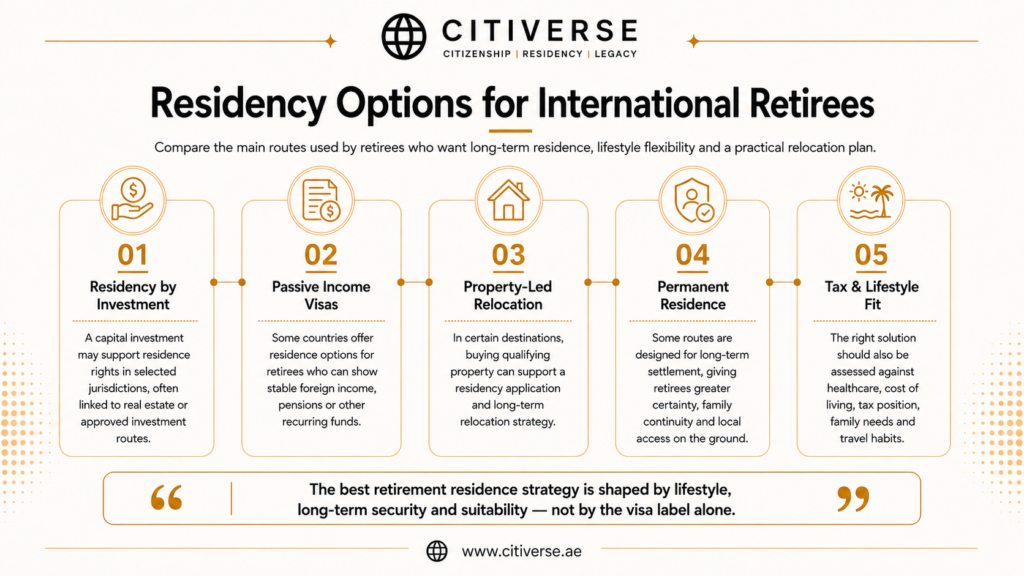
A residence program that works well for a working founder may be unsuitable for a retiree. Retirees typically place greater weight on permanence, healthcare, family access, property ownership, predictable ongoing costs and the ability to maintain status without unnecessary administrative complexity. Investment return may still matter, but lifestyle usability and continuity often become equally important.
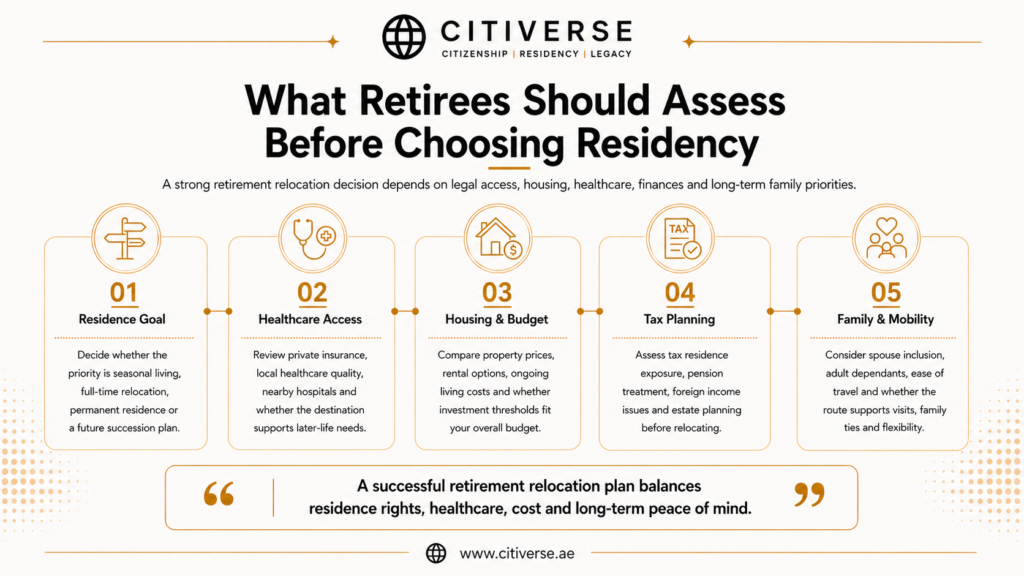
Before comparing countries, the applicant should define whether the intended move is full-time, seasonal or simply a long-term contingency plan. A couple who wants to spend nine months a year in one country has a very different planning profile from a family that wants a residence card, an apartment and the option to relocate later.
A traditional retirement or passive-income visa is usually based on pension income, savings or another recurring source of funds. It may offer a lower initial capital requirement, but it can also involve renewal conditions, minimum-stay rules, restrictions on work or more limited long-term certainty.
Residency by investment instead links the applicant’s status to a qualifying investment, commonly real estate or another approved asset. This can appeal to retirees who already intend to acquire property, prefer a more durable residence position, want to include family members or see the investment as part of a wider asset and succession plan.
Citiverse’s broader guide to Residency by Investment vs Citizenship by Investment explains why a residence solution should be selected for the legal outcome it creates, rather than because it is marketed as a “Golden Visa” or a route to a second passport.
Factor | Cyprus | UAE | Georgia |
Residence type | Permanent residence through qualifying investment | Long-term renewable Golden Residency | Short-term property residence or higher-tier investment residence |
Indicative investment entry point | From €300,000 | AED 2 million for the real-estate investor category | Property above USD 150,000; investment route above USD 300,000 |
Best suited for | Retirees seeking a permanent EU-member-state base and property-led planning | HNW retirees seeking connectivity, lifestyle infrastructure and long-term regional residence | Value-oriented retirees seeking property ownership and a comparatively accessible residence base |
Family planning | Spouse and qualifying children may be included under current rules | Spouse and children may be sponsored subject to current requirements | Family inclusion depends on the selected residence category |
Full-time relocation required? | No, although maintaining the permit and actual tax residence are separate issues | No general full-time relocation requirement for Golden Residency | Depends on route and long-term objective |
Tax residence automatic? | No | No | No |
For retirees who want a permanent legal base in an EU Member State, Cyprus Permanent Residency by Investment is the most retirement-oriented of the residence routes currently supported by Citiverse. The program is available to qualifying third-country nationals and starts with a minimum €300,000 investment in an approved category.
The official framework recognises new residential property, other qualifying real estate, an investment in the share capital of an operating Cyprus company and eligible Cyprus investment funds. For many retirees, real estate is the most intuitive route because it can combine residence planning with a future home, part-time base or investment asset.
Cyprus can be attractive where the applicant wants permanence without an obligation to live in the country full-time from the outset. The residence right is of unlimited validity, while the residence card itself is periodically renewed. The investment must be maintained and the permit should be managed in accordance with the ongoing monitoring requirements.
The main applicant must also demonstrate secured annual income of at least €50,000. The requirement increases by €15,000 for a spouse and €10,000 for each dependent minor child. Pension income can form part of the qualifying income evidence where the applicable route and documentation requirements are satisfied, making the framework particularly relevant to financially independent retirees.
Retirees considering a home in Cyprus can review the dedicated Cyprus Permanent Residency by Real Estate route. The new residential category generally requires the acquisition of qualifying first-sale property from a development company with a total value of at least €300,000, excluding VAT where applicable. Other real-estate categories may operate under different eligibility conditions.
The important planning point is that a property purchase should not be treated as a substitute for an eligibility review. The applicant’s income, source of funds, family structure, health insurance, criminal record and the exact classification of the property all need to align with the residence application.
A retiree can hold Cyprus permanent residence without automatically becoming Cyprus tax resident. Tax residence depends on the applicable day-count and legal tests, while the treatment of pension income, dividends, interest, property income and other assets depends on the individual’s full cross-border position.
This distinction is particularly important for retirees who plan to divide their time between several countries. Immigration status answers the question of where you may live. Tax residence answers a different question: which country may tax you as a resident and how treaty rules, local exemptions and foreign-tax relief interact.
Cyprus is an EU Member State but has not yet fully joined the Schengen Area. A Cyprus residence permit should therefore not currently be treated as a substitute for a Schengen visa where the holder’s passport would otherwise require one. Citiverse explains the current position in Can Cyprus Permanent Residents Travel Visa-Free to Schengen in 2026? Any future Schengen accession may improve short-stay mobility, but a retirement decision should stand on the benefits available today.
The UAE Residency by Investment route serves a different profile. It is particularly relevant to retirees who want Dubai or another UAE emirate as a highly connected international base, intend to own property and value long-term renewable residence without relying on employment sponsorship.
Current federal guidance sets a minimum AED 2 million capital threshold for the real-estate investor Golden Residency category. The exact residence duration and authority requirements should be confirmed for the applicant’s category and emirate at the time of filing, as Golden Residency rules and administrative practice can evolve.
For retirees, the UAE can be attractive where international connectivity, private healthcare, modern infrastructure and investment access matter more than obtaining a permanent European residence status. It may also suit individuals who expect to continue managing investments, holding board positions or maintaining active international business interests after formal retirement.
A Golden Residency does not automatically make its holder a UAE tax resident. Residence status, tax residence and the tax treatment of foreign pensions or investment income should be reviewed separately. Retirees should also budget for health insurance, medical care and any emirate-specific requirements rather than assuming that long-term immigration status creates automatic healthcare entitlement.
Georgia Residency by Investment may appeal to retirees who value property ownership, a comparatively accessible entry point and a residence base that does not require the same level of capital as Cyprus or the UAE.
Under the current 2026 framework, a short-term residence permit may be available to a foreign national who owns qualifying non-agricultural real estate with a market value exceeding USD 150,000 equivalent in GEL. A separate investment residence route applies where the investment or qualifying property value exceeds USD 300,000 equivalent in GEL.
The distinction matters. The lower property threshold and the higher investment-residence route are not interchangeable, and they create different long-term outcomes. For retirees considering Georgia, the property should be selected only after confirming which legal residence category is actually intended.
Retiree profile | Potential fit | Why |
European-base retiree | Cyprus | Permanent residence, property-led planning, Mediterranean lifestyle and an EU-member-state base |
Internationally mobile HNW retiree | UAE | Global connectivity, modern infrastructure, property investment and long-term renewable residence |
Value-oriented property retiree | Georgia | Lower property entry point and flexible residence planning |
Retiree planning a future full relocation | Usually Cyprus first | Permanence, property ownership and a framework that can support genuine long-term settlement |
Retiree seeking mainly a Plan B | Depends on profile | Presence requirements, renewal conditions and investment structure become more important than lifestyle alone |
American retirees are an important part of the international retirement market, but their planning requires several additional checks. U.S. citizens who remain eligible for Social Security can generally receive payments while living abroad, subject to the applicable Social Security rules and country restrictions. That makes foreign retirement feasible for many Americans, but it does not remove the need for local residence planning.
Medicare usually does not cover healthcare outside the United States except in limited circumstances. A U.S. retiree should therefore evaluate private insurance, local healthcare eligibility and the cost of routine and specialist treatment before moving. Healthcare planning should be completed before the property purchase or relocation date, not after arrival.
U.S. citizens living abroad also generally continue to have U.S. tax filing obligations on worldwide income. Foreign tax credits, treaty provisions and other rules may reduce or coordinate tax exposure, but moving to another country does not by itself terminate U.S. federal tax obligations. This is one reason immigration planning and tax planning should be handled as connected but separate workstreams.
Retirement abroad often affects more than the principal applicant. Spouse residence rights, adult children, grandchildren, inheritance planning and the future ownership of the qualifying property should be considered before the move. Citiverse’s guide to Residency by Investment for Families explains why age limits and dependant rules should be mapped early rather than treated as an afterthought.
A property used to support residence may later form part of an estate. The succession rules that apply to the asset, wills, ownership structure and cross-border estate taxation should be reviewed with appropriately qualified advisers. The residence permit and the property are related from an immigration perspective, but they are not the same legal asset.
In most cases, no. The safer sequence is to confirm the residence route, eligibility, family composition, source-of-funds position and property criteria before making a binding acquisition. A property can be attractive commercially and still fail to support the intended immigration application.
Citiverse’s Real Estate Acquisition service is designed around this sequence: jurisdiction first, qualifying asset second, and coordinated acquisition and residence implementation thereafter.
Consider a financially independent couple in their early sixties who plan to stop full-time work within two years. They own investments in several countries, want to spend much of the year in a warmer climate and would like a property that can also serve as a family base. They do not need a second passport and are comfortable maintaining an investment, but they want the residence status to remain useful even if they do not relocate permanently on day one.
For this profile, Cyprus may provide the strongest starting point because the legal outcome is permanent residence and the investment can be aligned with a future home. If the same couple places greater value on global airline connectivity, high-end infrastructure and a Middle East base, the UAE may be more suitable. If the priority is a lower property threshold and a flexible regional base, Georgia may deserve consideration. The correct answer depends on the outcome, not the marketing label.
Citiverse provides structured Citizenship and Residency Program Advisory for clients comparing long-term residence options. For retirees, the process begins with objectives, nationality, family structure, income profile, investment capacity, healthcare expectations and the intended level of physical presence.
Once a route is selected, Citiverse can coordinate property sourcing, application documentation and investment processing. Where cross-border tax, estate, pension or regulated financial questions arise, the process can be coordinated with appropriately qualified professionals so that immigration, investment and tax decisions are not treated in isolation.
Residency by investment can be a strong solution for retirees who want more than a temporary stay and are comfortable committing capital to a qualifying asset. It is particularly relevant where the residence itself, property ownership, family inclusion and long-term optionality all form part of the same plan.
It is not automatically the best route for every retiree. Applicants seeking the lowest-cost visa or a purely seasonal stay may find a non-investment category more appropriate in another jurisdiction. Citiverse’s role is to determine whether one of the supported investment-led routes creates the right long-term outcome before capital is committed.


Ready to Take the Next Step? Let’s Talk About Your Goals!