




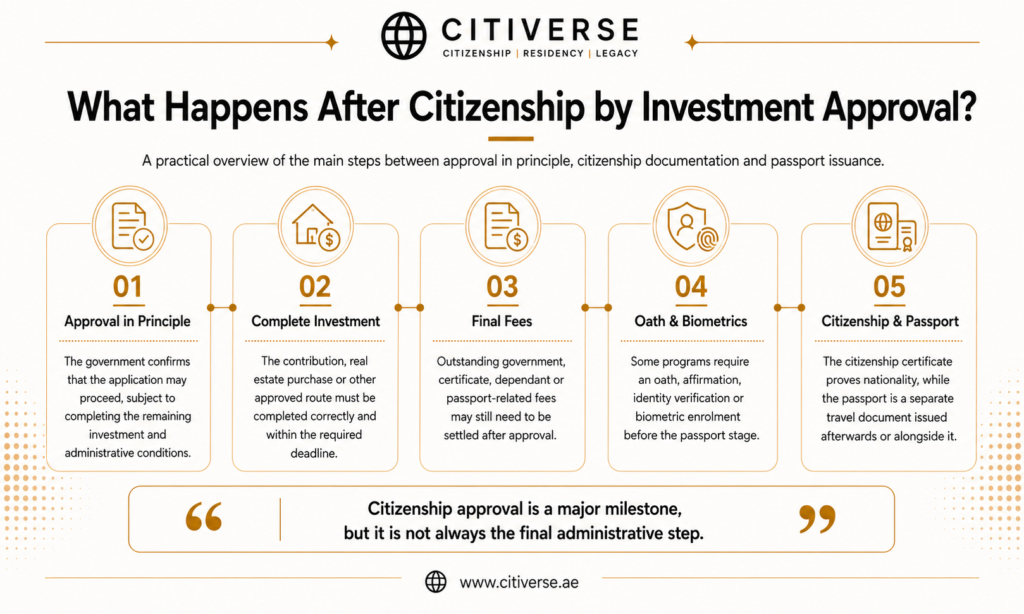
Citizenship by Investment approval is a major milestone, but it is not always the final administrative step. Depending on the program, an applicant may first receive approval in principle, then complete the qualifying contribution or investment, pay outstanding government fees, take an oath or affirmation, complete biometrics and receive a citizenship certificate before a passport application can be finalised.
The process also does not end when the first passport arrives. Citizenship and the passport are different legal concepts. The citizen may need to maintain a qualifying investment for a prescribed period, renew the passport, update biometric information, manage future children or family changes, and monitor travel or documentation requirements that can evolve after approval.
Citiverse treats post-approval planning as part of the wider Investment Processing lifecycle rather than an afterthought. A strong application should be designed from the beginning with the post-citizenship obligations in mind.
The phrase “Citizenship by Investment approval” can refer to different stages. In many direct CBI programs, the government first completes due diligence and issues an approval-in-principle letter. The applicant is then instructed to complete the qualifying contribution, real estate purchase or other approved investment and settle remaining government charges.
Only after the required financial route has been completed and verified does the process move to the formal citizenship stage. Depending on the jurisdiction, the applicant may then receive a certificate of naturalisation, certificate of registration or another official citizenship document and become eligible to apply for the passport.
Applicants who are still comparing programs can review How to Choose the Right Citizenship by Investment Program in 2026 to understand why the sequencing of payment, approval and citizenship should be assessed before an application is filed.
Stage | What usually happens | What the applicant should confirm |
1. Approval in principle | The government confirms that the application may proceed subject to completion of remaining conditions. | Deadline for completing the investment, outstanding fees and any conditions in the approval letter. |
2. Complete investment | The contribution is paid or the approved investment is finalised in the required manner. | Payment destination, escrow or developer process, title or ownership evidence and holding obligations. |
3. Final government charges | Outstanding processing, dependant, certificate or post-approval fees are paid. | Exact amounts, payment references and whether any fee is non-refundable. |
4. Oath / affirmation / biometrics | Applicants complete any required allegiance, biometric or identity formalities. | Who must attend, whether remote options exist and the relevant deadline. |
5. Citizenship document | The state issues the official certificate evidencing the new citizenship. | Correct spelling of names, dates, family relationships and safe custody of the original. |
6. Passport application | A passport application is submitted using the citizenship evidence and required identity documents. | Validity period, biometrics, collection method, processing fee and travel-document rules. |
7. Post-approval compliance | Any investment holding, presence or program-specific conditions continue. | Minimum holding period, replacement rules, monitoring and consequences of early disposal. |
8. Renewal and family updates | Passports are renewed and later family events are handled under the relevant nationality rules. | Renewal timing, future children, new spouses, name changes and document updates. |
Where the program uses an approval-in-principle structure, the applicant should complete the qualifying financial route only in the manner and sequence specified by the official approval. The process can differ materially between a non-refundable government contribution, approved real estate, a government bond, an approved project or another route.
For real estate, the post-approval stage may involve payment to the developer or escrow arrangement, transfer or registration of title, confirmation that the asset remains an approved project and delivery of evidence to the citizenship authority. The legal immigration qualification of the asset and its commercial quality remain separate tests.
The applicant should retain complete evidence of every transfer, contract, receipt and registration document. Those records may become relevant at passport renewal, property disposal, future family applications or a later government compliance review.
A headline investment amount rarely represents the final amount payable after approval. Depending on the program and family composition, outstanding government processing charges, dependant fees, certificate fees, passport fees, transaction expenses and professional costs may still need to be settled.
Payment deadlines can be strict. A client should therefore have liquidity ready before approval and should not assume that the approval letter creates an open-ended period to complete the investment. The exact timing should be confirmed before funds are moved or committed elsewhere.
Citizenship is a legal relationship with the state, so some programs require an Oath or Affirmation of Allegiance, identity verification, biometric enrolment or another formal step before or after the citizenship document is issued. The principal applicant and dependants can have different requirements depending on age and program rules.
These procedures are increasingly important as governments modernise passport security. An applicant who received citizenship several years ago should not assume that the biometric or passport procedure will remain unchanged throughout the life of the citizenship.
The citizenship certificate is one of the most important documents in the entire process. It evidences the underlying nationality and is often needed for the first passport, later passport renewal, registration of future children, replacement documents, inheritance matters or proof of citizenship to authorities and institutions.
Names, dates of birth and other identity details should be checked immediately. If an error appears, it should be corrected through the proper channel rather than carried into the passport and other records. The original certificate should be kept securely, with certified or digital copies retained in a separate location.
Citizenship is nationality. A passport is a travel document issued to a citizen. The distinction sounds technical, but it becomes important after approval because an applicant can already be a citizen while the first passport application is still being processed.
It also explains why a passport can expire or be replaced without the citizenship expiring. In established CBI jurisdictions, citizens generally renew passports under the country’s passport rules, but the validity period, biometric process, consular availability and documentation can differ.
Program example | Current post-approval / passport point | Why it matters |
Dominica | After the qualifying investment is completed, applicants receive a Certificate of Naturalisation and can apply for a passport. Dominican passports are generally valid for up to 10 years, while passports for children under 16 are issued for 5 years. | Citizenship is not the same as passport validity. The passport is renewed when required while citizenship continues, subject to the law. |
Antigua and Barbuda | The initial CBI passport is valid for 5 years. Renewal is linked to the citizen having spent a total of 5 days in Antigua and Barbuda during the first 5-year period. | A low-presence program can still contain a specific post-citizenship condition that must be planned before renewal. |
St. Kitts and Nevis | A biometric passport modernisation launched in April 2026. New Citizenship Programme applications include biometric enrolment, and pre-launch program passports remain accepted for travel during the transition to 31 July 2027. | Passport technology and enrolment rules can change after citizenship has been granted, so citizens need to monitor official updates. |
These examples are not a substitute for checking the current rules of the specific program. They demonstrate why the post-approval stage should be reviewed as carefully as the initial investment threshold.
Citizenship may be long term, but the investment used to qualify for it can still carry a mandatory holding period. This is particularly relevant to real estate and other recoverable investment routes. Selling, transferring, encumbering or replacing the asset before the permitted date can create a program-compliance issue.
The correct exit date should be confirmed from the current rules and the applicant’s own approval documents. A holding period may run from the date of citizenship, acquisition, registration or another program-specific event. Applicants should not rely on a generic marketing statement when planning a sale.
Program-specific guides such as Dominica Citizenship by Investment: Costs, Requirements and Process, Saint Kitts and Nevis Citizenship by Investment: Costs, Requirements and Process and Saint Lucia Citizenship by Investment: Costs, Requirements and Process should be reviewed together with the current official conditions of the selected route.




In a properly structured program, sale of the qualifying property after the required holding period does not necessarily terminate the citizenship. For example, Dominica’s official guidance confirms that a citizen can renew a passport after selling the investment property provided the required holding period was satisfied.
The key is timing and compliance. The applicant should verify that the statutory holding period has ended, that no route-specific restriction remains and that the sale will not affect another family member or later transaction. A property should never be disposed of early simply because the first passport has already been issued.
Family structure rarely remains static for the life of a citizenship. A child may be born after approval, an applicant may marry, a dependant may become independent, or names and civil-status records may change. Some jurisdictions provide procedures for post-citizenship additions or citizenship by descent, while others apply narrower conditions and separate fees.
These questions should be mapped before the initial application where possible. Citiverse’s guides to Second Citizenship for Families with Children and Citizenship by Investment for Future Generations explain why future family eligibility is part of the long-term value of a program.
After the passport is issued, the holder may need to update banks, brokers, companies, immigration records, insurance providers and other institutions with the new citizenship or passport details. The disclosure should be accurate and consistent with prior compliance records.
When a passport is renewed, the passport number and expiry date change. That can affect visas, residence permits, airline profiles, bank KYC records and corporate registers. A simple renewal therefore often creates a wider administrative checklist for internationally mobile clients.
Visa-free access is not guaranteed forever. States can add electronic travel authorisations, impose new entry conditions, suspend visa waivers or introduce biometric requirements. These developments affect the travel document, not necessarily the underlying citizenship.
This is why the mobility value of a citizenship should be reviewed over time. Second Citizenship for Travel Freedom explains how real-world access should be measured by the destinations and travel patterns that matter to the holder rather than by one fixed passport ranking.
Obtaining the citizenship and receiving the passport does not automatically make the new citizen tax resident in the citizenship country. Tax residence remains a separate analysis based on the relevant domestic rules and the individual’s actual circumstances.
The same principle applies to company management, banking, succession and asset structuring. The new citizenship can be an important component of an international plan, but it does not replace the legal analysis required for each connected jurisdiction.
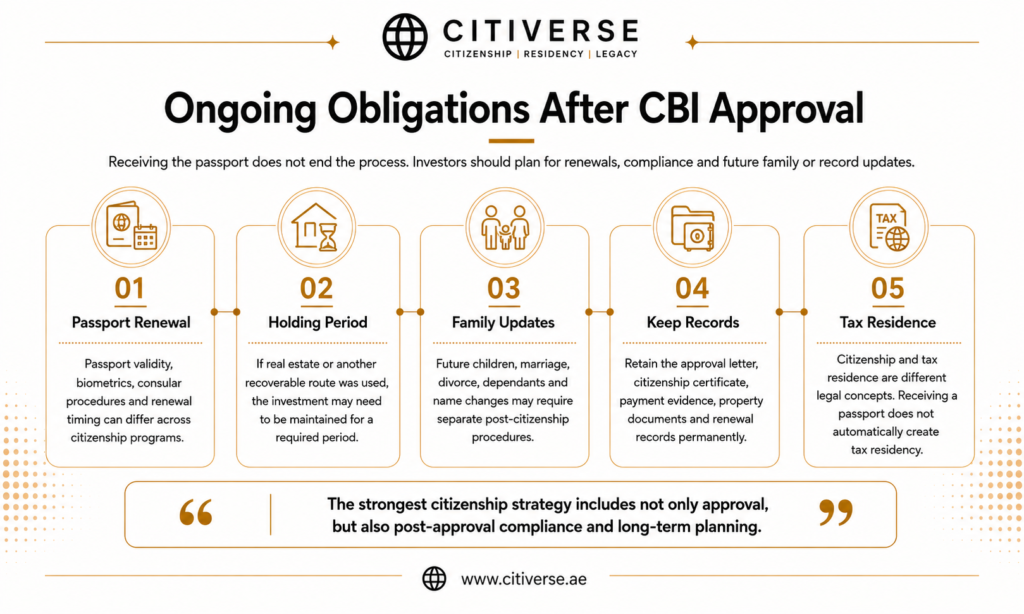
These records may be difficult to reconstruct many years later. Keeping them from the beginning protects the citizen if a passport authority, bank, estate adviser or citizenship unit later asks for historic evidence.
Citiverse provides Citizenship and Residency Program Advisory and Investment Processing Services across the application lifecycle. Post-approval support can include coordinating the qualifying investment, citizenship documentation, passport process, dependant steps and the practical implementation required by the selected jurisdiction.
Where a client plans to sell a qualifying asset, add a family member, change identity details or restructure a wider international position, the relevant program rules should be checked before action is taken. Tax, estate and regulated financial questions should be coordinated with appropriately qualified professionals.
Clients should also understand the circumstances in which an application or later status can face integrity concerns. The related guide Why Citizenship by Investment Applications Get Rejected explains why disclosure quality matters before approval, while the post-citizenship compliance process protects the status after approval.


Ready to Take the Next Step? Let’s Talk About Your Goals!