




A family can make a substantial commitment to a second citizenship and still discover years later that the phrase “for future generations” meant something narrower than expected. The real question is not whether a passport is described as lifelong, but how the nationality law treats children born before and after the investor becomes a citizen, how registration works, and whether the next generation can transmit citizenship again.
Citizenship by investment can create a durable family asset, but the transmission rules are not uniform. In some jurisdictions, a child born after the parent becomes a citizen may acquire citizenship by descent. In others, the child must be added through a post-citizenship application or registered under a separate nationality procedure. The position for grandchildren can be different again.
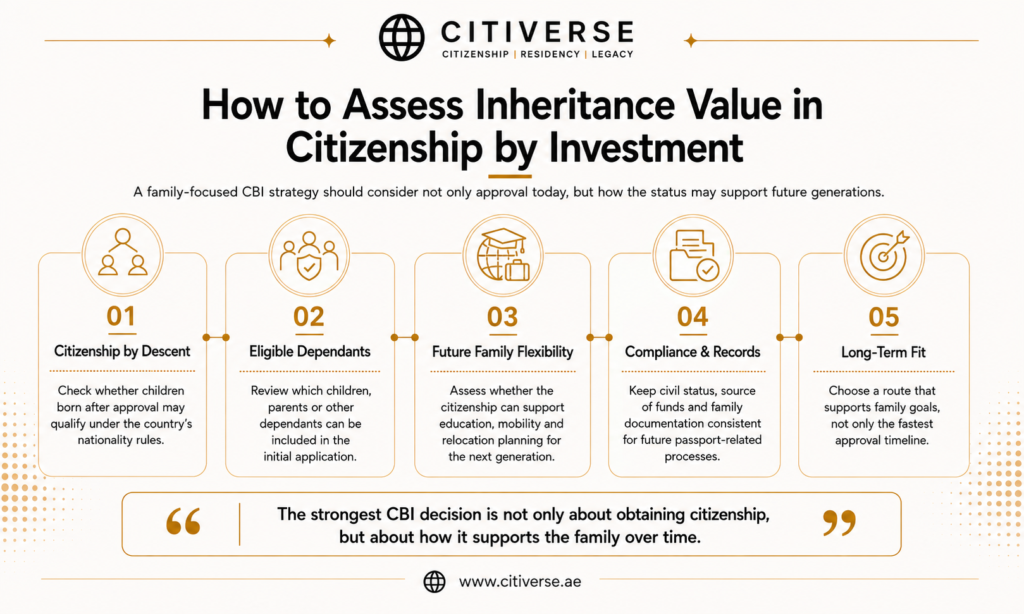
Citiverse therefore treats family continuity as a program-selection criterion in its own right. Applicants comparing Citizenship by Investment programs should assess today’s family eligibility together with future children, future grandchildren, registration obligations and the long-term legal value of the citizenship.
Yes, in some cases – but “inheritance” is an imprecise shorthand. Citizenship is not transferred through a will in the same way as property. The relevant legal mechanisms are usually citizenship by descent, registration, post-citizenship addition or another statutory family route.
A child may therefore receive the parent’s nationality automatically at birth, may become entitled to citizenship after registration, or may need a separate application under the investment-citizenship framework. Whether that child can later transmit the nationality to his or her own children depends on the law of the jurisdiction and, in some countries, on how the parent or grandparent originally acquired citizenship.
For investors planning around children and grandchildren, the strongest approach is to verify the transmission chain before applying. The family should know what happens to existing children, children born later, adopted children and the next generation – and what filings, deadlines or fees may apply at each stage.
The core points below provide the framework for assessing family continuity across the citizenship and residency solutions covered by Citiverse. Each point should be read together with the program-specific rules that follow.
Before comparing countries, it helps to separate four situations that are often grouped under the broad phrase “citizenship for future generations.” The legal outcome can be different in each one.
Family scenario | What it usually means | Why it matters |
Child included in the original application | The child applies together with the principal applicant as an eligible dependant. | Usually the most straightforward route because eligibility is assessed within the same CBI file. |
Child born after citizenship is granted | A future child may acquire citizenship by descent, registration or a post-citizenship addition. | This is the key test for families planning additional children after approval. |
Child born before the parent became a citizen but not included | The child may need a separate sponsored, dependant or nationality application. | Some jurisdictions treat pre-existing children differently from children born after citizenship. |
Grandchild / next generation | The investor’s child later seeks to transmit citizenship to his or her own child. | This determines whether the citizenship can operate as a genuinely multi-generational family status. |
Citizenship by descent usually arises from the nationality law itself. If the statutory conditions are met, the child may be a citizen from birth or may have a defined entitlement to registration because a parent is already a citizen. The practical process can still require a birth registration, citizenship certificate, passport application and evidence of the parent-child relationship.
A post-citizenship addition is different. The child is not treated as automatically falling into the original CBI file; instead, the program creates a later route through which a new child, spouse or another eligible dependant can apply. This can be an effective family-continuity mechanism, but it may involve specific age limits, fees, due diligence and timing rules.
This distinction is particularly important when reviewing marketing claims around “future generations.” Citiverse’s existing guide to second citizenship for families with children explains the current-family eligibility side of the decision; the present guide focuses on what happens after the initial citizenship has been granted.
The table below is a strategic comparison of the citizenship programs currently covered by Citiverse. It is designed to show the family-continuity mechanism, not to replace a case-specific nationality review. The exact result can depend on when a child was born, the parent’s citizenship status at that date, legal parentage, adoption, age, dependency and the law in force when the future application is made.
Program | Future-child mechanism | Planning view |
Vanuatu | Children born after a parent has become a Vanuatu citizen can establish citizenship through the citizen parent. A child born before the parent was naturalized and not included in the parent’s application does not receive the same entitlement through naturalization. | Strong for future children; birth timing should be mapped carefully. |
Grenada | Grenada maintains formal citizenship routes for children of Grenadian parents and separate government processes for grandchildren. Registration and documentary evidence remain important. | Strong multi-generational planning framework, subject to the applicable registration route. |
Antigua and Barbuda | The CIP expressly provides future-family mechanisms, including future spouses and a future child of a dependent child, with program fees and eligibility rules. | Flexible and family-oriented, but continuity is process-based rather than a blanket assumption. |
Saint Kitts and Nevis | The CIU processes post-citizenship additions for newborn children and other eligible children born after the main applicant acquired citizenship. Certain omitted dependants may require a sponsored application instead. | Strong continuity tools with clear post-citizenship procedures. |
Dominica | A main applicant who acquired citizenship through CBI may apply to add a biological or adopted minor child after citizenship, without a time restriction linked to when the main applicant became a citizen. | Good future-child flexibility; wider generational transmission should be reviewed separately. |
Saint Lucia | The CBI legislation allows qualifying applications for a child born or legally adopted after the citizen’s original application. Ordinary citizenship-by-descent rules separately refer to descent from a citizen by birth. | Family continuity is available, but the correct CBI or nationality route must be identified. |
Nauru | Nauru’s general citizenship law provides citizenship by descent for a person born outside Nauru where at least one parent was a citizen at the time of birth; minors and dependants also have application mechanisms. | Strong statutory basis for future children, with current ECRCP documentation to be confirmed. |
Turkey | A child born to a Turkish mother or, subject to the statutory parentage rules, a Turkish father is a Turkish citizen whether born in Turkey or abroad. | Strong and comparatively clear transmission for future children. |
São Tomé and Príncipe | Current program materials present CBI citizenship as permanent and inheritable by direct descendants. The framework is new and the operational registration mechanics should be confirmed for the family’s circumstances. | Promising legacy proposition, with extra value placed on current legal verification. |
El Salvador | Children born abroad to a Salvadoran parent fall within the constitutional nationality framework. 2026 reforms also created a clearer application route for certain minor children born abroad before a parent acquired Salvadoran nationality. | Strong family-continuity potential once the investor’s Salvadoran status and the child’s timing are mapped correctly. |
The comparison becomes more useful when the mechanism behind each program is understood. The sections below focus on the practical question a family should ask: what happens to children who arrive later, and how confidently can the status be planned across generations?
Vanuatu provides one of the clearer timing rules. Current official passport guidance recognises a person born in Vanuatu or abroad after 30 July 1980 as a citizen where at least one parent was a Vanuatu citizen at the time of birth, including a parent who held citizenship by naturalization. This gives families a strong basis for children born after the investor has completed the Vanuatu Citizenship by Investment process.
The timing distinction is important. Vanuatu’s Citizenship Office also states that, for entitlement through naturalization, the child must have been born after the parent became naturalized. A child born earlier who was not included in the parent’s citizenship application does not receive that entitlement through the same route. Families with existing children should therefore structure the initial application carefully rather than assuming they can be added later on identical terms.
Grenada has a particularly relevant structure for multi-generational planning because its government maintains citizenship application processes for children of Grenadian parents and for grandchildren. This makes Grenada Citizenship by Investment worth reviewing where the family’s objective extends beyond the principal applicant and the first generation.
The existence of a descendant route does not remove administration. Birth records, the Grenadian parent or grandparent’s citizenship evidence and other civil-status documents still matter. For a family office or HNWI household, this is a useful reminder that a strong legal transmission position should be paired with disciplined record keeping so the next generation can prove the chain of nationality when required.
The Antigua and Barbuda Citizenship by Investment framework is notable for spelling out future-family categories within the CIP. Current official guidance includes a future spouse of the main applicant, a future spouse of a dependent child in defined circumstances, and a future child of a dependent child, with specific program fees.
That is valuable for families whose structure may evolve after approval, but the mechanism should be understood as an application route with conditions rather than an unrestricted promise that every descendant automatically acquires citizenship. The practical planning question is whether the expected future family member fits the relevant category when the application is made.
The Saint Kitts and Nevis Citizenship by Investment Unit publishes defined post-citizenship addition rules. These cover a newborn child up to age three born after the main applicant acquired citizenship, an eligible dependent child aged three or above born later, and children born while the original application is still being processed.
There is also an important boundary: a dependant who was already eligible but was left out of the original application cannot simply use the same post-citizenship addition route. The family may need a sponsored application instead. This makes family mapping at the outset more than an administrative exercise; it can materially affect the route and cost available later.
Dominica’s official CBI guidance allows a main applicant who obtained citizenship through the program to apply to add a biological or legally adopted minor child after citizenship. Importantly, the current guidance states that there is no time restriction based on when the main applicant obtained citizenship. This gives Dominica Citizenship by Investment a useful future-child mechanism.
The distinction between a post-citizenship addition and wider citizenship by descent still matters. The mechanism is strong for a qualifying minor child of the CBI main applicant, while a family seeking certainty about grandchildren or more remote descendants should review the ordinary nationality law and the next generation’s position separately.
Saint Lucia illustrates why the parent’s legal route to citizenship matters. The Saint Lucia Citizenship by Investment legislation permits a qualifying dependant application for a child born or legally adopted after the citizen’s original application, subject to the program conditions.
At the same time, Saint Lucia’s general citizenship-by-descent legislation states that a person born outside Saint Lucia acquires citizenship at birth where the relevant parent or grandparent is a citizen by birth. A CBI investor acquires citizenship by registration, so families should not treat the general descent provision as interchangeable with the CBI post-citizenship route. The correct mechanism should be identified before relying on a future-child outcome.
Nauru’s general citizenship law provides that a person born outside the Republic is deemed to be a citizen where, at the time of birth, either parent was a citizen. The same framework also provides routes for minors and dependants to apply concurrently with or after a parent receives citizenship. For families considering the newer Nauru Economic and Climate Resilience Citizenship Program, this creates a meaningful statutory foundation for family continuity.
Because the investment-citizenship framework itself is relatively new, families should still confirm the current registration and passport procedure for children of ECRCP citizens at the time a future birth occurs. The strategic point is strong, but the documentary route should be treated as part of post-approval planning rather than left until a passport is urgently needed.
Turkey provides one of the clearest examples of citizenship transmission. Turkish nationality law states that a child born to a Turkish mother, or through a Turkish father subject to the applicable marriage and parentage rules, is a Turkish citizen whether born in Turkey or abroad. The provision does not create a separate child category based on whether the parent obtained Turkish citizenship by birth or later through the Turkey Citizenship by Investment route.
For a family planning future children, this provides a comparatively direct transmission proposition once the investor is a Turkish citizen. Civil registration and proof of parentage still need to be handled correctly, and the family should also consider whether the child’s other nationality permits dual citizenship and whether any military, reporting or other citizenship-related obligations could become relevant later.
The São Tomé and Príncipe Citizenship by Investment program is one of the newest options in the Citiverse portfolio. Current program materials describe the citizenship as permanent and inheritable by direct descendants, making family legacy part of the proposition from the outset.
The program’s recent introduction is precisely why verification matters. There is less operating history around post-approval registrations, passport issuance for future children and edge cases than in long-established nationality systems. Families attracted by the transmission feature should therefore obtain current confirmation of the legal and administrative mechanism for their expected family scenario rather than relying on a broad legacy statement alone.
El Salvador’s Constitution recognises children born abroad to a Salvadoran mother or father as Salvadorans by birth. In March 2026, the country also approved reforms intended to facilitate nationality for minor children born abroad before their parents acquired Salvadoran nationality by naturalization or nationalization. This makes the family-continuity analysis particularly relevant for investors considering El Salvador Citizenship by Investment.
The timing of the child’s birth and the legal form by which the parent became Salvadoran should be mapped before any conclusion is reached. The 2026 reform is useful because it addresses a practical gap for pre-existing minor children, while the constitutional parent-to-child rule supports planning for future children once the parent’s citizenship is fully established.




A lifetime grant describes the duration of the holder’s citizenship. It does not automatically answer what happens to a child or grandchild. Nationality law can impose different tests based on the place of birth, the citizenship status of the parent, the way the parent acquired citizenship, the child’s age, registration deadlines or the number of generations born abroad.
For this reason, families should avoid using passport validity, lack of a citizenship renewal requirement or the permanent nature of the investor’s status as evidence that future descendants automatically qualify. The family-continuity analysis is a separate legal layer and should be reviewed on its own terms.
The date on which the parent becomes a citizen is one of the most important facts in the file. Vanuatu is a clear example: official guidance expressly distinguishes children born after a parent becomes a naturalized citizen from children born before that event who were not included in the parent’s application. Other programs solve the same problem through post-citizenship additions or sponsored applications.
A family expecting another child during the application should also consider the processing timeline. A child born while an application is pending may need to be added before approval, while a child born immediately after citizenship may fall into a different route. The application team should know the expected due date, custody position and required civil documents early enough to avoid reworking the file.
“Child” is not always a single category. Many CBI programs recognize legally adopted children, while stepchildren may qualify only through the spouse or after a formal adoption or dependency test. Adult children commonly face additional requirements around education, financial support, marital status or disability. Those rules affect both the original application and any later attempt to extend citizenship.
Where adoption is being considered, the timing and legal recognition of the adoption are critical. A program may require the adoption to be completed before the citizenship application, while nationality law may set separate rules for an adopted child after the parent becomes a citizen. Family-law documents should therefore be reviewed together with the CBI rules rather than treated as a later administrative issue.
Sometimes, but the answer should never be inferred only from the fact that the investor’s child can receive citizenship. The second generation must first become a citizen through the correct route; the family must then ask whether that person can transmit nationality to a child born later. Grenada’s formal grandchild application framework is a useful example of why the next generation deserves its own analysis.
For long-term legacy planning, the practical question is the continuity chain: investor to child, child to grandchild, and potentially beyond. A jurisdiction with clear parent-to-child nationality rules may offer a stronger long-term proposition than a program that relies on discretionary additions for each new family member, even if both appear similar in a general “family inclusion” comparison.
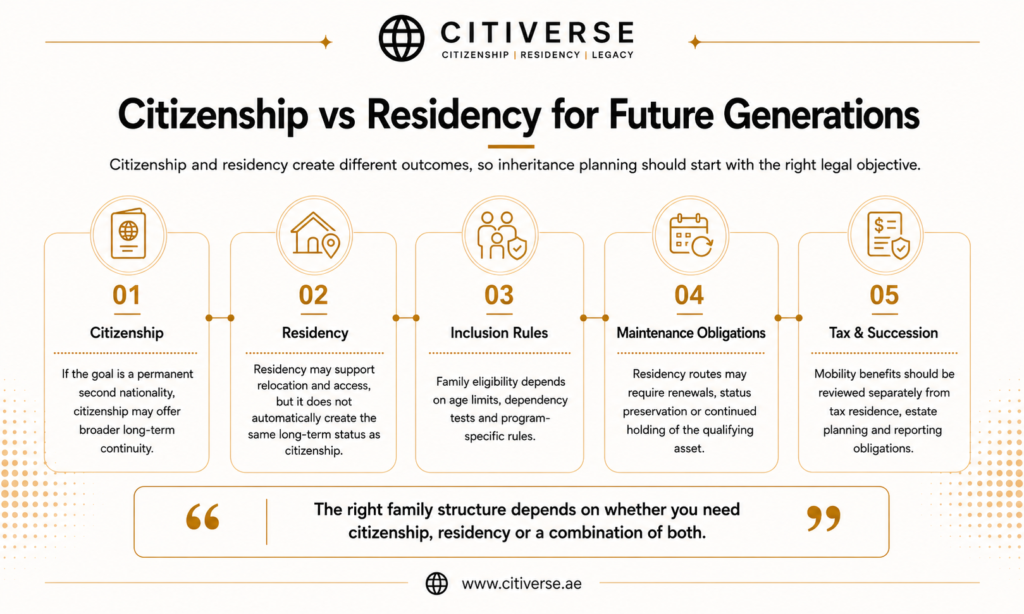
Citiverse also advises on Residency by Investment programs in Cyprus, the UAE and Georgia. These solutions should be separated from citizenship when discussing legacy. A residence permit gives immigration rights under the issuing country’s rules; it does not create a nationality that descendants inherit by bloodline.
Spouses and children may be included, sponsored or granted linked residence status, but their position depends on the individual program. Age limits, dependency, investment maintenance and family relationship can affect whether a child remains eligible. A child who grows beyond the dependant category may need an independent residence basis even though the parent continues to hold status.
Planning question | Citizenship | Residency by investment |
Does the status create nationality? | Yes, once citizenship is granted. | No. It creates residence rights under immigration law. |
Can a child receive status through a parent? | Often, through descent, registration or a CBI family mechanism. | Often, through family inclusion or sponsorship, subject to program rules. |
Can status pass automatically to grandchildren? | Possible in some nationality systems, but rules vary. | Generally no. A residence permit is not inherited by descent. |
Does ageing out matter? | It can affect dependant applications and post-citizenship additions. | Often important because a child may cease to qualify as a dependant. |
Can residence lead to citizenship? | Not applicable once nationality is already held. | Sometimes, but naturalization is a separate process with its own residence and eligibility requirements. |
For Cyprus Permanent Residency by Investment, the strategic value is a long-term residence base in Cyprus for qualifying applicants and eligible family members. It should not be described as a passport or as an inherited EU status. Any future naturalization route is separate and depends on the nationality rules and actual residence requirements applicable to the person concerned.
The UAE Residency by Investment and Golden Visa similarly provides long-term renewable residence rather than citizenship. Family sponsorship can be an important benefit, but the child’s own status should be planned around age and eligibility rather than treated as an inherited passport right. Georgia Residency by Investment follows the same broader principle: residence can support family relocation and long-term positioning, while citizenship remains a separate legal destination.
Applicants deciding between these two categories may also review Residency by Investment vs Citizenship by Investment before choosing a family strategy.
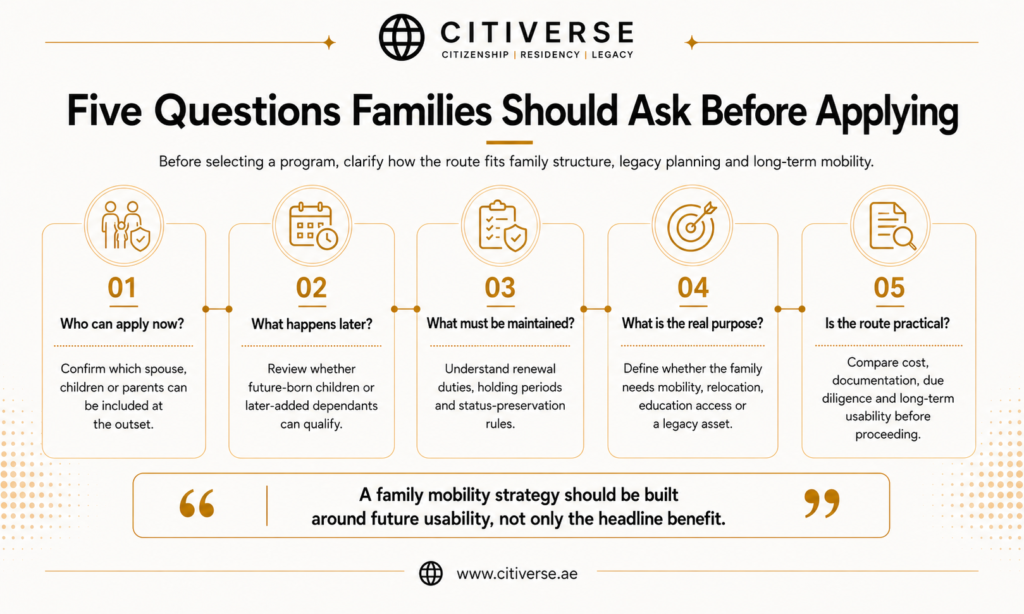
A program comparison becomes more useful when the family is mapped over time rather than only at the date of application. The following questions should be answered before the investment route is selected, particularly where “future generations” is one of the reasons for applying.
Where citizenship was obtained through real estate or another asset-backed route, the citizenship status and the underlying investment should be treated separately. A child may qualify for the nationality without automatically inheriting the qualifying property, and a property may pass under succession law without giving the heir citizenship. Holding periods, approved-project rules and title restrictions can also continue after the citizenship grant.
Families using a property-backed program should therefore coordinate citizenship planning with ownership and succession planning. The objective is to avoid a situation in which the immigration strategy assumes the asset will be retained by one family member while the estate plan directs it somewhere else. The two workstreams should be compatible, even though they are legally distinct.
Most problems arise from broad assumptions made at the beginning rather than from the citizenship certificate itself. A family may receive the expected passport and still have a weak legacy plan if future-child rules were never checked.
There is no single answer for every family. A household expecting future children may value a clear statutory parent-to-child rule. A family with older existing children may place more weight on dependant definitions and the ability to add family members later. A family office thinking across three generations may prioritize a jurisdiction with a clear grandchild or descendant framework and stable civil-registration procedures.
The right comparison should therefore begin with the family structure and the desired outcome, then move to investment cost, mobility, due diligence and processing time. Citiverse’s guide on how to choose the right Citizenship by Investment program provides the wider selection framework, while the present article adds the legacy dimension.
Citiverse provides structured, discreet guidance for investors and families comparing citizenship and residency solutions. Through Citizenship and Residency program advisory, the process can begin with a family map rather than a generic program ranking: who needs status now, who may need it later, and what outcome the family wants the second citizenship or residence to support.
Once a route is selected, Citiverse investment processing services can support document coordination, application sequencing and due diligence preparation through the appropriate authorised channel. Where nationality, succession, tax or family-law questions require jurisdiction-specific advice, the process can be coordinated with appropriately qualified professionals.
For a family-focused investor, the value of a second citizenship is partly measured in what remains useful ten, twenty or thirty years after the initial approval. That makes transmission rules as relevant as the investment threshold, mobility profile and processing time. A clear family-continuity route can reduce uncertainty when children are born later, when the next generation starts its own family or when the original applicant is no longer managing the structure.
The strongest plan begins by defining the family outcome and then selecting the jurisdiction whose nationality rules support it. Where the answer relies on registration or a post-citizenship application, those procedures should be understood and documented from the start so future generations inherit a workable legal position rather than a marketing assumption.


Ready to Take the Next Step? Let’s Talk About Your Goals!