




A good Plan B passport is not simply the passport with the highest visa-free score, the lowest investment threshold or the shortest advertised processing time. It is a second citizenship that creates useful, legally durable options when circumstances change, while fitting the applicant’s existing nationality, family, mobility needs and long-term international plans.
For some applicants, the most valuable feature is speed. For others, it is family continuity, independence from a residence permit, access to specific business destinations or the ability to pass citizenship to future generations. The correct starting point is therefore not “Which passport is best?” but “What should this citizenship allow me to do that I cannot do reliably today?”
Citiverse uses the term “Plan B passport” as practical shorthand, but the legal asset is the citizenship itself. The passport is the travel document issued because of that nationality. Applicants who are still defining the role of second citizenship should first review Passport Diversification in 2026: Why a Second Citizenship Is Becoming a Strategic Plan B and then assess individual programs against the seven factors below.
A Plan B passport is an additional passport held as part of a wider strategy to reduce dependence on one nationality or one set of mobility rules. It may support international travel, family planning, business continuity and future relocation, but its value is determined by what the underlying citizenship actually provides and how reliably that status can be maintained.
The concept should not be confused with emergency travel documentation or a temporary visa. A genuine second citizenship creates a legal relationship with another state, while the passport is one practical consequence of that status. This distinction matters because travel access can change, passports expire and renew, and individual program rules may evolve while the underlying nationality continues subject to the applicable law.
A Plan B cannot be evaluated without knowing the risk or limitation it is meant to reduce. An entrepreneur whose current passport creates visa friction has a different problem from a family that wants a permanent additional nationality, and both have a different objective from an investor who primarily wants a country where the family could physically relocate.
That distinction prevents overbuying and underplanning. A fast, low-cost citizenship can be entirely appropriate when the objective is nationality diversification, while a more established or more expensive route may create greater value when mobility, family continuity or business optionality matters more. If the real objective is a place to live rather than a second nationality, Residency by Investment may be the more direct tool.
For a direct comparison of current Plan B routes, see Best Citizenship by Investment for a Plan B in 2026: Grenada, Vanuatu or São Tomé and Príncipe?. That comparison applies the decision framework to three different program profiles rather than treating “best passport” as a universal ranking.
Before scoring any program, the applicant should confirm whether the new citizenship can legally coexist with the nationality or nationalities already held. A Citizenship by Investment jurisdiction may permit dual or multiple citizenship, while the applicant’s current country may impose loss, renunciation, notification or other consequences when a foreign nationality is acquired voluntarily.
This is a gateway issue because a Plan B should expand optionality rather than unintentionally remove an existing status. Citiverse’s guide to Citizenship by Investment Dual Citizenship Rules explains why both nationality laws must be checked before the citizenship event occurs.
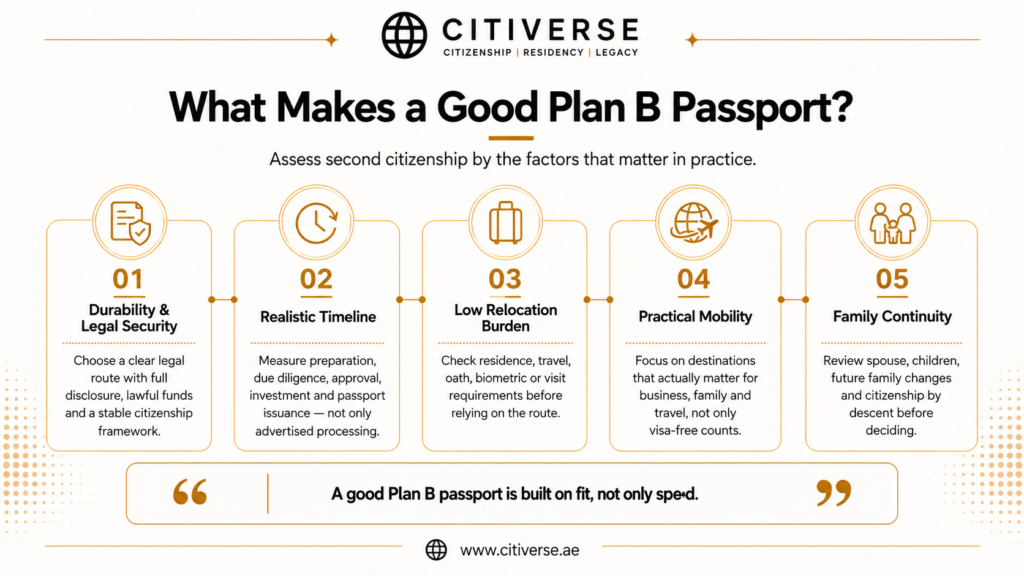
The first test is whether the citizenship is a durable legal status obtained through a clear statutory framework and a properly documented application. A Plan B has little value if the applicant focuses on passport issuance but ignores the integrity of the grant, the legal basis of the program or the conditions that can affect the citizenship later.
For the applicant, durability begins with truthful disclosure, lawful source of funds, payment of the full qualifying amount and compliance with the route actually approved by the government. It also requires understanding the difference between a passport problem and a citizenship problem. A passport can expire or be replaced, while deprivation of citizenship affects the underlying nationality itself.
Applicants should therefore review the program’s post-approval framework as carefully as the application stage. Citiverse’s guide Can Citizenship by Investment Be Revoked? explains why fraud, material non-disclosure, investment non-compliance and other statutory grounds can matter long after a passport has been issued.
Speed can be central to Plan B planning, but advertised processing time is only one part of the timeline. The applicant first needs a submission-ready file, and that can require police certificates, civil records, corporate documents, bank evidence, source-of-funds explanations, translations, certifications and dependant documents before government review even begins.
The more complex the applicant’s profile, the more important this preparation stage becomes. Multiple businesses, several countries of residence, previous visa refusals, litigation, regulatory exposure, a public profile or complex wealth can all create additional questions. A “fast program” does not make a complex file simple, and a realistic Plan B timeline should include time for due diligence responses and post-approval passport issuance.
Citiverse covers this distinction in How Fast Can You Get a Second Passport in 2026?. The practical question is not which program publishes the shortest number, but which route can process the applicant’s actual profile efficiently and lawfully.
A Plan B passport is often most valuable when it can be secured and maintained without forcing the applicant to relocate before they are ready. For investors who want nationality diversification while continuing to live and operate elsewhere, the physical-presence, residence and travel requirements of the program are therefore a core decision factor.
Low-presence citizenship can be particularly useful for internationally mobile entrepreneurs and families who already have a residence base. However, “no relocation required” should not be interpreted as “nothing to monitor.” Some jurisdictions can still impose oaths, biometric requirements, visits, passport procedures or program-specific conditions at particular stages.
Where the real objective is a physical fallback location, citizenship and residence should be separated conceptually. Residency by Investment vs Citizenship by Investment explains why a passport can provide nationality diversification while a residence permit can provide a more practical place to live.
Travel freedom is one of the most visible features of a second passport, but headline visa-free counts can distort the comparison. A passport that adds ten destinations the applicant never visits may create less value than one that solves access to a small number of important business, family or transit markets.
The analysis should therefore start with a destination list. Which countries matter for business? Where do children study? Where do family members live? Which airports and transit hubs are used regularly? Does the new passport reduce a recurring visa burden, or does it largely duplicate the access already provided by the applicant’s existing nationality?
Visa policy is also external to the citizenship itself and can change over time. For that reason, Citiverse recommends assessing mobility as a practical, evolving benefit rather than a permanent contractual guarantee. See Second Citizenship for Travel Freedom for a destination-based mobility framework.
A Plan B that works for the principal applicant but not for the family may fail at the moment it is actually needed. Eligibility should be mapped person by person, including the spouse, minor children, adult children, parents and any other dependants the family expects to include under the relevant program rules.
The assessment should also look beyond the first application. Future children, later marriage, divorce, changes in dependency and citizenship by descent can all affect long-term value. A family that wants citizenship to support more than one generation should understand how nationality can be transmitted and what administrative steps may be required after the original application is complete.
Citiverse’s guides to Second Citizenship for Families with Children and Citizenship by Investment for Future Generations explain why family continuity should be assessed before choosing the program, not only after citizenship has been granted.
Headline price is useful for screening options, but it is not the total cost of a Plan B. A complete comparison should include government application charges, due diligence, dependant fees, passport costs, legal and professional fees, document preparation, transaction costs and any investment-related expenses.
The type of capital commitment also matters. A non-refundable contribution is economically different from approved real estate or another recoverable investment route. An asset-based route can preserve capital value, but it may introduce holding periods, resale restrictions, project risk, transaction costs and ongoing ownership considerations that do not exist in the same form under a contribution route.
The correct question is therefore not simply “Which program is cheapest?” It is “What is the total financial commitment, what portion is recoverable, what risks attach to the capital, and does that cost produce enough strategic value for this applicant?” A lower-cost citizenship can be excellent value when it solves the problem, but poor value when it does not.
The final test is whether the citizenship will remain practical after the first passport arrives. A strong Plan B should be easy to understand and maintain through passport renewals, family changes, identity updates and any continuing investment or documentation obligations required by the selected jurisdiction.
Applicants should keep the citizenship certificate, approval correspondence, investment evidence, payment receipts and the original due diligence file securely. Years later, those records may be relevant to passport renewal, addition of a family member, disposal of a qualifying asset, banking KYC or a government compliance review.
Citiverse’s guide to What Happens After Citizenship by Investment Approval? covers the practical lifecycle from investment completion and citizenship documentation to passport issuance, renewal and ongoing obligations.




The seven factors can be used as a structured scorecard before comparing individual programs. The purpose is not to create a universal numerical ranking, but to identify which criteria are essential for the applicant and which trade-offs are acceptable.
Factor | What a strong Plan B should demonstrate | Question to ask |
1. Durability | Clear legal status, proper due diligence and understandable post-approval rules | Would I still trust this citizenship as a long-term legal status, not just a travel document? |
2. Realistic speed | A timeline that includes preparation, review, investment, citizenship documents and first passport | How long until the passport is realistically in hand for my profile? |
3. Independence from relocation | Manageable presence, visit, oath and biometric requirements | Can I secure and maintain the citizenship without changing where my family lives today? |
4. Practical mobility | Meaningful access to destinations that matter to the applicant | Which recurring travel problem does this passport actually solve? |
5. Family continuity | Suitable dependant rules and workable future-generation provisions | Does the strategy still work if my family structure changes? |
6. Total cost | Transparent total budget and a capital structure that matches the applicant’s preferences | What is the full cost and what capital, if any, remains tied up after approval? |
7. Long-term usability | Clear renewal, documentation, holding and update procedures | What will I need to do five or ten years after the first passport is issued? |
Due diligence affects every one of the seven factors. It affects timing because complex profiles require more review. It affects durability because a citizenship obtained on incomplete or misleading information can create serious later risk. It affects family planning because each adult dependant may have a separate compliance profile, and it affects program choice because one jurisdiction may be better suited to a particular background than another.
Applicants should therefore test eligibility and disclosure readiness before committing capital. Previous visa refusals, criminal or regulatory matters, sanctions exposure, litigation, former names, complex corporate structures and adverse media should be identified early rather than discovered during government review. Citiverse’s guide Why Citizenship by Investment Applications Get Rejected explains the most common integrity and documentation issues that can affect an application.
The value of the seven-factor framework becomes clearer when it is applied to programs with different strengths. Grenada, Vanuatu and São Tomé and Príncipe are useful examples because none is “best” on every factor, and each can be compelling for a different type of applicant.
Program profile | Where it may fit a Plan B | Main trade-off to examine |
Applicants who value an established Caribbean framework, family planning, broader mobility and strategic optionality, including separate US E-2 treaty-country eligibility subject to US requirements. | Higher entry cost and a longer process than the fastest direct alternatives. | |
Applicants for whom speed and a direct second-citizenship outcome are the dominant priorities, especially when the existing passport already covers many core destinations. | Mobility value should be assessed destination by destination, and current program administration must be checked carefully. | |
Applicants attracted by a lower entry point and nationality diversification through a newer direct CBI route. | A shorter operating track record and more limited mobility profile require a deliberate long-term assessment. |
For the detailed comparison, including speed, entry level, mobility, family fit and strategic positioning, see Best Citizenship by Investment for a Plan B in 2026. The important point is that the “winner” changes when the applicant changes the objective.
A Plan B is intended to reduce uncertainty, so the selection process should not introduce avoidable legal or compliance risk. Marketing claims that sound strongest at first glance often deserve the most scrutiny, particularly where they minimise due diligence, promise guaranteed timelines or blur the distinction between citizenship and a passport document.
A useful comparison should hold the applicant constant and change only the program. Start with the same family members, the same target destinations, the same budget, the same deadline and the same due diligence profile. Otherwise, headline tables can make one route look stronger simply because different assumptions have been used.
The comparison should also separate legal status from benefits that can change independently. Citizenship may be durable while visa-free access changes. A real estate route may remain legally qualifying while the underlying investment performs poorly. A fast approval may still be a weak choice if the applicant cannot keep the existing nationality or if the family cannot be included on workable terms.
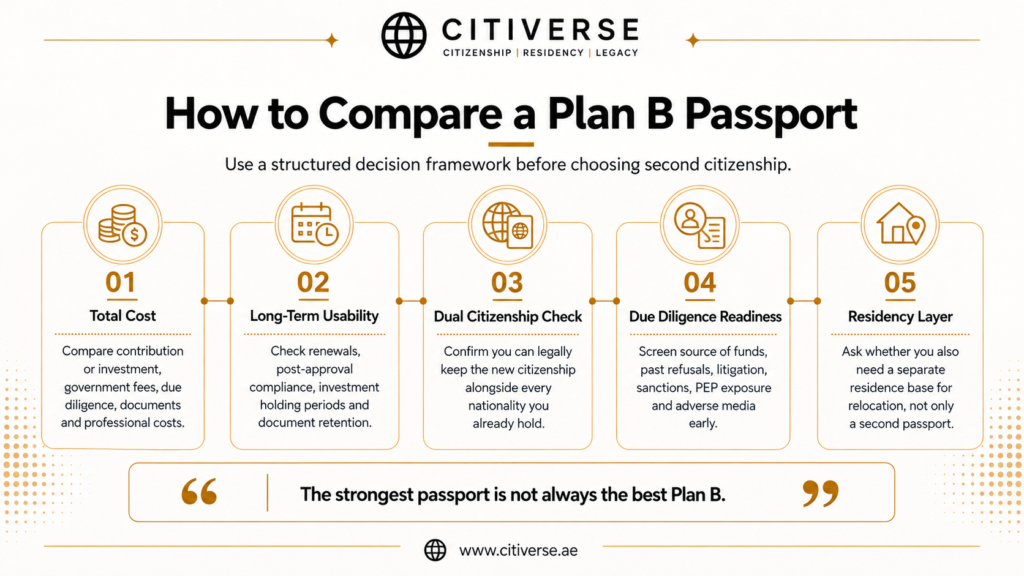
Second citizenship and second residence solve different problems. Citizenship can provide an additional nationality and passport, while residency provides a legal right to live in a particular jurisdiction under defined conditions. A family that wants both nationality diversification and a practical relocation base may therefore need two complementary layers rather than one product expected to do everything.
This is why Citiverse approaches Plan B planning as a wider global mobility exercise. A client may choose a direct Citizenship by Investment route for nationality diversification while using a separate residency route for lifestyle, education, business or tax-residency planning. The broader framework is covered in How to Build a Plan B in Uncertain Times.
Citiverse provides Citizenship and Residency Program Advisory for investors and families comparing second-citizenship routes. The process begins with the applicant rather than the program: existing nationality, family structure, residence position, mobility needs, timeframe, source of funds, investment preference, due diligence profile and long-term objectives.
Programs are then compared against the role they are expected to play. A fast citizenship may be appropriate when speed is genuinely the priority. A more established or higher-cost route may be stronger where family continuity, mobility or strategic business optionality matters more. Where citizenship is not the right tool, a residence-led solution can be assessed instead.
Once a route is selected, Investment Processing Services can support the application sequence and implementation through the appropriate authorised channel. The objective is not to accumulate passports, but to build a lawful, coherent structure that remains useful after approval.


Ready to Take the Next Step? Let’s Talk About Your Goals!