



Is Citizenship by Investment Only for Millionaires? A second passport is often portrayed as something reserved for the ultra-wealthy: private jets, family offices and multimillion-dollar portfolios. That picture is incomplete. In 2026, some established citizenship by investment (CBI) routes have published entry contributions well below US$250,000, while a newer program starts at US$90,000 before fees.
The short answer: no, you do not need to be a millionaire to consider citizenship by investment. You do need sufficient available capital, a lawful and documentable source of funds, a realistic understanding of the full cost and a clear reason for pursuing citizenship. Being able to meet a program’s minimum contribution is not the same as being able to afford the entire decision.
For a salaried professional, an entrepreneur or a family planning ahead, that distinction matters more than an impressive-looking passport photograph.
Government-published entry amounts offer a useful starting point. They do not tell you the full price of citizenship, and programs differ in their investment structure, family pricing, eligibility and ongoing conditions.
Program | Published qualifying minimum | Important budgeting point |
São Tomé & Príncipe | US$90,000 (single applicant) | Non-refundable contribution; additional processing and application fees; newer program framework. |
Vanuatu | US$130,000 (single applicant) | Published FIU due diligence fee of US$5,000, plus other potential charges. |
Dominica | US$200,000 (single applicant) | EDF contribution; processing, due diligence and other statutory fees extra. |
Antigua & Barbuda | US$230,000 (NDF) | Contribution can cover up to four applicants at the same base level; processing and due diligence extra. |
Grenada | US$235,000 (NTF) | Contribution level applies to an individual or family of up to four; additional fees apply. |
Saint Lucia | US$240,000 (NEF) | Contribution applies to main applicant with up to three qualifying dependants; other fees extra. |
Saint Kitts & Nevis | US$250,000 (SISC) | Base contribution for up to four; due diligence and other fees extra. |
Important: These are indicative published qualifying amounts, not personalised quotations or guaranteed total costs. Programs, fees and conditions can change. Some applicants may face enhanced due diligence or nationality-specific restrictions. The comparison is not a recommendation that every route suits every investor.
For the underlying program requirements, review the CITIVERSE pages for São Tomé & Príncipe, Vanuatu, Grenada and our broader Citizenship by Investment program overview.
A complete financial assessment should separate three amounts:
For example, Vanuatu’s published single-applicant schedule includes a US$130,000 qualifying amount and US$5,000 FIU diligence fee—a US$135,000 subtotal before any additional applicable expenses. That does not make US$135,000 a universal all-in price.
At the family end of the market, Antigua & Barbuda’s published NDF contribution is US$230,000 for an individual or a family of up to four, but its official schedule also lists US$20,000 processing fees for a family of up to four, plus separate due diligence and passport-related fees. A family should not budget US$230,000 as if that were the final invoice.
The following scenarios are illustrative profiles, not financial recommendations or eligibility assessments. They demonstrate that the relevant question is available capital and priorities, not a “millionaire” label.
Consider a senior professional who has worked internationally for 15–20 years, owns a home and has built substantial savings through salary, bonuses or investments. They may not have a seven-figure net worth. Yet they could potentially consider an entry-level CBI contribution if the funds are genuinely surplus to their housing needs, emergency reserve and retirement plan.
For this applicant, the practical issues are usually documenting the source of funds, understanding whether the passport would materially improve mobility and deciding whether a non-refundable contribution is justified by the expected benefit. Employment contracts, payslips, tax returns and banking history can help establish the financial trail, subject to the program’s requirements.
A professional who would need to drain nearly all accessible savings to afford the application may be financially eligible on paper but poorly positioned to proceed.
A business owner may have an established company, retained profits, proceeds from a partial exit or lawful dividends—but may not identify as wealthy. Their interest in citizenship can be practical: reducing dependence on a single nationality, planning international business travel or preparing options for family members.
The difficulty is that company turnover is not personal disposable wealth. Funds used for a CBI application must be lawfully available to the applicant and supported by an understandable financial history. A business owner should distinguish between company assets, distributable profits and personal savings.
Some entrepreneurs will find that a second nationality serves a specific purpose. Others may be better served first by a residence permit, business expansion or a more targeted immigration strategy. The right answer starts with the use case, not the headline investment amount.
For a family with two children, CBI may be part of a long-term plan involving international mobility, education choices and an alternative place of belonging. Family contribution bands in certain programs can make the per-person qualifying amount less intimidating than the price of four separate applications.
But the calculations still need care. Children’s ages, dependency, citizenship rules, government fees and later passport renewals can all affect the outcome. An adult child may not qualify under the same terms as a minor. Families should also ask what citizenship really changes for schooling or relocation: a second passport does not automatically secure admission, subsidised tuition or residence rights in unrelated countries.
Our separate guide on second citizenship for families with children explores those questions in more detail.
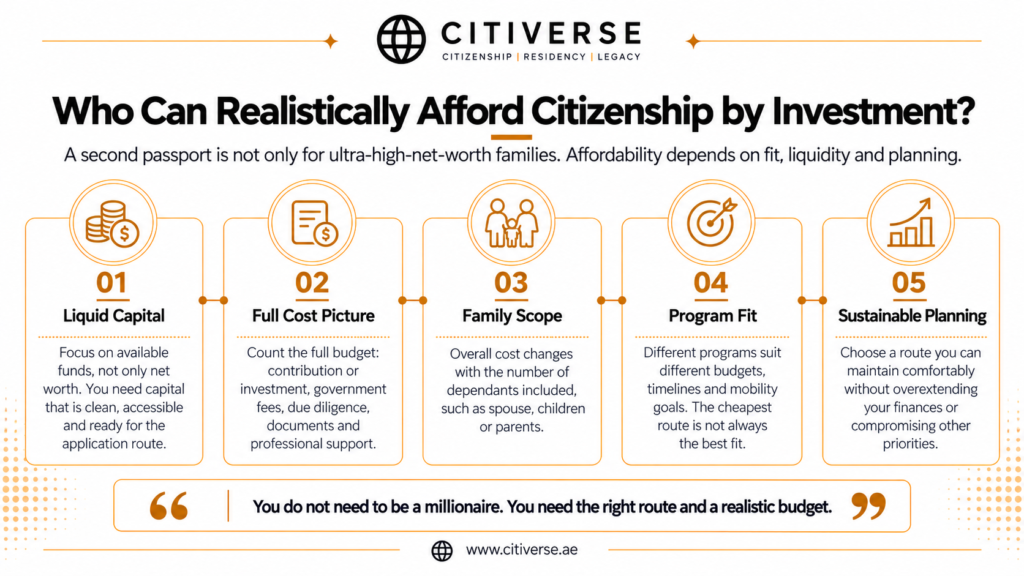
Before comparing programs, use these four questions to pressure-test your decision.
Build the budget around the expected all-in outlay, with room for variable costs. Keep emergency savings, debt commitments, children’s needs and near-term living expenses outside the CBI budget. A non-refundable contribution should be treated as money you are prepared to spend, not recover.
Legal earnings, dividends, asset disposals, inheritance or other legitimate funds can be viable sources when properly documented. CBI processes generally involve checks on identity, background, source of funds and, in many cases, wider source of wealth. Large unexplained transfers, inconsistent records and unsupported third-party payments can create serious obstacles.
Perhaps your existing passport already meets your travel needs, while your real goal is the right to live and work in another country. That is a residence or immigration question, not necessarily a second-citizenship question. Alternatively, your priority may be nationality diversification and long-term family continuity, where citizenship could be relevant.
Citizenship and residency are different planning tools. See Second Passport or Second Residency for a Plan B? for a practical comparison.
Countries can revise their immigration laws, screening procedures, residence requirements and passport mobility arrangements. Government approval is never automatic, and the applicant’s existing nationality may affect eligibility or dual-citizenship treatment. You need a plan that remains reasonable even if a timeline changes or an application is delayed.





Citizenship can provide a second nationality and the associated rights under the issuing country’s law. It may also create additional international travel options and help with family continuity. The exact value depends heavily on the passport you already hold and the routes you genuinely need.
It does not automatically provide:
A highly relevant example is Vanuatu: its citizenship offering remains an option for eligible applicants, but previous visa-waiver access to the EU/Schengen area has been withdrawn. A lower entry price should never be interpreted as equivalent mobility to another program.
If your principal objective is obtaining a practical long-term residence base, it may be worth comparing residency by investment before proceeding with CBI.
Contribution routes are typically easier to price: the required payment is usually non-refundable, and the main additional items are government and application expenses. For a client who values a straightforward structure and can absorb the cost, the calculation is clear.
Real estate routes may appeal to applicants who prefer to hold an asset, but they should not be presented as “free citizenship with a property purchase.” Approved projects, minimum holding periods, transaction expenses, maintenance charges, resale conditions and commercial performance all matter. A property that technically qualifies for CBI is not automatically a sound investment.
The best structure depends on your liquidity, appetite for investment risk and personal objectives. Comparing just the minimum contribution against the minimum property purchase price can produce the wrong conclusion.
An affordable application is not necessarily a worthwhile application. It may be sensible to postpone or avoid CBI if:
For many applicants, the strongest Plan B is not the most expensive one—or the cheapest one. It is the option that produces a useful legal outcome without weakening financial resilience.
A sensible initial comparison should cover six points:
You can also explore our guide to choosing a Plan B citizenship program for the strategic differences between selected jurisdictions. That guide considers program fit rather than affordability alone.
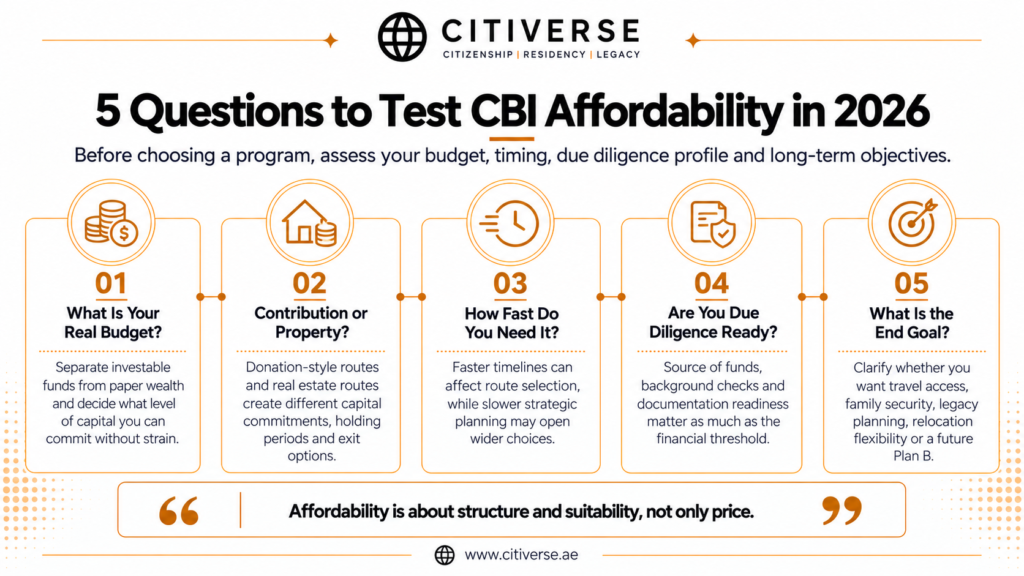
For the right applicant, citizenship by investment is no longer exclusively a multimillionaire’s consideration. But even the lowest advertised contribution represents a significant financial commitment. The objective should be to make that commitment deliberately, with a transparent budget and a specific result in mind.
At CITIVERSE, we help individuals, entrepreneurs and families assess citizenship and residency options against their budget, nationality, source of funds, family requirements and long-term plans. Our approach is structured, discreet and focused on understanding the practical implications before an application begins.
Rather than starting with a price list, we start with a better question: What do you need your second citizenship to accomplish?
Find Out If You Qualify for a Second Citizenship. Contact CITIVERSE for a confidential assessment and request a realistic program shortlist and itemised budget for your circumstances.


Ready to Take the Next Step? Let’s Talk About Your Goals!