




A Plan B passport is most valuable when it is already in place before circumstances make it necessary. Second citizenship is not an emergency travel product and it cannot be switched on instantly when a residence status changes, a relocation becomes urgent or access to a destination becomes more difficult. The strongest planning usually happens earlier, while the applicant still has time to compare programs, prepare a coherent file and choose a route for long-term fit rather than immediate pressure.
That does not mean investors should apply for citizenship simply because the world feels uncertain. A Plan B should solve a defined problem and be proportionate to the applicant’s actual mobility, family, business and long-term objectives. The timing question is therefore not “How early can I buy a second passport?” It is “At what point does waiting begin to reduce my options?”
Citiverse treats timing as one part of a wider global mobility strategy. Our guide to What Makes a Good Plan B Passport? explains how durability, realistic timing, mobility, family coverage, cost and post-approval usability should be considered together. This article focuses on the next question: when should that planning begin?
The most useful time to obtain a Plan B passport is before the applicant faces a hard need for it. That usually means beginning the assessment while current travel, residence, business and family arrangements are still functioning normally and there is enough time to choose the right jurisdiction rather than the fastest available route.
For some people, this point arrives when they can see a future relocation, residence expiry, business expansion or family move on the horizon. For others, it is when they recognise that too much of their mobility depends on one passport or one residence status. The trigger is not necessarily a crisis. It is the moment when the strategic value of having another nationality becomes clear and the applicant still has room to plan properly.
Applicants working against a known deadline should review How Fast Can You Get a Second Passport in 2026?. Published processing ranges are only part of the timeline. Preparation, due diligence, investment completion, citizenship documentation and first-passport issuance all need to be included.
A failsafe has value because it exists before the primary option stops working. The same logic applies to second citizenship. If an applicant waits until a specific passport, visa, residence permit or business arrangement has already become a problem, the second-citizenship process may itself be subject to the same time pressure that the Plan B was intended to remove.
Early planning changes the quality of the decision. Instead of asking which program can issue a passport fastest, the applicant can ask which citizenship adds the most useful mobility, whether the family can be included, whether the current nationality can be retained, what post-approval obligations exist and whether a separate residence base is also required. Those questions are much easier to answer well when there is no immediate deadline.
It also gives advisers time to identify issues before capital is committed. A complex company structure, historic residence in several countries, previous visa refusals, litigation, political exposure or an unusual source-of-funds profile does not automatically prevent an application. It may, however, require more documentation and a more careful choice of program. Time allows those issues to be assessed rather than discovered late in the process.
The phrase “backup passport” can make second citizenship sound like an emergency document that can be obtained after a problem arises. That is not how legitimate Citizenship by Investment works. The legal outcome is citizenship following a formal government process. The passport is issued because the applicant becomes a citizen; it is not a stand-alone product purchased for immediate travel.
Applicants should therefore distinguish between a short-term travel problem and a long-term nationality strategy. If a person has an immediate immigration, evacuation or consular issue, a Citizenship by Investment application may not solve that immediate problem. The appropriate response may involve immigration counsel, consular assistance, a residence application or another legal route. Second citizenship is better understood as a long-term layer of optionality that can reduce dependence on one status in the future.
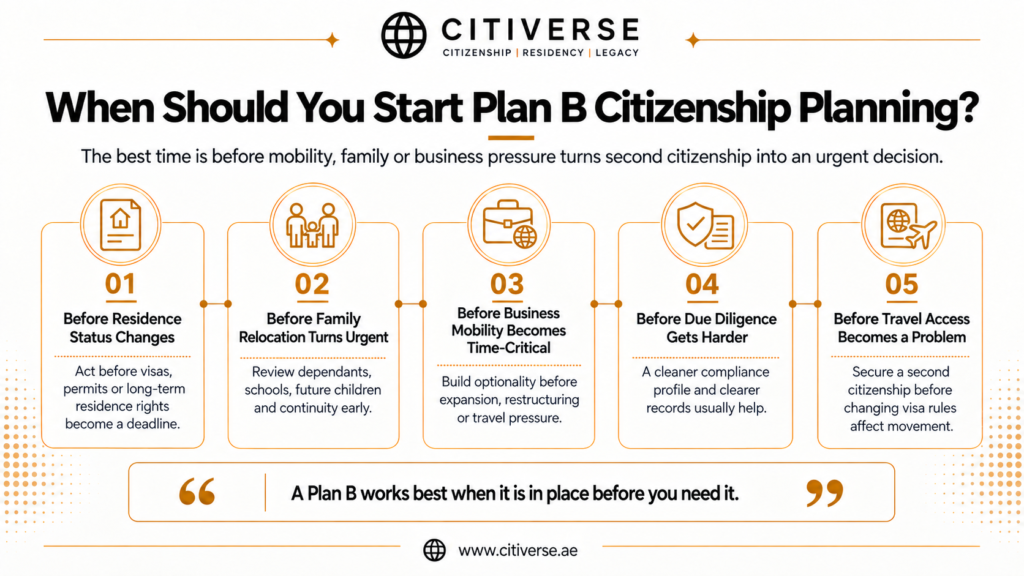
There is no universal trigger date. The right moment depends on what the applicant is trying to protect or improve. The following situations are useful planning signals because they create foreseeable future needs without necessarily creating an immediate crisis.
|
Planning signal |
Why it matters |
Practical response |
|
1. A residence status may change |
A current visa, residence permit or immigration route may expire, become less suitable or depend on employment, property or another condition. |
Review citizenship and residence alternatives while the existing status still works. |
|
2. A family relocation is becoming realistic |
Schooling, lifestyle, healthcare, ageing parents or family location may create a future move. |
Map which family members need citizenship, residence or both before the relocation date drives the decision. |
|
3. Business mobility is becoming more important |
International expansion can increase travel, banking, client and management demands across jurisdictions. |
Assess whether a second citizenship adds practical access rather than merely duplicating the current passport. |
|
4. Travel access is a recurring constraint |
Repeated visa applications or destination-specific restrictions may create a measurable burden. |
Compare passport utility against the destinations that actually matter to the applicant. |
|
5. Family eligibility may change with time |
Children may age out of dependant categories, dependency may change or family composition may evolve. |
Check current and future family eligibility before timing removes an available route. |
|
6. The applicant’s compliance profile is becoming more complex |
Business growth, new jurisdictions, public roles or regulatory exposure can increase documentation and due diligence requirements. |
Pre-screen the profile early and maintain complete records; never use timing as a reason to omit material facts. |
|
7. The applicant wants to reduce reliance on one jurisdiction |
One passport, one residence base or one immigration status may feel too concentrated for long-term family planning. |
Define what diversification should achieve and compare second citizenship with second residency. |
A residence permit often looks secure while the underlying conditions remain unchanged. But employment can end, property can be sold, family circumstances can change, a host country can amend a route or the holder may simply decide that the residence no longer fits their long-term plan. If the applicant already knows that the current status is temporary or conditional, waiting until renewal or expiry can turn a strategic decision into a time-sensitive one.
Second citizenship does not replace the right to reside in every country, so the correct solution may still include a separate residence strategy. The value of planning early is that the applicant can decide deliberately whether they need nationality diversification, a physical relocation base or both.
For the legal distinction, see Residency by Investment vs Citizenship by Investment: What’s the Difference?. A residence permit and a second passport solve different problems, and a strong Plan B may use them as separate layers.
Families often know about a potential move long before the exact date is fixed. A child may be approaching a new education stage, parents may want to live closer to adult children, or a business owner may expect to shift the family base after a transaction or expansion. This planning window is valuable because a second citizenship can be assessed alongside schooling, residence rights, property, family eligibility and succession rather than as a last-minute travel solution.
Family timing matters because dependant rules are not static for the individual. A child who qualifies today may not qualify in the same way after reaching a program age threshold, marrying or becoming financially independent. A spouse or parent may also have a different nationality position from the principal applicant. Starting earlier allows each family member to be mapped separately.
Citiverse covers these issues in Second Citizenship for Families with Children, including child age, dependency, custody, future children and the difference between an individual application and a genuine family strategy.
Entrepreneurs and internationally active professionals can reach a point where mobility is no longer a lifestyle preference but an operating requirement. New markets, client travel, investor meetings, corporate banking and management responsibilities may all depend on predictable cross-border access. If a recurring visa problem is already affecting business, a second passport may be worth assessing before a major expansion creates a fixed deadline.
The objective should still be practical. A second passport has little strategic value if it does not improve access to the markets the applicant actually uses. The right comparison should start with destinations, business needs and family travel patterns, not a general passport ranking.
Visa-free arrangements, electronic travel authorisations and entry policies are controlled by destination countries and can change independently of the passport holder. This is one reason mobility should be treated as an evolving benefit rather than a permanent guarantee. A Plan B built entirely around one current visa waiver can become fragile if that benefit changes.
Early planning allows the applicant to focus on diversification rather than reaction. If the existing passport already covers the most important destinations, the second citizenship may need to add something different: a family legacy, an alternative nationality, a different regional profile or a route that complements an existing residence strategy.
Citizenship applications are assessed against the applicant’s identity, financial background, source of funds, business history, immigration history, legal record and other due diligence factors. An internationally active person can become more complex over time simply because they acquire more companies, more residences, more counterparties and more public or regulated exposure.
That does not mean an applicant should rush to apply before information exists or try to avoid future disclosure. The opposite is true: all material facts must be disclosed accurately whenever an application is made. The planning advantage is that a person with a straightforward, well-documented profile has more time to gather evidence and address questions before a fixed deadline is attached to the outcome.
The compliance point is explained in more detail in Why Citizenship by Investment Applications Get Rejected. A strong application starts with profile assessment and document quality, not with the investment payment.
Source-of-funds and source-of-wealth evidence is often easier to prepare when records are current and the transaction history is clear. Years later, older corporate accounts, contracts, sale documents, banking records or evidence of an original capital event may be harder to retrieve. This is particularly relevant for entrepreneurs whose wealth has been built through several businesses, exits, property transactions or investment structures.
The practical lesson is not to create a citizenship application solely because documents are available today. It is to maintain organised records as part of broader international planning. If second citizenship is already a realistic objective, early preparation can reduce the risk that the applicant has to reconstruct an important financial history under time pressure.
A Plan B is often intended to protect flexibility for more than one generation. That requires looking beyond the current application group. Children can age, dependency can end, new children can be born, marriages can take place and succession planning can change. A route that is suitable for the family today may be less efficient later if the rules for dependants no longer fit the family structure.
Early planning makes it possible to consider citizenship transmission, future family additions, passport renewal and the treatment of later life events before the original application is filed. The question is not only whether the family can obtain citizenship now, but whether the status remains useful as the family changes.




Urgency changes the decision environment. The legal requirements do not disappear, but the applicant has less room to respond to them. A tight deadline can also encourage the wrong question: “Which program is fastest?” instead of “Which route can be completed properly and still solve the long-term problem?”
|
Area |
When there is time |
When the need is urgent |
|
Program choice |
A wider set of jurisdictions can be assessed for fit. |
The applicant may focus only on the routes that appear fast enough. |
|
Documentation |
Police certificates, civil records, corporate documents and financial evidence can be gathered methodically. |
Missing or inconsistent documents can become the critical path. |
|
Due diligence |
Potential issues can be reviewed before submission and explained properly. |
Requests for additional information can disrupt an already tight timetable. |
|
Family planning |
Each dependant can be assessed and future family needs considered. |
Age thresholds, dependency changes or custody issues may reduce options. |
|
Investment decision |
Contribution, real estate and other routes can be compared on total value and risk. |
The applicant may accept a poor investment structure simply because it is available quickly. |
|
Post-approval planning |
Renewal, holding periods, records and family changes can be understood in advance. |
The focus may end at passport issuance, leaving ongoing obligations underplanned. |
There is no responsible universal answer such as “apply six months before you need the passport.” Citizenship timelines differ by jurisdiction and applicant, and the preparation stage can be as important as government processing. The more useful approach is to work backwards from the event that could create reliance on the Plan B.
|
Planning position |
What it means |
Approach |
|
No immediate deadline |
Ideal planning environment |
Define the objective, compare citizenship and residency, pre-screen eligibility and decide whether a second status adds enough value to justify action. |
|
A foreseeable change is developing |
Active planning stage |
Map the family, gather core documents, review dual-citizenship compatibility and compare realistic end-to-end timelines. |
|
A fixed future date now matters |
Time-sensitive assessment |
Prioritise routes that fit the actual deadline without lowering due diligence or documentation standards. |
|
The disruption has already happened |
Emergency environment |
Do not assume CBI will solve the immediate problem. Obtain the relevant immigration, consular or legal advice and assess citizenship separately as a longer-term measure. |
If speed has become a material constraint, compare the published timeline with the applicant’s real preparation needs. How Fast Can You Get a Second Passport in 2026? explains why passport-in-hand timing should be measured from application readiness, not only from government submission.
An applicant can be suitable for a program today and less suitable later, or the reverse. Family composition changes. Business structures evolve. Nationality rules change. Governments amend investment thresholds, dependant definitions, interview requirements, due diligence procedures and passport processes. A Plan B strategy should therefore be treated as something that is reviewed periodically rather than assumed to remain available indefinitely.
This is also why an old quote, brochure or online comparison should not be treated as a permanent entitlement. The relevant rules are the rules in force when the application is prepared and assessed. Early planning provides optionality, but it does not freeze program conditions. Before filing, the current framework must always be checked again.
No. Uncertainty alone is not a sufficient reason to acquire a second citizenship. A Plan B should have a defined purpose and a measurable benefit. If the applicant already has strong mobility, a secure long-term residence base, adequate family options and no realistic use for another nationality, a second citizenship may add complexity without enough value.
Citiverse does not treat fear as a decision criterion. Geopolitical change, travel restrictions and regulatory shifts are valid planning considerations, but they should lead to structured analysis rather than urgency for its own sake. The correct question is what specific exposure the applicant wants to reduce and whether citizenship is the appropriate tool.
For the broader strategic context, see Passport Diversification in 2026: Why a Second Citizenship Is Becoming a Strategic Plan B and How to Build a Plan B in Uncertain Times. Both place second citizenship within a wider mobility and resilience strategy rather than presenting it as a universal requirement.
Early planning does not always mean immediate application. Sometimes the correct result of an assessment is to wait. The difference is that waiting becomes an informed choice rather than an absence of preparation.
A good Plan B process can therefore end with three different conclusions: apply now, prepare now and apply later, or choose a different tool. The objective is not to maximise the number of passports. It is to create the right level of lawful international optionality.
Timing becomes easier to understand once the applicant separates nationality from location. A second citizenship can diversify nationality and passport dependence. A second residence can provide a practical legal base in a country where the family could live. These benefits overlap only partly.
An applicant may therefore secure a citizenship before it is needed while also maintaining or obtaining a residence route in a different jurisdiction. For example, the citizenship may provide long-term nationality diversification while the residence provides the practical home, business or education base. In other cases, residence alone may be sufficient and a second citizenship may not be necessary.
This distinction will become the next stage of the Plan B decision framework: not simply which passport to obtain, but whether the failsafe requires citizenship, residency or both. The correct structure should be built around the client’s actual fallback scenario.
For a decision framework across programs, see Best Citizenship by Investment for a Plan B in 2026: Grenada, Vanuatu or São Tomé and Príncipe?. The comparison shows why speed, cost and mobility can produce different answers for different applicant profiles.
A Plan B is not complete when the first passport is delivered. The value of the citizenship depends on whether the holder can understand and maintain the status over time. Passport renewals, biometric changes, investment holding periods, family additions and record keeping can all remain relevant after approval.
The original application file should also remain coherent years later. A citizenship obtained through incomplete disclosure, an unlawful investment arrangement or material misrepresentation can create a very different risk profile from one obtained through a properly documented application. Early planning should therefore protect not only the speed of approval, but the integrity of the citizenship after approval.
Citiverse has separate guides to What Happens After Citizenship by Investment Approval? and Can Citizenship by Investment Be Revoked? for applicants who want to understand the post-citizenship lifecycle and the importance of ongoing compliance.
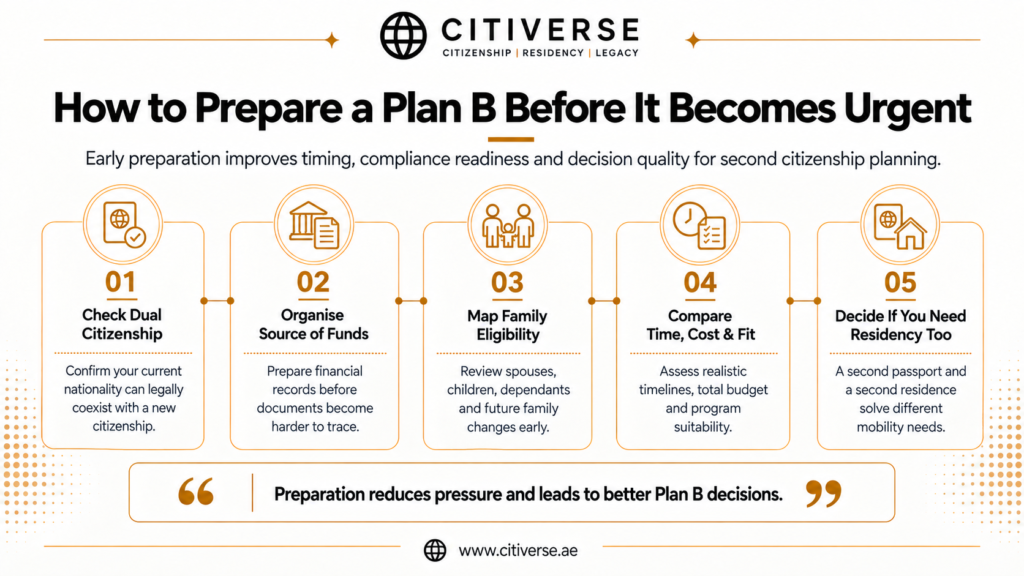
Citiverse helps investors, entrepreneurs and international families assess second citizenship before urgency narrows the decision. The process begins with the objective: what the applicant wants the Plan B to achieve, when it could be needed and what existing nationality, residence, business and family arrangements must be preserved.
The next stage is profile assessment. That can include family mapping, dual-citizenship considerations, due diligence readiness, source-of-funds planning, realistic timelines and comparison of suitable Citizenship by Investment or Residency by Investment routes. Where specialist nationality, immigration, tax or regulated investment advice is required, the relevant work should be coordinated with appropriately qualified professionals.
The aim is not to create urgency. It is to remove unnecessary urgency from the future decision. A Plan B that is prepared in advance gives the client time to choose for fit, complete due diligence properly and understand how the status will function after approval.


Ready to Take the Next Step? Let’s Talk About Your Goals!