





The Saint Lucia Citizenship by Investment Program offers qualifying investors and families a direct route to citizenship through an approved economic contribution or investment. In 2026, the minimum qualifying level begins at US$240,000, but the headline amount is only the starting point. A complete assessment must also account for government charges, due diligence, family fees, document preparation and any asset-specific costs.
For applicants comparing second-citizenship options in 2026, Saint Lucia presents a Caribbean program with a comparatively broad selection of contribution, real estate, government bond and approved enterprise routes. The route can be valuable when it matches the applicant’s nationality, family structure, source of wealth and long-term mobility priorities, rather than being selected solely because of its advertised price or processing time.
Citiverse approaches Saint Lucia citizenship as a structured legal and investment process. Before capital is committed, the application should be tested for eligibility, documentation readiness, family inclusion, source-of-funds clarity and the practical value the citizenship is expected to create.
Applicants can review the dedicated Saint Lucia Citizenship by Investment program page for a concise program overview. This article provides the deeper cost, requirements and process analysis needed before an application is prepared.
The main points to understand before considering Saint Lucia citizenship are set out below. Each should be reviewed in the context of the full application rather than treated as an isolated program benefit.
Program factor | 2026 overview |
Program framework | Program uzyskania obywatelstwa Saint Lucia w zamian za inwestycję |
Operating since | 2015 |
Minimum qualifying level | US$240,000 |
Indicative processing | several months or longer, depending on application completeness, due diligence and administrative capacity |
Family inclusion | A spouse and qualifying dependants can be included, subject to current age, dependency and due diligence rules. The National Economic Fund contribution may be particularly relevant to families because the current minimum can cover a principal applicant with a defined number of qualifying dependants, although additional fees still apply. |
Physical presence | There is generally no long-term physical residence condition attached to citizenship obtained through the program. Applicants should still verify any interview, biometric, oath or document-collection requirements that apply to their particular file. |
Core strategic feature | a Caribbean program with a comparatively broad selection of contribution, real estate, government bond and approved enterprise routes |
Program rules, fees and administrative procedures can change. A current written quotation and eligibility review should be obtained before any transfer or binding investment commitment is made.
The Saint Lucia Citizenship by Investment Program allows an eligible principal applicant and qualifying family members to obtain citizenship after satisfying the legal requirements, passing due diligence and completing an approved financial route. The process is not a purchase of a passport. Citizenship is granted by the state only after the application has been reviewed and the required conditions have been fulfilled.
The program’s role within a global mobility plan depends on what the applicant needs. For some families, Saint Lucia can support nationality diversification and long-term contingency planning. For entrepreneurs, it may complement residence and business structures in other jurisdictions. The citizenship should be assessed according to actual travel needs, family continuity and the credibility of the application profile.
Applicants still deciding between jurisdictions may use Citiverse’s framework on how to choose the right Citizenship by Investment program. The comparison should begin with the desired outcome and only then move to price, timing and route selection.
Saint Lucia may be considered because it offers a Caribbean program with a comparatively broad selection of contribution, real estate, government bond and approved enterprise routes. This can provide a more direct legal route than ordinary residence-based naturalization, provided the applicant can meet the financial, documentary and due diligence standards.
The value of the citizenship remains personal. A passport that improves access for one nationality may add little for another. A family may value dependent inclusion and status continuity more than destination counts, while an entrepreneur may prioritize a credible alternative nationality and the ability to coordinate it with an international residence base.
Travel benefits should be assessed through practical routes and entry formalities rather than passport rankings alone. Citiverse explains this distinction in Second Citizenship for Travel Freedom.
The Saint Lucia framework allows applicants to compare a straightforward non-refundable contribution with property, government securities and selected project-led routes. This flexibility is useful, but it requires a more technical all-in cost and risk comparison.
Investment route | Minimum amount | Key considerations |
National Economic Fund contribution | US$240,000 | A non-refundable contribution route. Current family coverage, dependant supplements and processing fees should be confirmed in the final quotation. |
Approved real estate investment | From US$300,000 | Investment in an approved development, with project due diligence, holding conditions, government fees and ownership expenses. |
National Action Government Bonds | From US$300,000 plus the applicable administration fee | A non-interest-bearing government securities route, normally subject to a prescribed holding period and opportunity cost. |
Approved enterprise or infrastructure project | Project-specific and substantially higher | Investment in an approved project where available, requiring independent commercial and regulatory review. |
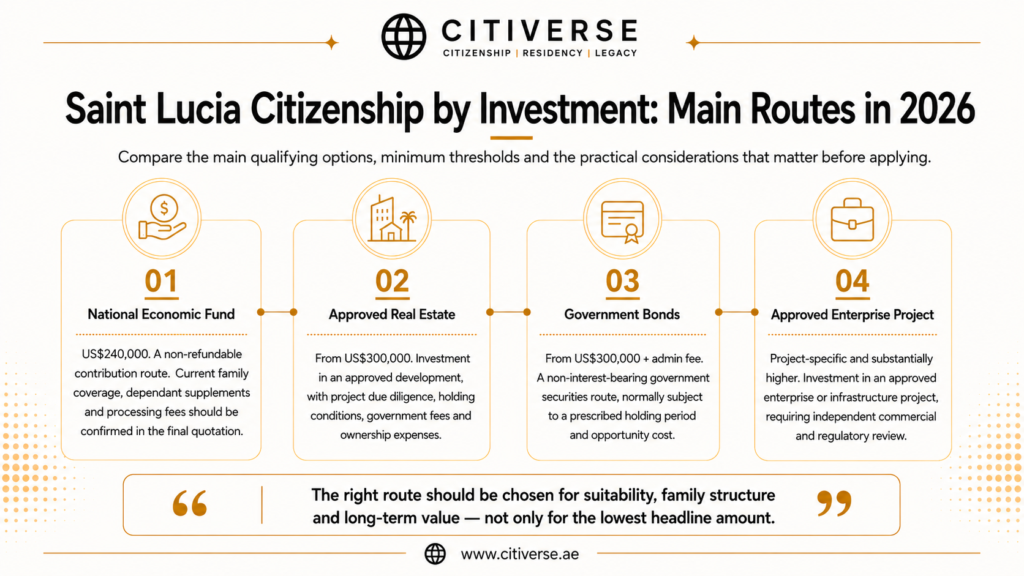
The current qualifying level is US$240,000. A non-refundable contribution route. Current family coverage, dependant supplements and processing fees should be confirmed in the final quotation.
A contribution is normally non-refundable and should be treated as the cost of qualifying rather than an investment expected to generate a return. The simplicity of the route should be weighed against the fact that the capital is not recovered.
The current qualifying level is From US$300,000. Investment in an approved development, with project due diligence, holding conditions, government fees and ownership expenses.
Before committing to an asset, the applicant should review title, valuation, approval status, contractual restrictions, holding period, management charges, potential income and exit conditions. Immigration eligibility does not guarantee capital appreciation, rental performance or liquidity.
The current qualifying level is From US$300,000 plus the applicable administration fee. A non-interest-bearing government securities route, normally subject to a prescribed holding period and opportunity cost.
A capital-preservation route can return the principal after the required holding period, but it may involve administration fees, currency exposure, custody terms and the opportunity cost of locked capital. These factors should be included in the comparison.
The current qualifying level is Project-specific and substantially higher. Investment in an approved project where available, requiring independent commercial and regulatory review.
Before committing to an asset, the applicant should review title, valuation, approval status, contractual restrictions, holding period, management charges, potential income and exit conditions. Immigration eligibility does not guarantee capital appreciation, rental performance or liquidity.
Where an approved property route is being considered, the citizenship analysis should be coordinated with real estate acquisition and investment due diligence before a reservation or purchase agreement becomes binding.
The minimum investment is not the complete application budget. The total cost can include government processing, due diligence, interviews, passports, identity documents, professional support, translations, legalization, medical checks, bank charges and route-specific expenses. Families also pay additional amounts according to the number, age and relationship of dependants.
The NEF route should be costed as a non-refundable payment plus processing, due diligence, interview and passport charges. Property, bond and enterprise routes require separate budgets for administration, holding, custody, legal review, ownership or commercial exposure.
Applicants should also retain a contingency reserve. Enhanced due diligence, replacement documents, additional legal opinions or changes in family composition can increase cost after preparation has begun. A complete budget reduces the risk of selecting a route that becomes unsuitable midway through the process.
Although the precise legal tests depend on the program, a successful applicant must normally satisfy the following core requirements. Each requirement should be supported by evidence that is current, consistent and capable of independent verification.
Potential concerns should be reviewed before substantial costs are incurred. Previous visa refusals, litigation, bankruptcy, regulatory investigations, sanctions exposure, political exposure, adverse media or inconsistent company records may require additional evidence and may affect eligibility.
Citiverse’s article on why Citizenship by Investment applications are rejected explains how incomplete disclosure, weak financial evidence and inconsistent records can undermine an otherwise viable file.
The document list is tailored to the applicant’s nationality, countries of residence, professional history, family and funding route. A typical file includes the categories below, but the final checklist should be issued after the eligibility review.
Documents may require apostille, consular legalization, notarization or certified translation. Names, dates and addresses should be reconciled before submission, particularly where different transliteration systems or historical records have produced variations.




The application should follow a controlled sequence so that eligibility, investment and documentation risks are addressed before irreversible payments are made. The process below reflects the usual structure, while exact government stages may differ by program and route.
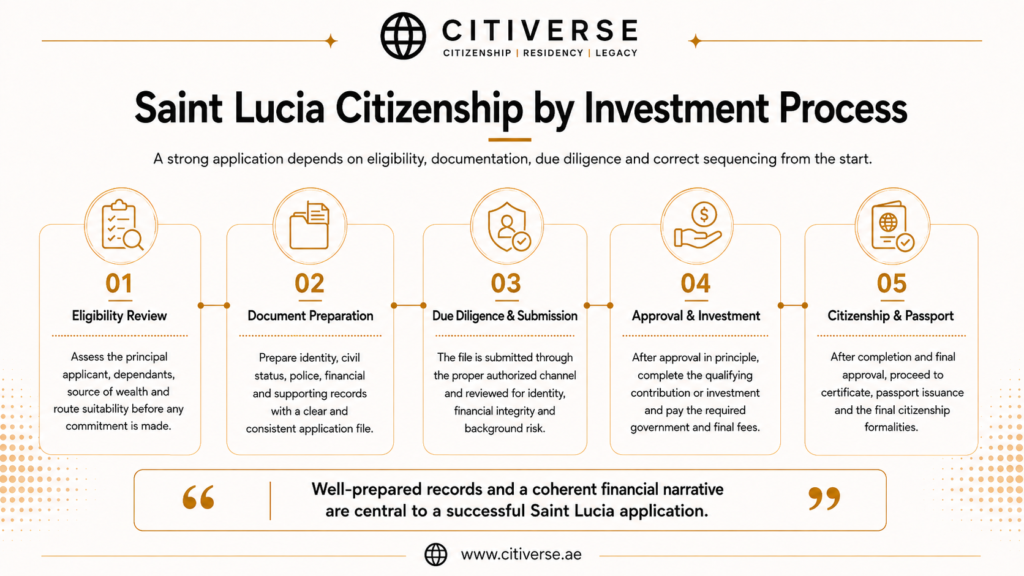
The applicant’s nationality, residence history, family, professional background and intended use of Saint Lucia citizenship are assessed. Potential compliance concerns and alternative programs are considered before the route is selected.
Every proposed dependant is checked for eligibility, and a complete cost calculation is prepared. This avoids relying on a single-applicant headline amount for a larger family file.
The NEF, property, bond and approved-project alternatives are compared using total cost, recoverability of capital, holding period, income expectations, administration and exit. Availability of the selected route is confirmed before funds are reserved.
Civil records are certified, the source-of-wealth narrative is developed and the specific investment funds are traced. Forms and supporting evidence are checked for consistency.
The authorized application channel submits the file for government review. Identity verification, background screening, financial due diligence and any required interview or biometric procedure take place.
After the relevant approval stage, the applicant completes the contribution or investment and pays the outstanding government charges in accordance with the program instructions.
The government verifies completion of the financial route and issues the citizenship documentation. The applicant then completes the passport, identity, oath or biometric process required under the current procedure.
The applicant maintains any required asset, presence condition and passport validity, and obtains advice before changing the investment or family structure.
Source of wealth explains how the applicant accumulated the overall financial position over time. Source of funds identifies the origin and movement of the specific money used for the qualifying route. The two concepts are connected, but a strong application must evidence both.
Entrepreneurs may need company accounts, registers, contracts, invoices, dividend resolutions and tax records. Investors may rely on securities statements, redemption records or documented property sales. Gifts and inheritance require evidence of the donor or estate and, in many cases, the underlying source of the transferred wealth.
The financial narrative should match the applicant’s professional history, declared assets, banking activity and tax records. Unexplained transfers, nominee relationships, cash-intensive activity or a sudden movement of funds shortly before submission can result in additional questions even where the wealth is legitimate.
Politically exposed persons and applicants with heightened public profiles may require enhanced preparation. Citiverse provides a dedicated overview of secure solutions for politically exposed persons.
A spouse and qualifying dependants can be included, subject to current age, dependency and due diligence rules. The National Economic Fund contribution may be particularly relevant to families because the current minimum can cover a principal applicant with a defined number of qualifying dependants, although additional fees still apply.
Family inclusion should be planned across the entire timeline. A child who qualifies at the beginning of preparation may approach an age limit before approval, while an adult dependant may need to remain in education or financially dependent. Custody, consent and previous-marriage documentation can also affect the application sequence.
Families should compare present eligibility with long-term continuity. Citiverse’s guide to second citizenship for families with children explains how age, education and future family changes can influence program selection.
There is generally no long-term physical residence condition attached to citizenship obtained through the program. Applicants should still verify any interview, biometric, oath or document-collection requirements that apply to their particular file.
Citizenship and tax residence are separate. A passport does not automatically make the holder tax resident in the issuing country, and it does not terminate tax residence elsewhere. Days of presence, permanent homes, family location, employment, business management and domestic law determine the actual position.
Applicants considering relocation should also distinguish citizenship from a residence permit. The practical differences are discussed in Residency by Investment vs Citizenship by Investment.
Saint Lucia provides more route diversity than programs limited to a donation and a property purchase. That flexibility is useful, but it also makes the decision more technical. A contribution may minimize administrative complexity, approved real estate preserves an underlying asset, and government bonds may return the principal after the holding period while tying up capital and carrying non-refundable administration costs.
The most suitable route depends on liquidity, family composition, appetite for project risk, desired holding period and the value placed on recovering capital. A comparison should use the full cost and the realistic exit position rather than only the qualifying amount.
A family that can allocate US$300,000 may appear to have a choice between real estate and government bonds. The correct comparison should include property costs, bond administration fees, the holding period, expected income, resale liquidity and the family’s preference for simplicity or asset exposure.
This type of analysis is more useful than identifying a single ‘best’ program. The correct route depends on the applicant’s existing nationality, family, financial profile, tolerance for investment risk and the outcome the citizenship is expected to support.
The most common problems arise when the applicant treats the program as a simple payment rather than a coordinated legal, financial and due diligence process. The following mistakes can increase cost, delay the file or lead to an unsuitable route.
Citiverse provides structured and discreet guidance for individuals and families considering citizenship by investment. The process begins with eligibility, objectives and family mapping, followed by route comparison, cost planning, document preparation and coordinated implementation.
Through Citizenship and Residency program advisory, Citiverse helps applicants decide whether the route fits their mobility, family and investment priorities before a substantial commitment is made.
Once the program and investment route are confirmed, Citiverse’s investment processing services support document coordination, due diligence preparation, investment sequencing and application management through the appropriate authorized channel.
Where personal tax, corporate, regulated or succession questions arise, the process can be coordinated with appropriately qualified external professionals. The objective is a clear application structure in which each advisor addresses the area for which they are responsible.
Saint Lucia may be suitable for applicants who value a Caribbean program with a comparatively broad selection of contribution, real estate, government bond and approved enterprise routes. The route should still be tested against the applicant’s current passport, priority destinations, family eligibility, source of funds and willingness to accept the cost and obligations of the chosen investment.
A successful application begins with preparation rather than payment. Clear records, a realistic budget and a program selected for the correct reason create a stronger foundation for both approval and long-term use of the citizenship.
Speak with Citiverse to review your eligibility, family structure and the current Saint Lucia citizenship options before committing funds.