Citizenship by investment can open access to global mobility, security, and long-term opportunity. But approval is never automatic. The same principle applies to many residency by investment and golden visa routes. Applicants are not assessed only on their ability to meet the required investment threshold. They are also reviewed on eligibility, documentation, source of funds, personal background, reputation, and compliance. For investors, entrepreneurs, and internationally active families, this distinction matters.
A successful application does not begin when documents are submitted. It begins earlier, with a careful review of the applicant’s profile, objectives, family circumstances, financial background, and potential risk factors. Many applicants ask the same question before starting the process: can a citizenship by investment application be rejected? The answer is yes. In many cases, rejection is not caused by a lack of capital. It is caused by unclear documentation, failed due diligence, inconsistent information, unsuitable program selection, or risk factors that were not identified before submission.
This article explains the most common reasons citizenship by investment applications are rejected – and why a professional pre-assessment can help applicants reduce avoidable risk before committing to a global mobility strategy.
Is Citizenship by Investment Guaranteed?
No. Citizenship by investment is a formal government process, not a guaranteed transaction. Each program has its own rules, eligibility criteria, investment options, documentation requirements, due diligence procedures, and approval process. Even if an applicant appears to meet the financial requirement, the final decision remains subject to government review.
Authorities may review the applicant’s identity, source of wealth, source of funds, business activity, travel history, immigration background, family members, sanctions exposure, litigation record, political exposure, and public reputation. This is why the question is not only whether an applicant can afford a program. The more important question is whether the applicant is suitable for that program.
Before comparing Residency by Investment and Citizenship by Investment, applicants should understand what may prevent approval. The right route is not always the fastest, most visible, or lowest-cost option. It is the one that aligns with the applicant’s profile, objectives, risk position, and long-term plans.
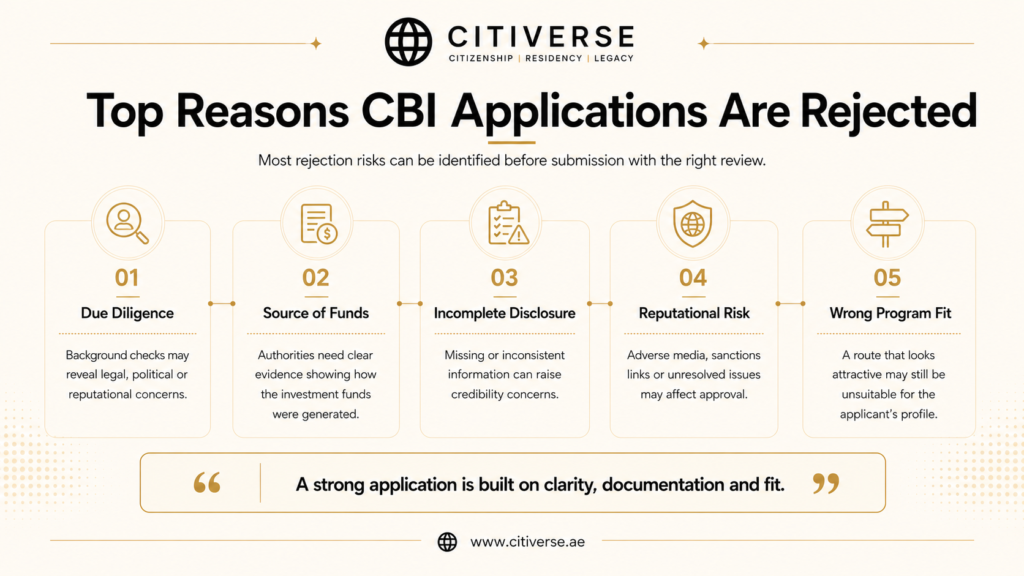
Top 5 Reasons Citizenship by Investment Applications Are Rejected
Citizenship by investment applications may be rejected for different reasons, depending on the jurisdiction and the applicant’s circumstances. However, most rejection risks fall into five main categories.
- Failed Due Diligence
Due diligence is one of the most important stages of any citizenship by investment application. It is designed to protect the integrity of the program, the issuing country, and the international reputation of the citizenship granted. For applicants, it is often the stage where hidden risks, incomplete explanations, or inconsistencies become visible.
Due diligence may include a review of identity documents, criminal record certificates, sanctions databases, business history, litigation background, adverse media, political exposure, family connections, professional activity, and source of wealth. A failed due diligence review can lead to rejection even where the applicant has sufficient funds and has selected a qualifying investment.
This does not mean that every complex applicant will be rejected. Many successful applicants have international business structures, public profiles, previous disputes, or complicated financial histories. The issue is not complexity itself. The issue is whether the facts are transparent, properly documented, and consistent. For example, an applicant may be a politically exposed person, a founder of several companies, or an investor with assets across multiple jurisdictions. These factors may not automatically prevent approval, but they will usually require more careful review and stronger documentation. A strong application does not hide complexity. It explains it with precision.
Before applying, the applicant’s background should be assessed from a due diligence perspective. This includes identifying potential red flags, reviewing whether they can be explained, and deciding whether the selected program is appropriate for the applicant’s risk profile.
- Unclear Source of Funds or Source of Wealth
Source of funds and source of wealth are often among the most sensitive parts of a citizenship by investment application. Authorities want to understand not only that the applicant has enough funds, but also how those funds were generated, accumulated, transferred, and made available for the investment. This distinction is important.
Source of wealth usually refers to the origin of the applicant’s overall wealth. This may include business ownership, employment income, dividends, sale of assets, inheritance, investment returns, real estate transactions, or other legitimate sources. Source of funds usually refers to the specific money being used for the application and investment. Authorities may want to trace the funds from their origin to the applicant’s account and then to the required investment route.
An applicant may have fully legitimate funds and still face delays or rejection if the financial trail is incomplete or unclear. This can happen where the funds came from a business sale without clear supporting documents, a family gift without proper evidence, cryptocurrency gains without sufficient transaction history, third-party transfers, informal asset sales, or complex corporate structures. It can also happen where bank statements, tax returns, contracts, audited financials, or ownership documents do not align with the narrative presented in the application.
For entrepreneurs and investors, this area requires particular attention. Wealth is often generated over many years through different companies, jurisdictions, assets, and transactions. That does not make the application impossible. It simply means the financial story must be prepared with care. A citizenship by investment application should not leave authorities guessing.
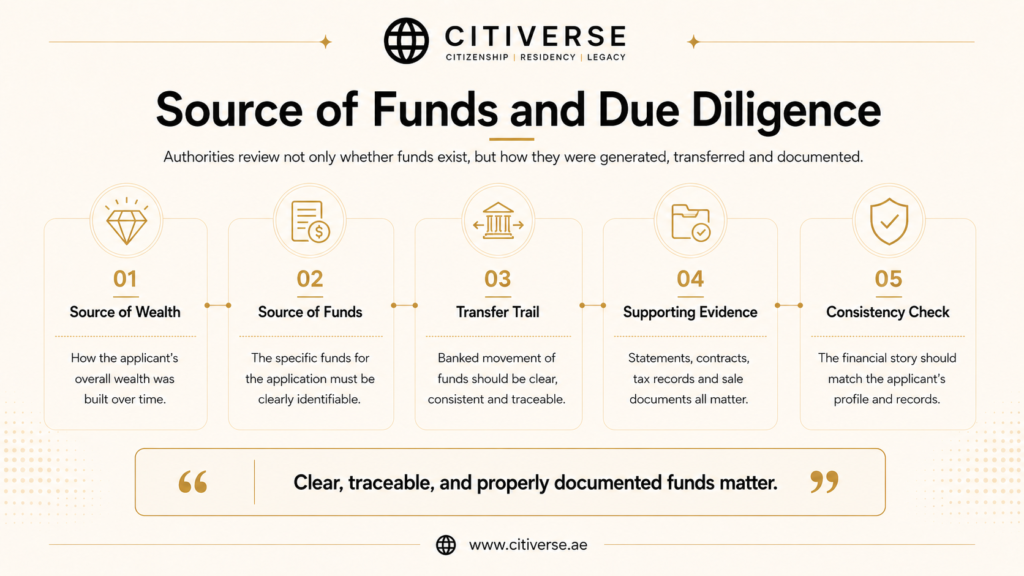
The source of funds should be clear, traceable, and supported by reliable documents. The source of wealth should be credible and consistent with the applicant’s professional and financial history. This is one of the key reasons applicants seek advisory support before applying. The objective is not to create an artificial narrative. The objective is to present the real financial background with clarity, structure, and evidence.
- Incomplete Disclosure or Inconsistent Information
Incomplete disclosure is another common reason citizenship by investment applications face difficulty. In investment migration, transparency is essential. Authorities expect applicants to provide accurate information about their identity, family, residence history, immigration background, business interests, financial position, and legal history. Problems often arise when details are omitted, changed, or presented inconsistently across documents.
This may include previous visa refusals, old addresses, name changes, previous citizenship or residency applications, former directorships, company ownership, family details, litigation, tax matters, or employment history. Some omissions are accidental. Others may be caused by misunderstanding the form, relying on incomplete records, or assuming that older matters are no longer relevant. In some cases, applicants may believe that a previous refusal, dispute, or negative issue will harm the application and therefore decide not to disclose it. That approach can create greater risk than the issue itself.
A previous visa refusal, legal dispute, or business problem does not always prevent approval. However, failing to disclose it where required can raise concerns about credibility and intent. Authorities do not assess only the underlying facts. They also assess whether the applicant is transparent and reliable. For this reason, all relevant information should be reviewed before submission. If there is a difficult issue, it should be assessed carefully and addressed in the right way. Silence is rarely the safest strategy.
A well-prepared application presents the applicant’s position clearly from the beginning. It avoids contradictions. It ensures that documents, forms, explanations, and supporting evidence all tell the same story.
- Criminal, Sanctions, Political or Reputational Risk
Some applications are rejected because the applicant presents a legal, sanctions, political, or reputational concern. This may include criminal convictions, pending investigations, unresolved regulatory matters, sanctions exposure, close association with sanctioned individuals, adverse media, serious tax disputes, politically exposed person status, or involvement in sensitive industries.
These matters are assessed seriously because citizenship by investment programs are subject to increasing international scrutiny. Governments must protect their reputation and ensure that successful applicants meet the expected standards of integrity and compliance. A criminal conviction may create a direct obstacle, depending on the nature of the offence and the rules of the program. Sanctions exposure may be even more serious and can make an application impossible in many cases.
Political exposure is more nuanced. Being a politically exposed person does not always mean that an applicant is ineligible. However, it usually means that enhanced due diligence will apply. The applicant’s role, source of wealth, public profile, jurisdiction, family connections, and business interests may all be reviewed in greater detail.
Reputational risk can also affect an application. Negative media, unresolved allegations, controversial business activity, or public disputes may trigger further questions, even where there is no conviction. For high-profile applicants, the most important step is early risk assessment. The question is not only whether a risk exists. The question is whether it can be explained, documented, and accepted within the framework of the selected program.
In some cases, one route may be unsuitable, while another residency or citizenship solution may be more appropriate. This is why program selection should be based on the applicant’s full profile, not only on investment amount or timeline.
- Wrong Program Selection or Technical Documentation Errors
Not every citizenship or residency route is suitable for every applicant. Some applications are rejected because the applicant chooses the wrong program or fails to meet specific technical requirements.
This can happen when the applicant focuses on speed, cost, or marketing appeal without assessing the deeper requirements of the program. A route that appears attractive on paper may not be suitable once nationality, residence history, family structure, source of funds, risk profile, travel objectives, tax position, and long-term plans are considered.
Technical errors can also create serious problems. Documents may be expired, incorrectly legalised, improperly translated, incomplete, inconsistent, or submitted in the wrong format. Dependants may be included without meeting the eligibility criteria. Investment documents may not satisfy the program rules. The applicant may misunderstand renewal requirements, physical presence obligations, or the difference between residency rights and citizenship rights.
These issues are particularly relevant for applicants comparing citizenship by investment with residency routes such as Cyprus permanent residency by investment. Each route has its own purpose, documentation standard, family inclusion rules, and long-term implications.
The right program is not always the fastest option. It is not always the cheapest option. It is the route that can be properly supported, approved, and maintained. For families and investors, this is a strategic decision. A well-chosen program should support mobility, security, legacy planning, business needs, and family continuity. A poorly chosen program can create delays, additional costs, and unnecessary rejection risk.
Does a Previous Visa Refusal Matter?
A previous visa refusal can matter, but it does not automatically prevent a citizenship by investment application. The impact depends on the country that issued the refusal, the reason for refusal, how long ago it happened, whether the issue has been resolved, and whether the selected program specifically asks for this information.
A refusal based on missing documents may be viewed differently from a refusal involving credibility concerns, overstaying, financial inconsistency, security issues, or misrepresentation. What matters most is that the refusal is reviewed and disclosed where required.
Trying to ignore or hide a previous refusal can create more serious consequences than the refusal itself. Authorities may consider non-disclosure as a credibility issue, especially if the information is later discovered during due diligence. A professional advisor can help assess the refusal, understand whether it affects the selected route, and determine how it should be presented.
Citizenship by Investment Applications. Can You Reapply After a Rejection?
In some cases, an applicant may be able to reapply after a rejection. In other cases, the rejection may create serious limitations. The answer depends on the program, the reason for rejection, and whether the underlying issue can be corrected.
If an application was rejected because of incomplete documentation or a technical error, the issue may be easier to address. If the rejection was caused by failed due diligence, sanctions exposure, serious misrepresentation, or an unresolved legal issue, the position may be more difficult.
Applicants should also understand that investment migration is becoming more compliance-focused. Due diligence standards are stricter than in the past, and information may be shared or reviewed across different channels. A refusal in one jurisdiction may affect future applications elsewhere, particularly if the same issue remains unresolved. Before reapplying, it is important to understand why the previous application failed. Submitting another application without correcting the underlying problem can create further risk and may reduce future options.
How to Reduce the Risk Before Applying for Citizenship by Investment
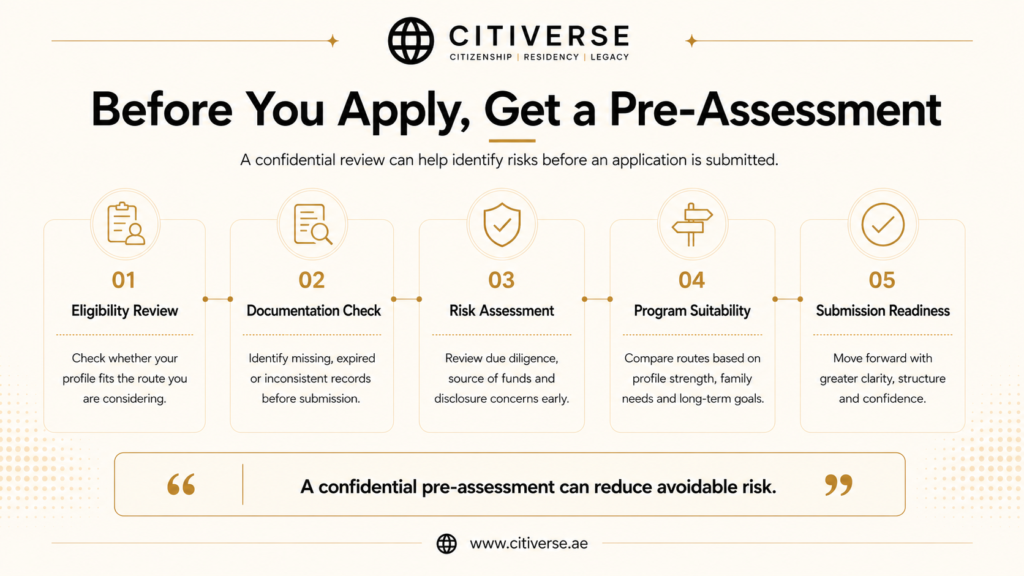
The most effective way to reduce rejection risk is to assess the case before submission. A professional pre-assessment allows the applicant to understand whether their profile is suitable, which route may be appropriate, and what issues should be addressed before the formal process begins.
This may include reviewing nationality, residence history, family members, previous visa refusals, source of funds, source of wealth, business ownership, litigation, public profile, political exposure, sanctions risk, and documentation readiness.
It may also involve comparing citizenship and residency options to determine which route is most realistic and aligned with the applicant’s objectives.
This process does not guarantee approval. However, it can help identify avoidable risks early. It can also help applicants avoid choosing an unsuitable route, submitting incomplete information, or committing funds before their position has been properly reviewed.
For families building a wider passport diversification strategy, this clarity is essential. The objective is not only to secure a second option. It is to build a stable, compliant, and sustainable global mobility plan.
Citizenship by Investment. Why Professional Advisory Matters?
Citizenship by investment decisions are rarely based on investment amount alone. They involve law, compliance, documentation, financial evidence, family planning, government discretion, and long-term strategy.
For high-net-worth individuals, entrepreneurs, and internationally active families, a poorly prepared application can create more than a delay. It may affect future applications, reputation, and broader mobility planning. Professional citizenship by investment advisory helps ensure that the process begins with clarity.
At Citiverse, we curate citizenship and residency pathways with a compliance-led approach. Every case begins with understanding the client’s objectives, personal profile, family needs, documentation position, and potential risk factors. The goal is not simply to apply. The goal is to apply for the right program, with the right documentation, at the right time.
Speak With Citiverse Before You Apply
If you are concerned about due diligence, source of funds, previous visa refusals, documentation, or the risk of rejection, a confidential assessment can help you understand your options before committing to a program.
Citiverse works with individuals, investors, entrepreneurs, and families seeking carefully selected citizenship and residency solutions. Before you apply, understand your position. Speak with Citiverse for a discreet pre-assessment of your eligibility, risk profile, and most suitable global mobility options.