





For many investors, the first concern about Citizenship by Investment is not the cost or the processing time. It is whether obtaining a new citizenship will affect the passport and nationality they already hold. The answer cannot be determined by looking at the new program alone.
A successful applicant may be applying to a country that permits dual or multiple citizenship, while the law of the applicant’s existing country may impose completely different rules. The correct analysis therefore has two sides: the Citizenship by Investment jurisdiction and the nationality law of every citizenship the applicant already holds.
This distinction is particularly important for international families, expats and entrepreneurs whose legal identity, travel patterns, tax filings, banking relationships and family rights are already spread across several countries. A second citizenship should expand long-term options without unintentionally damaging an existing status that may be more valuable.
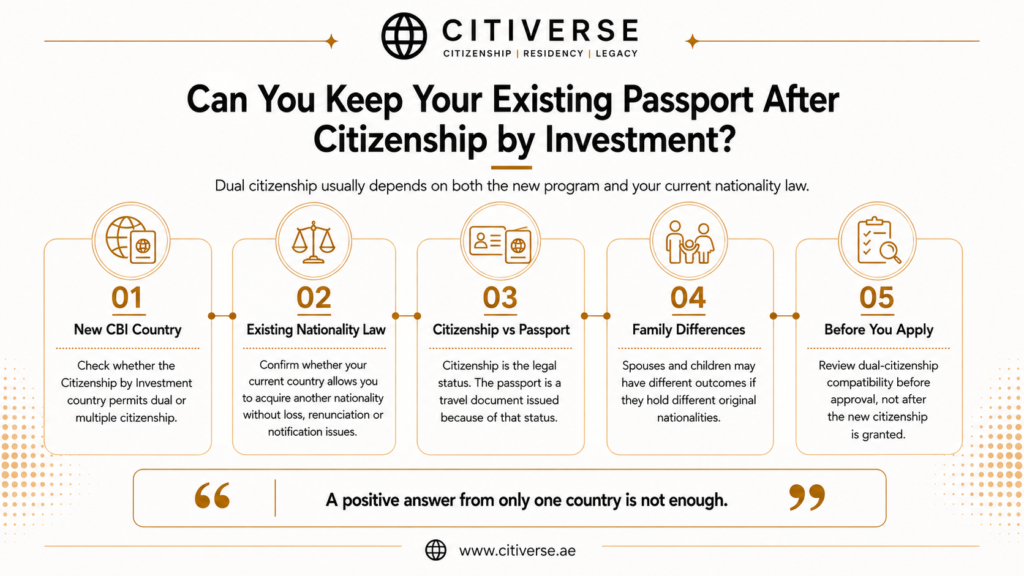
Often yes, but not always. Whether you can keep your existing passport after Citizenship by Investment depends primarily on whether your current country allows you to voluntarily acquire another nationality without losing, renouncing or otherwise affecting your original citizenship.
The new Citizenship by Investment country may expressly recognise dual citizenship. That only answers one side of the question. Your existing nationality law can still require loss, renunciation, notification, registration or another legal step when a foreign citizenship is acquired voluntarily.
For this reason, a Citizenship by Investment application should never be treated as a simple passport purchase. The legal outcome is citizenship first. The passport follows from that nationality. The effect on your existing citizenship should be confirmed before the new nationality is acquired, not after the certificate and passport have already been issued.
Dual citizenship, also called dual nationality, means that a person is legally recognised as a national of two countries at the same time. Holding two passports is usually a practical consequence of that status, but the passport documents themselves are not the source of the nationality.
This distinction matters because a passport can expire, be replaced, be withdrawn as a travel document or be subject to new biometric requirements without the underlying citizenship necessarily disappearing. Conversely, if a person loses a nationality under the law of their original country, an unexpired passport issued by that country does not preserve the citizenship.
Citiverse therefore approaches second citizenship planning by separating the legal status, the passport document and the practical mobility outcome. Each should be tested independently.
Before applying, the applicant should review two separate legal questions. First, does the new Citizenship by Investment jurisdiction permit the applicant to hold another nationality? Second, does the applicant’s current country allow its citizen to acquire the new nationality while retaining the existing one?
A positive answer from only one country is not enough. An investor may choose a program that openly permits multiple citizenships but still face automatic loss or mandatory renunciation under the law of the original country. This is one of the most important pre-application checks for clients whose current nationality is difficult to reacquire once lost.
Existing nationality | General 2026 position | Practical point before CBI |
United States | U.S. citizens can hold dual or multiple nationality. | A U.S. citizen should still understand U.S. passport-use rules and continuing U.S. legal and tax obligations. U.S. citizens must use a U.S. passport to enter and leave the United States. |
United Kingdom | The UK recognises and allows dual nationality. | A British citizen can generally apply for foreign citizenship and keep British citizenship, but the other country must also permit the combination. |
Germany | Multiple nationality has been broadly permitted since 27 June 2024. | German citizens can generally acquire a foreign nationality without losing German citizenship, but the new country’s rules still need to be checked. |
India | India does not permit dual citizenship in the conventional sense. | An Indian citizen who voluntarily acquires the citizenship of another country generally ceases to be an Indian citizen. OCI status is not Indian citizenship. |
China | China does not recognise dual nationality for Chinese nationals. | A Chinese national settled abroad who voluntarily acquires foreign nationality may lose Chinese nationality under the Nationality Law. Individual facts require careful review. |
These examples illustrate why the applicant’s starting nationality matters as much as the program being considered. The legal position can also depend on how citizenship was acquired, place of birth, descent, residence, historic nationality events and the timing of the new acquisition. A family with several original nationalities may therefore need more than one analysis.
Many established direct Citizenship by Investment jurisdictions are structured to accommodate applicants who retain another nationality. Current program frameworks in jurisdictions such as Dominica, Saint Lucia, St. Kitts and Nevis and Nauru permit dual citizenship. This is one reason these programs can work for internationally mobile applicants who do not want to replace their original citizenship.
However, program-level compatibility should not be turned into a marketing shortcut. The correct statement is not “you can always keep your passport.” The correct statement is that the new jurisdiction may permit multiple citizenships, subject to the applicant being legally able to retain the citizenship they already hold.
Applicants comparing direct programs should review How to Choose the Right Citizenship by Investment Program in 2026 alongside the nationality analysis rather than selecting a route on passport access or headline cost alone.




If the current nationality cannot legally be retained after voluntary acquisition of a foreign citizenship, the applicant should decide whether the benefits of the new citizenship justify the consequences of losing or renouncing the existing one. That decision should be made before any irreversible step is taken.
Citiverse’s comparison of Residency by Investment vs Citizenship by Investment explains why changing nationality is not necessary when the client primarily wants a long-term residence base.
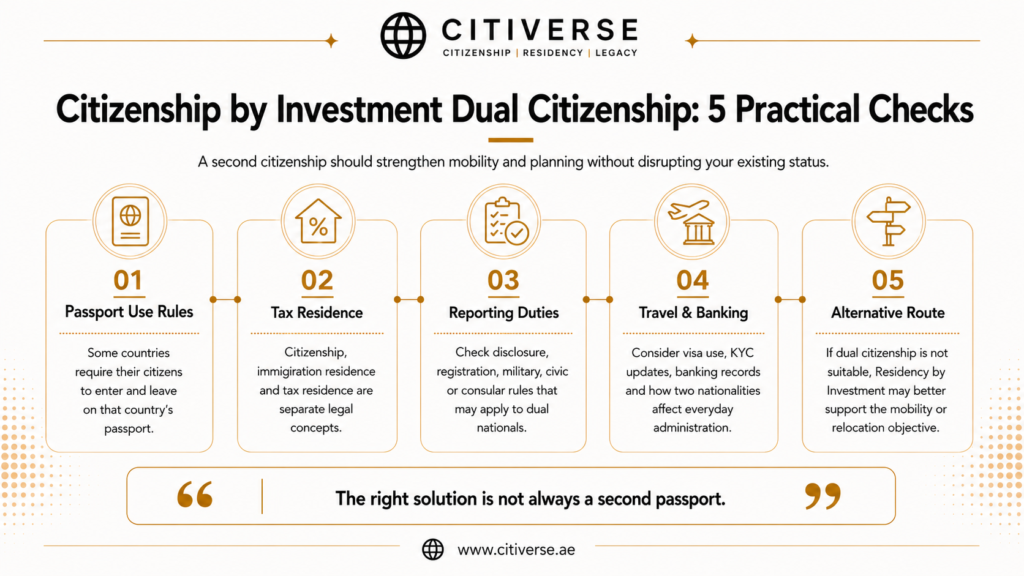
Where dual nationality is legally recognised, the holder may often maintain valid passports from both countries. How each document should be used depends on the laws of the countries involved. A dual national may be required to enter or leave one of their countries of citizenship on that country’s passport, while using the other passport for travel to destinations where it provides more practical access.
Applicants should also remember that airlines, border systems and electronic travel authorisations increasingly match identity data across travel documents. Names, dates of birth and other personal information should therefore remain consistent. A second passport should not be used to obscure previous travel, visa refusals, nationality, sanctions exposure or identity information.
For mobility planning, the relevant question is not how many passports a person holds but which document creates meaningful access. Citiverse’s Second Citizenship for Travel Freedom guide explains why practical usability matters more than a headline visa-free score.
Acquiring a second citizenship does not automatically move tax residence from one country to another. Tax residence is normally determined by domestic rules, physical presence, homes, family and economic ties, company management and applicable treaty provisions. Some countries also tax citizens on a basis that can continue after relocation.
This is particularly important for U.S. citizens and other applicants with continuing reporting obligations connected to nationality, domicile or asset structures. Citizenship planning and tax planning may interact, but they should never be treated as the same workstream.
The benefits of dual citizenship can be substantial, but the legal relationship with two states may also create obligations. The exact position varies by country and by the personal profile of the citizen.
A family application should not assume that the principal applicant’s nationality position automatically applies to everyone else. A spouse may have a different citizenship, a child may hold nationality by descent from two parents, and future children may acquire citizenship under rules that differ from those applying to the original CBI applicant.
This is why family eligibility and nationality transmission should be reviewed together. Citiverse’s guides to Second Citizenship for Families with Children and Citizenship by Investment for Future Generations address the wider family and legacy questions that sit beyond the initial passport application.
Expats often have the most complex dual-citizenship profiles because nationality, immigration residence and tax residence may already be located in different jurisdictions. A person may be a citizen of one country, hold long-term residence in another, manage a company from a third and educate children in a fourth.
For that profile, a second citizenship can be valuable when it adds a durable nationality independent of the current expat visa. But it should be tested against the current passport, host-country residence, family structure and future relocation plan. Adding a new nationality without mapping those relationships can create complexity without solving a defined problem.
The broader decision framework is covered in Second Citizenship for Expats: When Does Citizenship by Investment Make Sense?.
Applicants with complex background or disclosure questions should also review Why Citizenship by Investment Applications Get Rejected before committing capital.
Citiverse provides structured Citizenship and Residency Program Advisory for applicants comparing second citizenship options. The process begins with the client’s existing nationality or nationalities, current residence, family profile, mobility objectives, investment preferences and due diligence position.
Where dual-citizenship compatibility requires advice on the nationality law of the applicant’s current country, that legal question should be confirmed with appropriately qualified counsel before the citizenship event occurs. Citiverse can then align the selected investment migration route with the confirmed legal position and coordinate the application through the appropriate authorised channel.
Once a route is selected, Investment Processing Services can support documentation, application sequencing and implementation. The objective is to ensure that the new citizenship adds value without creating an avoidable conflict with an existing status.


Ready to Take the Next Step? Let’s Talk About Your Goals!