





Second Citizenship for Travel Freedom:
How to Evaluate the Real Mobility Value of a Second Passport
Travel freedom is one of the most visible reasons people consider second citizenship. A second passport may reduce reliance on traditional visa applications, improve access to important destinations and create greater flexibility for international travel.
However, the number of visa-free countries shown in a passport ranking does not always reflect how useful that passport will be in practice. A destination may require electronic authorization, restrict the length or purpose of a stay, impose additional entry conditions or have little relevance to the holder’s personal and commercial priorities.
The real mobility value of a second passport therefore depends on more than a headline country count. It should be measured against the applicant’s current nationality, priority destinations, travel frequency, family profile and long-term international plans.
Citiverse assesses travel freedom as part of a wider global mobility strategy. The objective is to identify a citizenship or residency route that creates practical access where it is genuinely needed, rather than selecting a passport because it appears strong in a general ranking.
Key Takeaways: Second Citizenship for Travel Freedom
- Visa-free access does not always mean traveling without prior formalities.
- Electronic travel authorization, visa-on-arrival procedures and entry conditions can still affect the journey.
- The value of a second passport depends on whether it improves access to the destinations that matter to the holder.
- Tourism access does not automatically provide the right to work, study, relocate or establish a business.
- A second passport should complement the applicant’s existing nationality rather than duplicate benefits already available.
- Family members may have different mobility profiles, even when they apply through the same citizenship program.
- Visa-waiver arrangements and travel requirements can change, so mobility value should be reviewed over time.
- Residency may provide more practical value than citizenship where the main objective is relocation or long-term presence.
What Does Travel Freedom Actually Mean?
Travel freedom is the ability to move internationally with less administrative friction and greater predictability. It can include reduced reliance on embassy visa applications, shorter preparation times and access to a broader range of destinations for business or leisure.
For a globally mobile individual, travel freedom may also mean being able to respond quickly when a meeting, family matter or commercial opportunity arises. The practical benefit comes from having usable options before travel becomes urgent.
A second citizenship can support three dimensions of mobility:
- Reach, meaning the destinations that become more accessible.
- Friction, meaning the time, cost and documentation required before departure.
- Resilience, meaning reduced dependence on one nationality or one set of visa relationships.
A strong mobility strategy should consider all three dimensions together. A passport that performs well in only one area may not be the best fit for the holder’s actual travel patterns.
Visa-Free Travel Does Not Always Mean Friction-Free Travel
Travel access is often grouped into broad categories, but those categories create different practical experiences.
Access type | What it generally means | What the traveler should check |
Visa-free access | No traditional visa application is normally required before a short visit | Stay limit, permitted purpose, passport validity and entry conditions |
Electronic travel authorization | Online approval may be required before boarding | Processing time, validity, fees and passport linkage |
Visa on arrival | Permission is requested at the border or airport | Fees, supporting documents, queues and eligibility |
Electronic visa | A visa is obtained online before travel | Processing time, documents and permitted activities |
Traditional visa | An embassy, consulate or application-center process is required | Appointment availability, evidence, processing time and cost |
Passport rankings may group visa-free access, electronic travel authorization and visa-on-arrival arrangements within one broader mobility score. In practice, these forms of access involve different levels of preparation, cost and travel flexibility.
A route requiring online authorization may still provide significant convenience compared with a traditional visa. It should nevertheless be assessed according to the time, documentation and approval required before each journey.
How to Measure the Real Mobility Value of a Second Passport
A second passport should be evaluated through a personalized mobility framework rather than a general destination count.
Mobility factor | Key question |
Priority destinations | Does the passport improve access to countries you actually visit? |
Pre-travel requirements | Is travel visa-free, electronically authorized or subject to an online visa? |
Stay duration | How long may you remain during each visit? |
Permitted activities | Is the access suitable for tourism, meetings, study or another purpose? |
Transit access | Does the passport simplify important connecting routes? |
Family alignment | Do your spouse and children receive comparable access? |
Passport complementarity | Does it fill gaps created by your current nationality? |
Entry predictability | Are the requirements clear and operationally manageable? |
Long-term stability | Is the mobility profile likely to remain useful as rules evolve? |
Relocation value | Do you need short-stay access or the right to live in the country? |
The practical value of a second passport should be measured against the destinations, travel patterns and access requirements that matter to the individual. A higher position in a general passport index does not necessarily translate into greater mobility for a particular applicant.
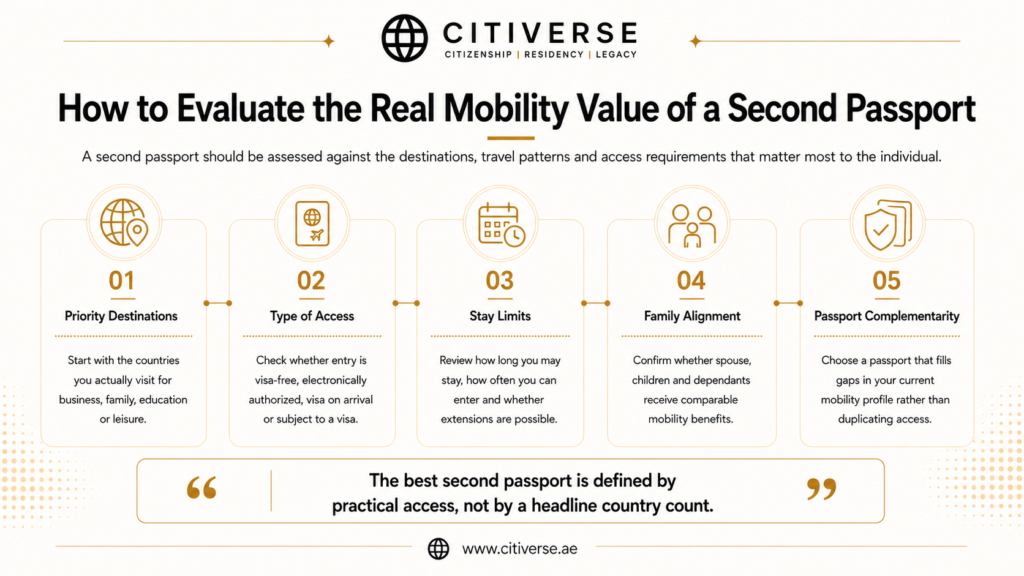
Start With the Destinations That Matter Most
A second passport should be evaluated against a personalized list of priority destinations. This may include countries connected to business activity, investment interests, family members, education, healthcare or regular leisure travel.
A passport with a longer general destination list may still deliver limited value if it does not improve access to the applicant’s priority markets. Conversely, a passport with a lower headline score may be strategically useful if it removes a significant barrier affecting frequent travel.
The assessment should identify:
- destinations that currently require traditional visas;
- destinations where applications are slow or unpredictable;
- important transit hubs;
- countries visited several times each year;
- markets relevant to business expansion;
- and locations where family members live or study.
The comparison should then show how each potential second passport changes the applicant’s current position. Citiverse’s guide on how to choose the right Citizenship by Investment program explains how mobility should be assessed alongside family structure, investment preference and due diligence readiness.
Compare the Formalities Required Before Departure
The absence of a traditional visa does not always eliminate preparation. Some destinations require eligible travelers to obtain digital permission before they can board a flight or arrive at the border.
A mobility assessment should distinguish between:
- access requiring no advance authorization;
- electronic travel authorization;
- electronic visa;
- visa on arrival;
- and a full consular visa process.
The important question is how much friction remains. An online authorization completed in advance may be manageable for planned travel, while a traditional visa involving appointments, supporting documents and passport submission can materially reduce flexibility.
Processing reliability also matters. A digital system may usually provide a quick decision, but the traveler should still understand how long approval can take and whether each family member requires a separate authorization.
Review the Length and Frequency of Permitted Stays
Visa-free access normally relates to short visits. It does not give the traveler an unlimited right to remain in the destination country.
Rules may restrict:
- the number of days per visit;
- the total number of days within a rolling period;
- the frequency of entry;
- or the possibility of extending the stay.
These limits can be particularly important for individuals who travel repeatedly to the same region. A passport may simplify entry while still being unsuitable for someone who spends several months each year in one country.
The assessment should therefore reflect the applicant’s actual calendar. Regular short business trips create a different mobility requirement from seasonal residence, extended family stays or long-term relocation.
Check Which Activities Are Permitted
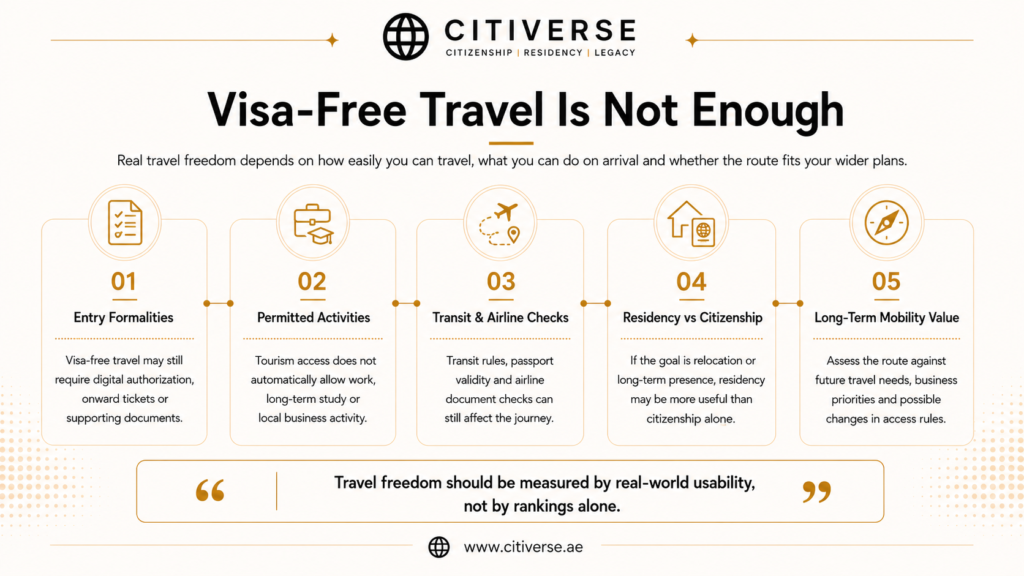
Visa-free travel usually supports limited activities such as tourism, family visits or selected business meetings. It does not normally provide an unrestricted right to take employment, deliver local services, study long term or establish residence.
Business travelers should confirm whether their intended activities are permitted. Attending a conference or meeting may be treated differently from performing paid work, managing local operations or remaining in the country for an extended assignment.
The same distinction applies to education. Short courses may be covered by visitor access in some destinations, while formal study generally requires a separate immigration status.
Travel freedom should therefore be assessed against the purpose of each journey, not only the ability to cross the border.
Consider Airline, Transit and Border Requirements
The practical travel process begins before the traveler reaches passport control. Airlines may check passport validity, entry permission, onward travel and other documentation before allowing a passenger to board.
The traveler may also need:
- a passport valid for a specified period;
- proof of accommodation;
- a return or onward ticket;
- evidence of sufficient funds;
- travel or health documentation;
- and confirmation of the purpose of the visit.
Transit rules can create another layer of complexity. A passenger who does not intend to enter a country may still require specific documentation when changing airports, collecting baggage or using a route involving an overnight connection.
A second passport can improve travel freedom when it reduces these operational obstacles. The route should therefore be tested against complete itineraries rather than only the final destination.
Measure How the Second Passport Complements the First
The best second passport is not necessarily the one with the strongest standalone ranking. It is often the passport that fills the most important gaps created by the holder’s existing nationality.
This is the principle behind a structured passport diversification strategy. The combined mobility profile of two passports can be more relevant than the general strength of either passport viewed separately.
The analysis should identify:
- destinations already accessible with the current passport;
- markets where the second passport creates new access;
- destinations where one passport offers a simpler process;
- and situations where nationality-specific restrictions may still apply.
A second passport that largely duplicates existing benefits may provide limited additional value. The strongest option should add practical flexibility rather than another document with a similar travel profile.
Evaluate the Stability of the Mobility Profile
Visa-waiver relationships are not permanent guarantees. Governments can introduce travel authorizations, change entry rules or suspend arrangements in response to political, security or regulatory developments.
This does not remove the value of second citizenship, but it changes how the decision should be made. Applicants should avoid treating a current country count as a fixed benefit that will remain unchanged indefinitely.
The review should consider:
- the broader reputation of the jurisdiction;
- the maturity and governance of the citizenship route;
- the country’s international relationships;
- and the applicant’s willingness to accept future changes in mobility access.
Citiverse’s analysis of mobility risk in 2026 explains why passport diversification should be approached as long-term planning rather than as a guarantee of static visa-free access.
Review Mobility for the Entire Family
A second citizenship decision often involves more than one traveler. A spouse, minor child or adult dependent may have different priorities, existing nationalities and travel requirements.
The family assessment should establish:
- who will receive citizenship;
- whether all family members can apply together;
- whether children may age out of eligibility;
- whether parental consent is required;
- and whether future children can be added.
Travel convenience can be reduced when one family member still needs a traditional visa for a regular destination. The strategy should therefore consider the family’s collective mobility rather than focusing only on the principal applicant.
These issues are covered in greater detail in Citiverse’s guide to second citizenship for families with children.
Assess Business Mobility Separately
Entrepreneurs and investors often travel for time-sensitive commercial reasons. A delayed visa can affect meetings, negotiations, conferences, banking appointments or the ability to respond to a new market opportunity.
For business mobility, the applicant should identify:
- markets visited most frequently;
- countries where visa applications currently create delays;
- key regional hubs;
- relevant treaty or business-access opportunities;
- and whether short-stay visitor status covers the intended activity.
A second passport may improve the ability to attend meetings and explore markets. It does not automatically authorize local employment, permanent management activity or residence.
Citiverse’s guide to a second passport for entrepreneurs examines how commercial objectives should influence the choice of citizenship route.
Distinguish Travel Access From Residence Rights
Travel freedom and the right to live in another country are not the same outcome. Visa-free entry usually permits temporary visits, while residency provides a legal basis for longer-term presence.
Residency may be more appropriate when the objective is to:
- establish a home;
- relocate family members;
- place children in local education;
- operate a business from the country;
- or spend substantial periods there each year.
Some applicants benefit from citizenship in one jurisdiction and residency in another. The citizenship may support broader travel flexibility, while the residency provides a practical base in the country where the individual intends to live.
The difference is explained in Citiverse’s comparison of Residency by Investment vs Citizenship by Investment.
A Practical Second Passport Mobility Scorecard
Before selecting a citizenship route, applicants can score each shortlisted passport against the following questions.
Question | Low value | Strong value |
Does it improve access to priority destinations? | Few relevant additions | Removes important current restrictions |
How much preparation is required? | Traditional visas remain common | Important trips require limited formalities |
Does it support last-minute travel? | Long or unpredictable approvals | Practical pre-travel process |
Are stay limits suitable? | Too restrictive for normal travel patterns | Appropriate for expected trip duration |
Does it support business visits? | Limited relevance to commercial markets | Useful access to priority business destinations |
Does it complement the current passport? | Mostly duplicates existing access | Fills meaningful mobility gaps |
Does it work for the family? | Uneven or incomplete family access | Consistent mobility for relevant family members |
Is relocation part of the objective? | Passport does not solve the real need | Citizenship is coordinated with residency |
Is the route sustainable? | Based mainly on a current ranking | Fits a wider long-term strategy |
Are the costs proportionate? | High cost for limited mobility gain | Clear practical value relative to total cost |
A passport does not need to achieve the highest result in every category. It should perform strongly in the areas that matter most to the applicant.

Featured Citizenship by Investment Programs
Discover premium second citizenship opportunities in world-class destinations that offer exceptional lifestyle benefits
Practical Travel Freedom Scenarios
An Entrepreneur With Frequent Short-Notice Meetings
An entrepreneur regularly travels to three commercial hubs but currently needs advance visas for two of them. A passport that improves access to those markets may create more practical value than one offering a longer list of leisure destinations.
The analysis should also confirm whether the intended activities fall within business-visitor rules. If the entrepreneur plans to relocate or manage a local operation, a separate residence or work route may still be required.
A Family With Different Current Nationalities
The principal applicant and spouse already hold different passports, while their children have only one nationality. The strongest strategy may be the program that improves the family’s combined mobility and allows all relevant dependents to be included.
A passport selected only around the principal applicant may leave the family facing different visa processes. Family eligibility should therefore be reviewed at the beginning of the comparison.
An Investor Seeking a Long-Term European Base
An investor initially asks for second citizenship because the objective is described as greater travel freedom. Further review shows that the investor intends to purchase a home, spend significant time in Europe and place children in school.
In that case, residency may address the underlying objective more directly. A second citizenship may still form part of the wider plan, but it should not be treated as a substitute for residence rights.
A Frequent Traveler Comparing Two Passport Rankings
One passport appears stronger because it provides access to more destinations overall. The second passport, however, improves access to the traveler’s most important business region and requires fewer pre-departure formalities for regular routes.
The second option may therefore deliver greater real mobility value. Headline rankings should support the analysis rather than replace it.
How to Compare Citizenship Programs for Travel Freedom
Citiverse advises on selected citizenship by investment programs that may support different mobility, family and investment objectives.
A comparison should consider:
- the applicant’s current passport;
- the exact destinations gained;
- electronic authorization requirements;
- family eligibility;
- processing and due diligence;
- investment route and total cost;
- passport renewal;
- and the wider reputation of the jurisdiction.
Applicants should avoid selecting a program only because its passport provides access to a stated number of destinations. The value of the route should be demonstrated through a personalized mobility-gap analysis.
For high-net-worth applicants, these factors may form part of a broader citizenship by investment for HNWIs strategy involving family planning, investment, due diligence and international positioning.
Common Mistakes When Choosing a Second Passport for Travel Freedom
Comparing Only the Number of Visa-Free Destinations
A country count does not show whether the accessible destinations are relevant to the applicant. It may also fail to distinguish clearly between fully visa-free travel and routes requiring advance electronic approval.
The applicant should begin with a personalized destination list. The second passport should then be measured by the mobility gaps it removes.
Assuming Visa-Free Entry Guarantees Admission
Visa-free status normally allows a traveler to request entry without obtaining a traditional visa in advance. Border authorities may still examine the purpose of travel, supporting documents and compliance with entry conditions.
Travelers should continue to prepare the appropriate documentation. A second passport can reduce friction, but it does not remove border controls.
Confusing Tourism Access With Work or Residence Rights
Short-stay access does not normally authorize employment, permanent business activity or long-term study. Individuals planning to relocate should compare residence and work routes separately.
This distinction is particularly important for entrepreneurs and families. The wrong status may provide easier entry without delivering the legal rights required after arrival.
Ignoring the Existing Passport
A second passport should not be evaluated in isolation. Its value comes from the additional options it creates when combined with the holder’s current nationality.
Applicants should avoid paying for benefits they already possess. A mobility-gap analysis makes the incremental value clearer.
Overlooking Family Travel Requirements
The principal applicant may gain convenient access while a spouse or child remains subject to a different process. This can reduce the value of the strategy for family travel.
Every relevant family member should be reviewed. Age limits, dependency and documentation requirements may affect whether the family can obtain the same citizenship.
Assuming Current Access Will Never Change
Travel relationships can evolve, and new electronic systems may be introduced. Applicants should select a jurisdiction with a broader strategic fit rather than relying entirely on a current list of destinations.
The decision should remain useful even if some travel formalities change. Family inclusion, status durability and wider optionality may provide value beyond one visa waiver.
Treating Second Citizenship as a Tax Solution
Citizenship does not automatically establish or change tax residence. Tax residence depends on separate legal rules and the individual’s factual circumstances.
Mobility planning and tax analysis should therefore be coordinated but kept distinct. Citiverse focuses on citizenship, residency and implementation, with separate specialist input coordinated where required.
A Seven-Step Travel Freedom Assessment
Step 1: Map the Current Passport Position
List the destinations available without a traditional visa, those requiring electronic authorization and the markets requiring consular visas. This creates the baseline against which each second passport can be measured.
Step 2: Identify Priority Destinations
Focus on countries connected to business, family, education and frequent travel. Destinations that are unlikely to be used should carry less weight in the decision.
Step 3: Classify the Type of Access
Categorize each important destination as visa-free, electronically authorized, visa on arrival, electronic visa or traditional visa. This shows the real preparation required before travel.
Step 4: Review Stay Limits and Permitted Activities
Confirm how long each visit may last and whether the expected activity is permitted. A route designed for tourism may not satisfy a business, study or relocation requirement.
Step 5: Test Family and Transit Routes
Review the mobility profile for all included family members and for the complete journey. Connecting airports, transit rules and airline documentation can affect the practical travel experience.
Step 6: Compare Citizenship With Residency
Where the objective includes living, studying or managing a business in a particular country, residency may provide the stronger route. Citizenship and residency can also be combined when they address different needs.
Step 7: Review Cost, Due Diligence and Long-Term Value
The final decision should reflect total cost, family fees, documentation, investment structure and future usability. The strongest route is the one that creates proportionate and sustainable mobility value.
How Citiverse Supports Travel Freedom Planning
Citiverse helps individuals, families, entrepreneurs and investors assess the practical mobility value of second citizenship and residency options. Our support may include:
- current passport and mobility-gap analysis;
- identification of priority destinations;
- citizenship and residency comparison;
- family eligibility review;
- investment-route assessment;
- due diligence preparation;
- application coordination;
- and long-term global mobility planning.
Through citizenship and residency program advisory, Citiverse helps clients move beyond headline passport rankings and identify routes aligned with their travel patterns, family requirements and international objectives.
Once a suitable route has been selected, Citiverse also supports citizenship and residency application processing through structured document preparation and coordinated implementation.
Choose a Second Passport That Works in Practice
Second citizenship can meaningfully improve travel freedom, but its value should be tested against real destinations, real journeys and clearly defined objectives. The strongest passport on paper is not always the passport that creates the most useful outcome for a particular individual or family.
Citiverse provides discreet and structured guidance for applicants comparing citizenship and residency options. Our approach begins with the mobility gaps that need to be addressed and then identifies the route capable of delivering practical, long-term value.
Speak with Citiverse to review your current passport position, priority destinations and suitable second citizenship or residency options before making a commitment.
Choose a Second Passport That Expands Your Real Travel Options
Citiverse helps individuals and families compare citizenship and residency routes based on priority destinations,
current nationality, family needs and long-term mobility objectives.
Explore Citizenship & Residency by Investment
Programs by Citiverse
Discover premium citizenship and residency opportunities in world-class destinations, offering exceptional lifestyle benefits. Explore our overview brochure or continue reading below.
Frequently Asked Questions: Second Citizenship for Travel Freedom
Does Second Citizenship Guarantee Visa-Free Travel?
Second citizenship may provide visa-free or simplified access to additional destinations, but the exact benefits depend on the passport and destination. Some countries may still require electronic authorization, supporting documents or compliance with specific entry conditions.
A second passport can reduce administrative friction, but it does not guarantee admission. The traveler must continue to satisfy the applicable border and entry requirements.
What Is the Real Mobility Value of a Second Passport?
Real mobility value is the practical improvement a second passport creates for the holder. It considers relevant destinations, preparation time, stay limits, travel purpose, family access and how the passport complements the person’s current nationality.
The value is therefore personal rather than universal. A passport can be highly useful for one applicant and provide limited additional access for another.
Is Visa-Free Travel the Same as an Electronic Travel Authorization?
No. Visa-free travel may still be subject to an electronic authorization that must be obtained before departure.
The process is generally simpler than a traditional visa application. The traveler must nevertheless complete the authorization correctly and receive approval before traveling.
Is Visa on Arrival the Same as Visa-Free Entry?
No. Visa on arrival normally requires the traveler to complete a process at the destination, which may include forms, supporting documents and payment of a fee.
It may be convenient compared with a consular visa, but it can create more friction than entry without a visa or prior authorization.
Does Visa-Free Travel Allow Me to Work?
Usually not. Visa-free entry is normally intended for limited activities such as tourism, family visits or selected business meetings.
Employment, long-term study or local business activity may require a separate visa, work permit or residence status.
Is the Passport With the Most Visa-Free Countries Always the Best?
No. A higher destination count may have limited value if the passport does not improve access to the countries the applicant actually visits.
The strongest route is the one that fills meaningful gaps in the applicant’s existing mobility profile while meeting wider family, investment and due diligence requirements.
Can I Choose Which Passport to Use When Traveling?
Dual citizens may often use the passport offering the most appropriate access for a particular journey, but country-specific rules must be followed. Some countries require their citizens to enter or leave using that country’s passport.
Travel authorizations, airline bookings and passenger records should also use consistent passport details. Inconsistencies can create delays during check-in or border control.
Can Visa-Free Access Change After I Obtain Citizenship?
Yes. Governments may change visa-waiver arrangements, introduce electronic authorization systems or revise entry requirements.
Second citizenship should therefore be selected for broader strategic value rather than relying only on one current destination list.
Does a Second Passport Give Me the Right to Live Abroad?
A second passport gives the holder citizenship rights in the issuing country. It does not automatically provide residence rights in unrelated jurisdictions.
Visa-free access to another country is normally limited to short visits. Where the main objective is relocation, residency by investment may be more appropriate.
Can My Family Receive the Same Travel Benefits?
Family members who obtain the same citizenship generally receive the corresponding passport rights. Their eligibility to join the application depends on the program’s rules regarding spouses, children, parents and other dependents.
The family structure should be reviewed before the program is selected. This helps avoid a situation in which only some family members receive the intended mobility benefits.
What Is the Best Second Passport for Travel Freedom?
There is no universal best passport because the answer depends on the applicant’s current nationality, priority destinations and travel patterns. A tailored comparison should identify which route creates the greatest practical improvement.
Cost, family inclusion, due diligence, investment structure and long-term stability should also influence the decision.
Does Second Citizenship Change My Tax Residence?
Not by itself. Citizenship, immigration residence and tax residence are separate concepts.
Any planned relocation or change in personal arrangements should be reviewed separately by appropriately qualified advisors.
How Can Citiverse Help Me Evaluate Travel Freedom?
Citiverse can compare the applicant’s current passport with suitable citizenship and residency routes. The review considers priority destinations, family needs, investment preferences, due diligence and long-term global mobility objectives.
The aim is to identify a route that works in practice rather than selecting a program based only on headline passport rankings.
所有最新消息和见解
无论您是在寻求更好的生活方式、安全的投资还是更高的流动性,Citiverse 都是您通往无边界未来的门户。