




Living abroad already gives an expat international experience, but it does not necessarily create long-term legal optionality. An employment visa, investor permit, family-sponsored status or renewable residence card can provide an excellent base for daily life while still leaving the individual dependent on the rules of one host country and one original nationality.
This is where second citizenship can become relevant. For some expats, Citizenship by Investment can create an additional nationality that is independent of the current employment or residence relationship. For others, the real objective is simply to establish a new home, secure residence rights in a preferred jurisdiction or create a family base, in which case another residency by investment route may solve the problem more directly.
The right question is therefore not whether every expat should obtain a second passport. It is whether citizenship creates a legal and practical benefit that the applicant does not already have, and whether that benefit justifies the investment, due diligence, family planning and long-term responsibilities involved.
An expat is generally someone living outside the country of their nationality, often under a residence status connected to work, investment, family or another immigration category. That status can be highly stable, but it does not usually change the person’s nationality. If the residence permit expires, the underlying employment ends, the qualifying investment is sold or the family relationship changes, the right to remain may also need to be reassessed.
Second citizenship is different because it creates an additional nationality. Where the law permits dual or multiple citizenship, the applicant may retain the original citizenship while acquiring another one. The new nationality can continue independently of the person’s current expat country, although passport renewal, family transmission, investment holding periods and other program-specific obligations must still be understood.
For expats who have already built an international life, this distinction matters. The value of citizenship is not that it makes the applicant “more international”; it is that it can add a durable legal status that remains available even if the person changes jobs, sells a property, relocates again or restructures their wider international affairs.
|
Question |
Expat Residence |
Second Citizenship |
|
What does it create? |
Legal permission to reside in a particular country |
Nationality and, where applicable, the right to hold that country’s passport |
|
Is it tied to a host-country condition? |
Often yes: employment, investment, family, business or renewal requirements |
Citizenship is generally more durable, subject to the law and integrity of the original application |
|
Does it provide short-stay mobility elsewhere? |
Depends on the permit, nationality and regional rules |
Depends on the passport and destination-country entry rules |
|
Does it automatically change tax residence? |
No |
No |
|
Can it support future generations? |
Residence rights for dependants vary and may expire or change |
Citizenship may be transmissible under the nationality law, but rules differ by country |
|
Is it a substitute for a relocation plan? |
It is the legal basis for residence in the issuing country |
Not necessarily; citizenship and actual residence are separate decisions |
This is why an expat should start with the outcome rather than the product. A person who wants a permanent additional nationality is solving a different problem from someone who wants the right to live in Europe, establish a home in Dubai or acquire property in Georgia. Citiverse’s guide to Residency by Investment vs Citizenship by Investment provides the broader framework for separating these outcomes.
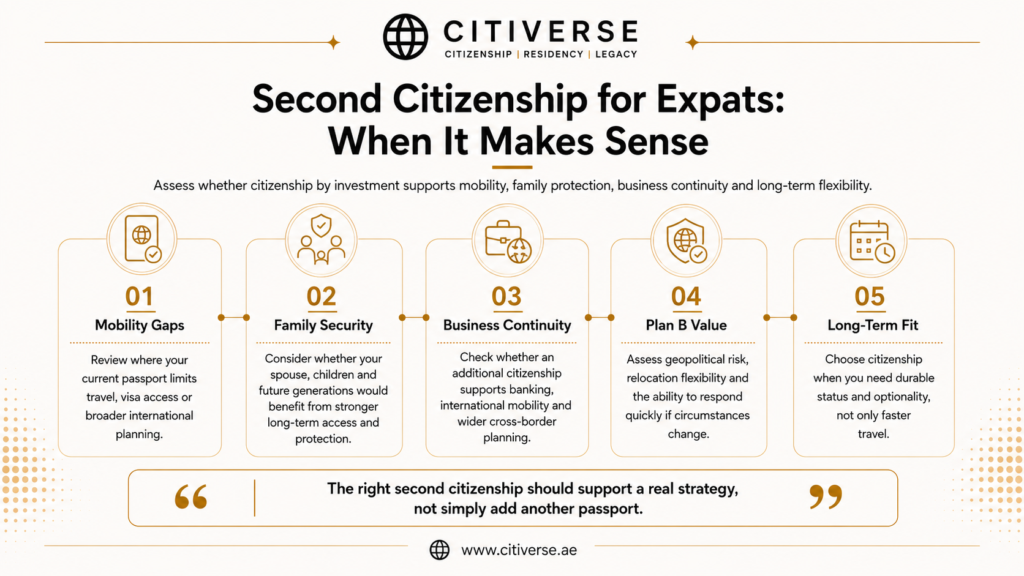
Citizenship by investment becomes more compelling when the applicant can identify a clear gap in the existing international structure. The following situations are common among expats, but the relevance of each one depends on nationality, family composition, due diligence profile and the intended use of the new status.
Many expats hold residence through employment, a business licence, property, family sponsorship or an investor category. These arrangements can be long term, but they remain connected to the legal conditions of the host jurisdiction. An expat who expects to change employment, sell an asset or leave the host country may prefer to hold an additional status that does not disappear with that move.
Second citizenship can provide that independence because it is not normally tied to the expat’s current host country. This can be particularly relevant to individuals who have lived abroad for many years but do not intend to naturalise where they currently reside, or who want a separate citizenship option before their professional or family circumstances change.
An expat may live in a highly connected international hub while still travelling on a passport that requires visas for important business, family or lifestyle destinations. In that situation, residence in the host country and travel rights under the original passport are separate issues. A second citizenship may improve the travel position where the new passport genuinely adds access to destinations that matter.
The comparison should be practical rather than driven by rankings. Citiverse’s article on the real mobility value of a second passport explains why entry conditions, stay limits, work rights, electronic authorisations and the applicant’s actual travel pattern matter more than a headline count of accessible countries.
A person can have an international career, own companies in several countries and hold multiple residence permits while still relying on a single nationality. This creates a form of concentration risk because travel access, consular protection, international perception and future policy changes remain connected to one passport.
For some expats, citizenship by investment is therefore a form of nationality diversification rather than a relocation exercise. That concept is explored further in Citiverse’s guide to passport diversification and second citizenship as a strategic Plan B. The objective should be long-term optionality, not collecting documents without a defined use case.
Expat families often have more complex planning needs than individual applicants. Children may study in one country, parents may live in another, and the principal applicant’s residence may depend on employment or investment in a third jurisdiction. A second citizenship can create a common legal status for eligible family members where the selected program supports the family structure.
Age limits, dependency, custody, future-born children and the ability to pass citizenship to later generations can materially affect the result. Parents should therefore review Second Citizenship for Families with Children and Citiverse’s analysis of citizenship by investment and future generations before assuming that every family member will be covered in the same way.
A founder may operate through international companies, serve clients across several markets and manage investments from an expat base while still facing personal visa restrictions. In that profile, citizenship can support mobility and contingency planning, but it does not replace company structuring, licensing, banking or tax-residence analysis.
The most useful comparison is between what the business can already do and what the owner personally cannot do. Citiverse’s guide to a second passport for entrepreneurs examines this distinction in more detail and explains why citizenship should be integrated with the entrepreneur’s actual commercial geography.
Some expats have no immediate intention of leaving their current country. Their residence is secure, lifestyle is strong and the business environment works well. In that case, citizenship by investment may still be relevant as a separate long-term option, provided the applicant is not treating it as a substitute for a genuine relocation plan.
This is a particularly important distinction for HNWIs and internationally mobile families. A citizenship can provide nationality diversification, while a separate residence base can provide the practical place to live, study, invest or operate. Citiverse’s Citizenship by Investment for HNWIs guide explains how these two layers can complement one another without being confused.
A second citizenship can be valuable, but it should not be treated as a universal solution to every problem associated with living internationally. Several issues require separate analysis and, in many cases, separate professional advice.
Applicants with concerns about background, source of funds or documentation should review why Citizenship by Investment applications can be rejected before selecting a program or making a non-refundable commitment.




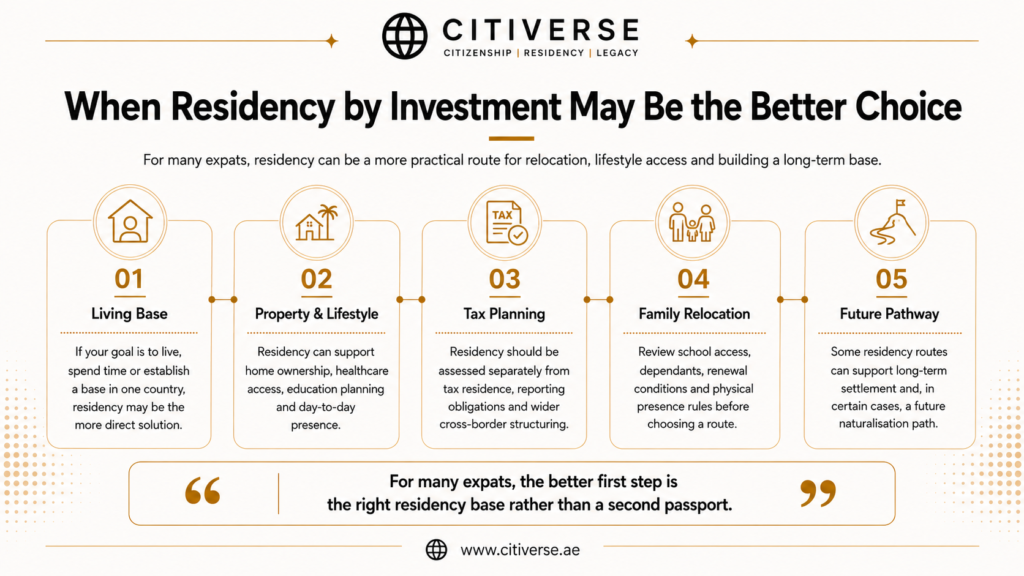
For many expats, the most valuable next step is not another nationality but a more durable place to live. Residency by investment can be the better solution where the objective is geographic: establishing a European base, moving closer to family, purchasing a home, accessing local services or creating a long-term business and lifestyle hub.
Citiverse advises on selected Residency by Investment programs in Cyprus, the UAE and Georgia. These jurisdictions serve different profiles, so the decision should be based on permanence, investment structure, family needs and how the applicant expects to use the residence in practice.
|
Residency option |
2026 positioning for an expat |
Core point to assess |
|
Cyprus Permanent Residency by Investment |
Permanent residence in Cyprus through a qualifying investment from €300,000 |
Strong fit where the objective is a long-term EU-member-state base, property-led planning and low required physical presence |
|
UAE Golden Residency |
Long-term renewable residence; current federal real-estate investor threshold is AED 2 million |
Strong fit for a globally connected Middle East base, investment, business continuity and family residence |
|
Georgia property / investment residence |
Short-term property route above USD 150,000 and investment residence route from USD 300,000 |
Relevant where a lower property entry point or regional base is more important than EU permanent residence |
An expat looking for a European residence solution may prioritise Cyprus Permanent Residency by Investment. Someone building a long-term Middle East base may prefer UAE Residency by Investment, while a value-oriented property strategy may make Georgia Residency worth reviewing. None of these routes should be selected solely because the applicant already lives abroad; each must solve a specific next-stage objective.
|
If your main objective is… |
Usually start by assessing… |
Why |
|
An additional nationality and passport |
Citizenship by Investment |
The desired outcome is nationality rather than residence in one specific country |
|
A home and legal right to live in a defined jurisdiction |
Residency by Investment |
Residence is directly connected to the place where the applicant wants to live |
|
Better short-stay mobility |
Citizenship, depending on the current passport |
A second passport may improve travel access, but only if the mobility gain is relevant |
|
Local schooling, healthcare and family relocation |
Residency by Investment |
These are residence-based benefits connected to daily life in the selected country |
|
Long-term nationality diversification |
Citizenship by Investment |
Citizenship may remain useful after the applicant changes residence again |
|
Tax relocation |
Separate tax and residency planning |
Neither a passport nor a residence card should be assumed to determine tax residence automatically |
|
A combined Plan B |
Potentially both |
Citizenship and residence can serve different purposes in a coordinated structure |
Once citizenship is identified as the correct objective, the next stage is not to choose the cheapest or fastest program. The applicant should compare the available routes against the existing nationality, family profile, investment preferences, due diligence position and intended long-term use of the citizenship.
Applicants comparing direct citizenship routes can use Citiverse’s Citizenship by Investment program selection framework and the dedicated Caribbean Citizenship by Investment comparison as the next research step.
Expats often have legitimate but fragmented financial histories. Salary may have been earned in one country, company dividends paid from another, property sold in a third jurisdiction and investment funds held through an international bank or brokerage account. This does not make the applicant unsuitable, but it increases the importance of preparing a coherent documentary trail.
The file should distinguish source of wealth from source of funds. Source of wealth explains how the overall financial position was built over time, while source of funds traces the specific money used for the qualifying investment. Corporate ownership records, employment history, tax returns, audited accounts, bank statements, sale agreements and investment records may all become relevant depending on the profile.
Long periods abroad can also create additional document requirements, including police certificates and residence history from several jurisdictions. Citiverse’s Citizenship and Residency Program Advisory is designed to identify these issues before a route is selected and before the formal application sequence begins.
Consider an entrepreneur who is a citizen of Country A, has lived in a Gulf jurisdiction for eight years, owns an international business and has a spouse and two school-age children. The current residence works well, but it depends on the family’s ongoing legal connection to the host country. The applicant also travels frequently to Europe and Asia and wants a status that remains useful if the family relocates again in five years.
A second citizenship may be relevant if the applicant wants nationality diversification, improved mobility and a status independent of the current expat residence. However, if the family’s immediate objective is to establish a home in Europe and place the children in a particular education system, a residency route such as Cyprus may create the more direct practical outcome. The strongest plan may therefore involve citizenship for long-term nationality diversification and a separate residence decision when the family is ready to relocate.
Citiverse approaches expat citizenship planning as a structured mobility decision rather than a passport purchase. The review begins with nationality, current residence, family structure, travel needs, business interests, source of wealth, preferred investment route and the applicant’s intended use of the second citizenship.
Through Citizenship and Residency Program Advisory, Citiverse can compare appropriate citizenship and residency options, identify documentation and due diligence considerations, and help determine whether citizenship is actually the right solution. Once a route is selected, Investment Processing Services can support document coordination, application sequencing and implementation through the appropriate authorised channel.
Where tax, corporate, succession or regulated financial questions arise, these should be addressed by appropriately qualified professionals. The objective is to keep citizenship, residency, tax and business planning connected without treating them as interchangeable.
Second citizenship can be a strong addition to an expat’s international structure when it solves a defined problem: nationality concentration, mobility limitations, family continuity or the need for a status that remains available after the current residence ends. It is less compelling when the real objective is simply to live in another country, access local services or obtain a property-backed residence base.
The most durable decision is made by separating nationality from residence and then deciding whether one or both are needed. An expat already has international experience; the next stage is to convert that experience into a legal structure that remains useful as work, family and location change.


Ready to Take the Next Step? Let’s Talk About Your Goals!